Papadogiannis Petros, Gambra Enrique, Łabuz Grzegorz, Yan Weijia, Martín-Becerra Diana, Sisó-Fuertes Irene, de Castro Alberto, Barcala Xoana, Auffarth Gerd U, Dorronsoro Carlos, Sawides Lucie
2EyesVision SL, Madrid, Spain.
The David J Apple Center for Vision Research, Department of Ophthalmology, University Hospital Heidelberg, INF 400, 69120 Heidelberg, Germany.
Biomed Opt Express. 2024 Oct 25;15(11):6521-6530. doi: 10.1364/BOE.538878. eCollection 2024 Nov 1.
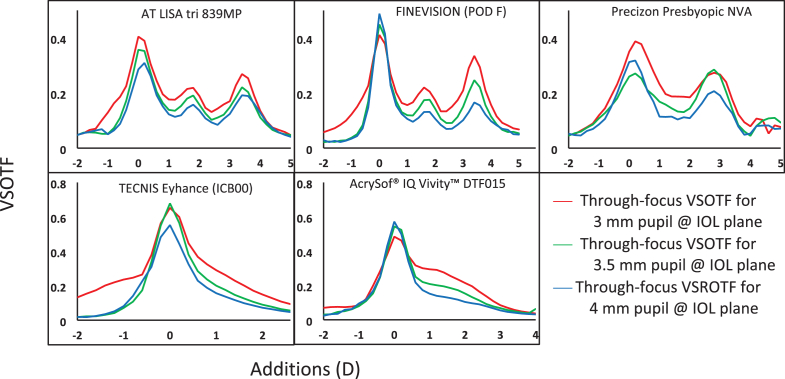
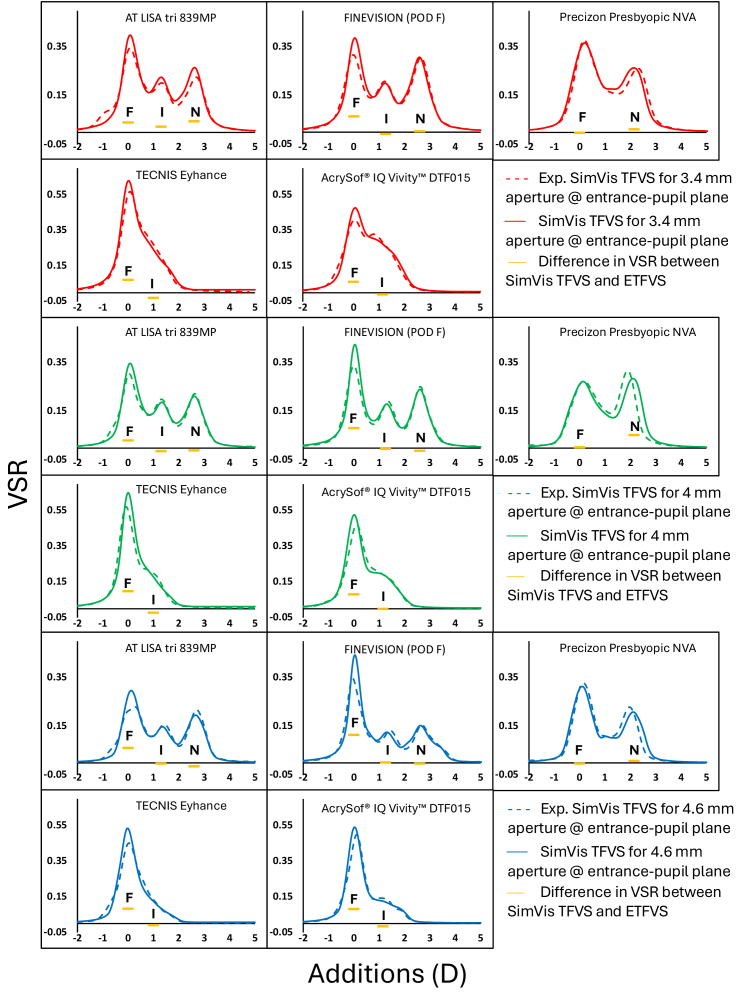
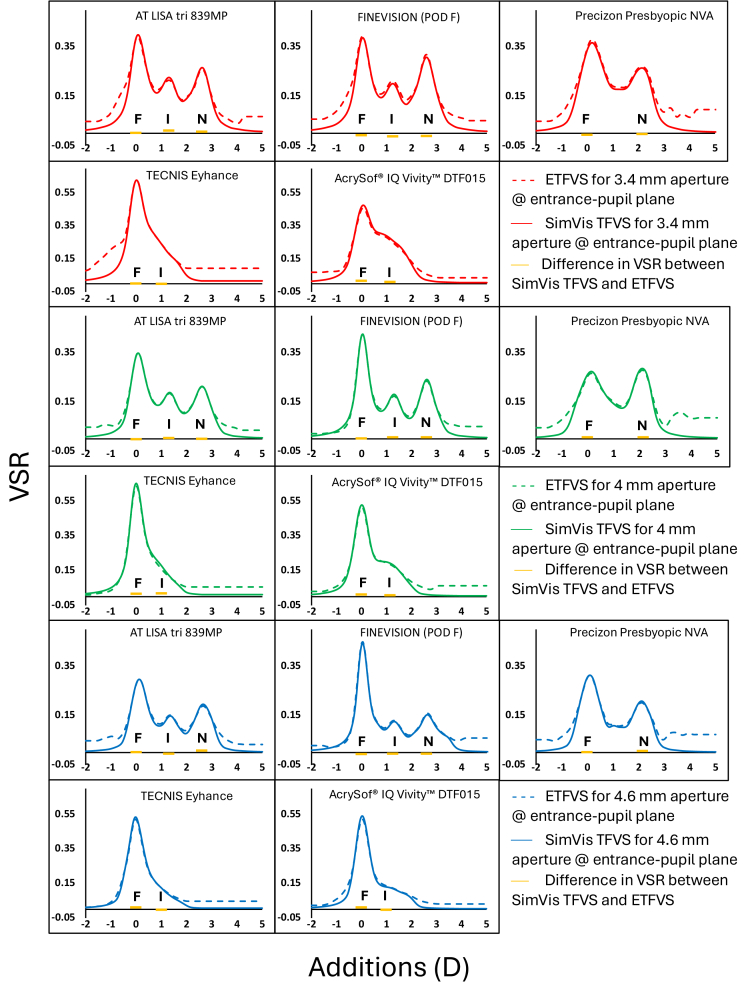
This study presents a systematic method to simulate various intraocular lenses (IOLs) available in the market. Five IOLs (two trifocals, one bifocal, one enhanced monofocal, and one extended depth of focus (EDOF)) were evaluated in terms of through focus visual Strehl (TFVS) utilizing the OptiSpheric IOL PRO2 device (Trioptics GmbH). Then, the estimated TFVS (ETFVS) and the temporal coefficients necessary for temporal multiplexing were computed, and through an iterative process, the SimVis TFVS was obtained. Finally, a high-speed focimeter was used to measure the opto-tunable lens responses to the temporal profile, and the experimental SimVis TFVS was acquired. Therefore, results are analyzed in terms of ETFVS (computed from the VSR-OTF), SimVis TFVS (computed from the TCs through temporal multiplexing), and experimental SimVis TFVS (acquired from the high-speed focimeter setup). The ETFVS and the SimVis TFVS curves demonstrated excellent alignment across all IOLs with cross-correlation coefficients > 0.94. Similarly, the experimental SimVis TFVS and the SimVis TFVS curves showed high correlation with cross-correlation coefficients > 0.97 and root mean square error (RMSE) < 0.05 for each lens. We demonstrated that different IOL designs can be visually simulated using its TFVS to obtain the corresponding temporal coefficients for simulations through temporal multiplexing using the SimVis technology.
本研究提出了一种系统方法,用于模拟市场上现有的各种人工晶状体(IOL)。利用OptiSpheric IOL PRO2设备(Trioptics GmbH),根据全聚焦视觉斯特列尔比(TFVS)对五种IOL(两种三焦点、一种双焦点、一种增强型单焦点和一种扩展焦深(EDOF))进行了评估。然后,计算估计的TFVS(ETFVS)和时间复用所需的时间系数,并通过迭代过程获得SimVis TFVS。最后,使用高速焦度计测量光可调透镜对时间轮廓的响应,并获取实验性SimVis TFVS。因此,根据ETFVS(从VSR-OTF计算得出)、SimVis TFVS(通过时间复用从时间系数计算得出)和实验性SimVis TFVS(从高速焦度计设置中获取)对结果进行分析。ETFVS和SimVis TFVS曲线在所有IOL上均显示出极佳的一致性,互相关系数>0.94。同样,实验性SimVis TFVS和SimVis TFVS曲线显示出高度相关性,每种透镜的互相关系数>0.97,均方根误差(RMSE)<0.05。我们证明,不同的IOL设计可以通过其TFVS进行视觉模拟,以获得相应的时间系数,从而使用SimVis技术通过时间复用进行模拟。