Stanley Natalie, Dhawka Luvna, Jaikumar Sneha, Huang Yu-Chen, Zannas Anthony S
Department of Computer Science and Computational Medicine Program, The University of North Carolina at Chapel Hill.
Department of Genetics, The University of North Carolina at Chapel Hill.
bioRxiv. 2024 Nov 7:2024.10.05.616811. doi: 10.1101/2024.10.05.616811.
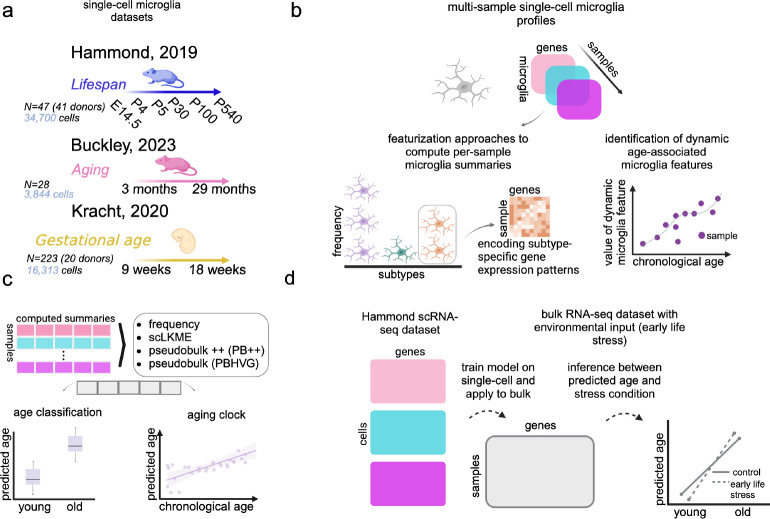
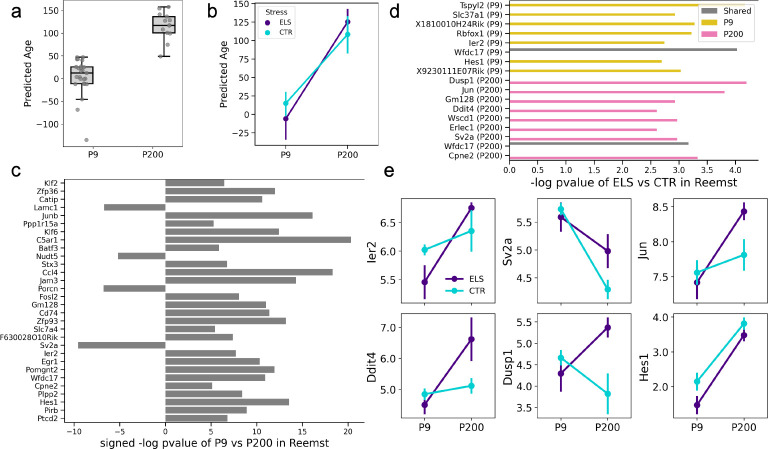
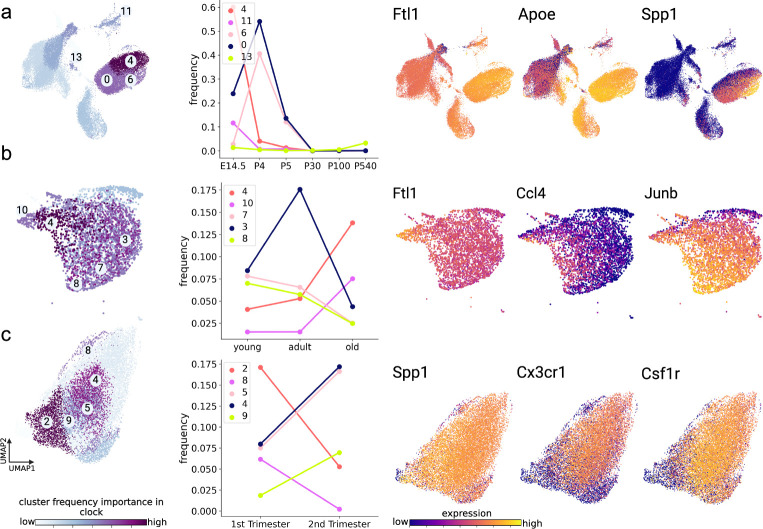
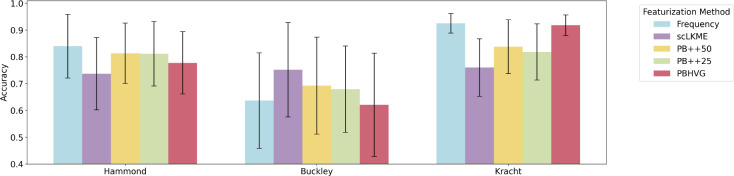
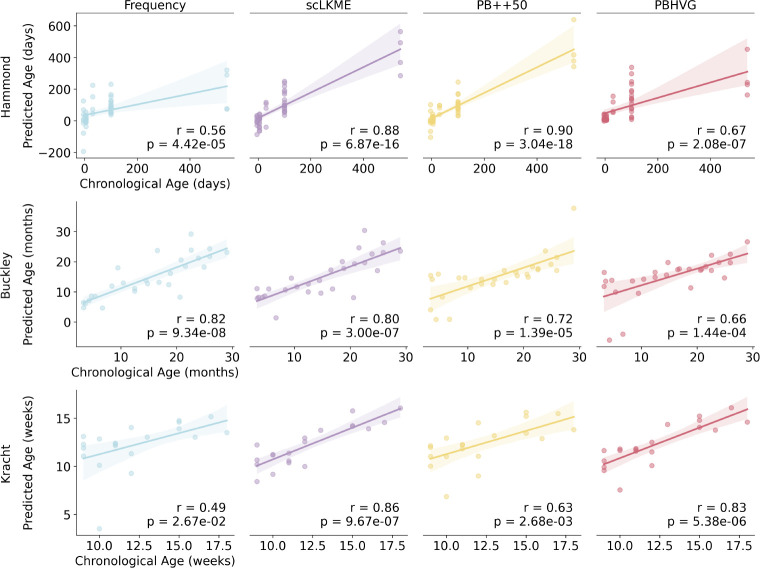
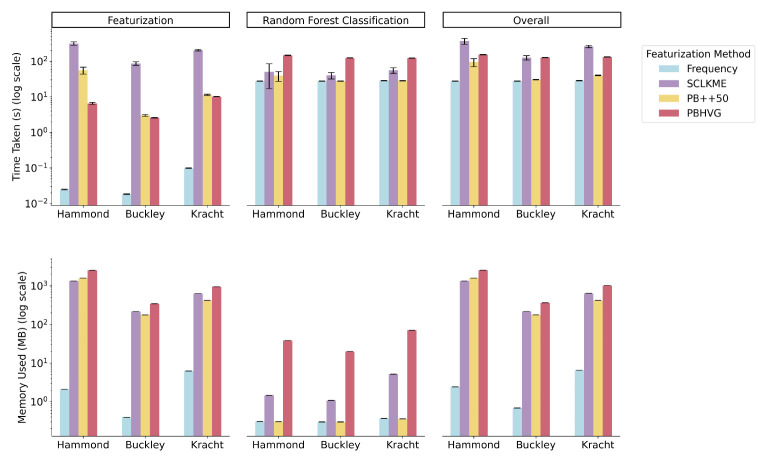
'Biological aging clocks' - composite molecular markers thought to capture an individual's biological age - have been traditionally developed through bulk-level analyses of mixed cells and tissues. However, recent evidence highlights the importance of gaining single-cell-level insights into the aging process. Microglia are key immune cells in the brain shown to adapt functionally in aging and disease. Recent studies have generated single-cell RNA sequencing (scRNA-seq) datasets that transcriptionally profile microglia during aging and development. Leveraging such datasets, we develop and compare computational approaches for generating transcriptome-wide summaries to establish robust microglia aging clocks. Our results reveal that unsupervised, frequency-based featurization approaches strike a balance in accuracy, interpretability, and computational efficiency. We further extrapolate and demonstrate applicability of such microglia clocks to readily available bulk RNA-seq data with environmental inputs. Single-cell-derived clocks can yield insights into the determinants of brain aging, ultimately promoting interventions that beneficially modulate health and disease trajectories.
“生物衰老时钟”——被认为能够反映个体生物年龄的复合分子标志物——传统上是通过对混合细胞和组织进行整体水平分析而开发出来的。然而,最近的证据凸显了在单细胞水平深入了解衰老过程的重要性。小胶质细胞是大脑中的关键免疫细胞,在衰老和疾病过程中会发生功能适应性变化。最近的研究生成了单细胞RNA测序(scRNA-seq)数据集,对衰老和发育过程中的小胶质细胞进行转录组分析。利用这些数据集,我们开发并比较了用于生成全转录组汇总以建立可靠的小胶质细胞衰老时钟的计算方法。我们的结果表明,基于频率的无监督特征提取方法在准确性、可解释性和计算效率之间取得了平衡。我们进一步推断并证明了这种小胶质细胞时钟在结合环境输入的现成批量RNA-seq数据中的适用性。源自单细胞的时钟能够揭示大脑衰老的决定因素,最终推动有益地调节健康和疾病轨迹的干预措施。