Department of Anesthesiology and Pain Medicine, Seoul National University Hospital, Seoul National University College of Medicine, 101 Daehak-ro, Jongno-gu, Seoul, 03080, Republic of Korea.
Sci Rep. 2024 Nov 18;14(1):28507. doi: 10.1038/s41598-024-78114-x.
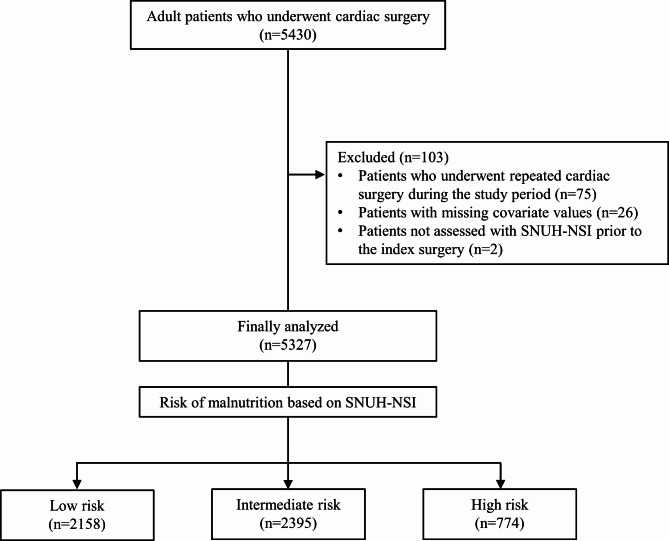
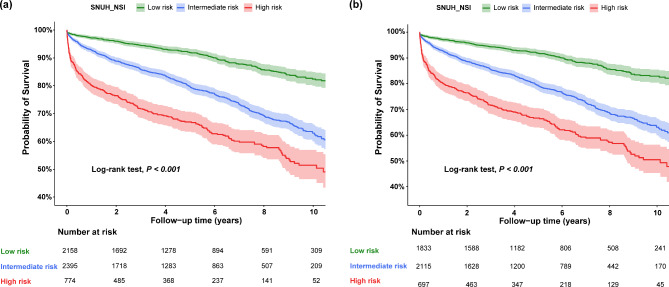
Malnutrition is a significant risk factor for postoperative outcomes in patients undergoing cardiac surgery. The Seoul National University Hospital-Nutrition Screening Index (SNUH-NSI) is an automated screening tool designed to comprehensively assess malnutrition risk. However, its predictive value in patients undergoing cardiac surgery remains unvalidated. This study included adult patients who underwent cardiac surgery at a tertiary teaching hospital between May 2008 and December 2019. Patients were classified as low-, intermediate-, or high-risk for malnutrition based on the SNUH-NSI. The association between malnutrition risk and postoperative cumulative all-cause mortality was evaluated using multivariable Cox regression analysis. The predictive ability of the SNUH-NSI was compared with conventional nutritional indices. Compared to the low-risk group, both the high-risk (adjusted hazard ratio [HR], 2.64; 95% confidence interval [CI], 2.19-3.19; P < 0.001) and intermediate-risk groups (adjusted HR, 1.54; 95% CI, 1.31-1.82; P < 0.001) demonstrated a significantly elevated risk of cumulative all-cause mortality. The multivariable model incorporating SNUH-NSI demonstrated moderate but superior predictive performance compared to that of other conventional nutritional indices. Preoperative malnutrition assessed by the SNUH-NSI was found to be a significant predictor of mortality following cardiac surgery. Implementing the SNUH-NSI for automated preoperative malnutrition screening could be an efficient and cost-effective approach.
营养不良是心脏手术后患者术后结局的一个重要危险因素。首尔国立大学医院-营养筛查指数(SNUH-NSI)是一种自动筛查工具,旨在全面评估营养不良风险。然而,它在心脏手术患者中的预测价值尚未得到验证。本研究纳入了 2008 年 5 月至 2019 年 12 月在一家三级教学医院接受心脏手术的成年患者。根据 SNUH-NSI,患者被分为低、中、高营养不良风险组。使用多变量 Cox 回归分析评估营养不良风险与术后累积全因死亡率之间的关系。比较 SNUH-NSI 与传统营养指数的预测能力。与低风险组相比,高风险组(调整后的危险比 [HR],2.64;95%置信区间 [CI],2.19-3.19;P<0.001)和中风险组(调整后的 HR,1.54;95%CI,1.31-1.82;P<0.001)的累积全因死亡率均显著升高。纳入 SNUH-NSI 的多变量模型显示出优于其他传统营养指数的中等但优越的预测性能。SNUH-NSI 评估的术前营养不良被发现是心脏手术后死亡率的一个重要预测因素。实施 SNUH-NSI 进行自动术前营养不良筛查可能是一种高效、经济有效的方法。