School of Clinical Medicine, Qingdao University, Qingdao, 266071, China.
Department of Hematology, Qingdao Hospital, University of Health and Rehabilitation Science, Qingdao Municipal Hospital, Qingdao, 266071, China.
Sci Rep. 2024 Nov 19;14(1):28557. doi: 10.1038/s41598-024-79537-2.
We aimed to explore the efficacy and safety of Selinexor combined bortezomib, lenalidomide, and dexamethasone (XVRd) protocol in newly diagnosed multiple myeloma with extramedullary disease.
This is a single-arm, open, observational clinical study. For induction/consolidation(21-day cycles), patients received 8 cycles of XVRd protocol. In maintenance (28-day cycles), patients received XR (Selinexor + Lenalidomide) at least 2 years until disease progression, death or withdrawal. The primary endpoints were overall response rates and minimal residual disease negative rates.
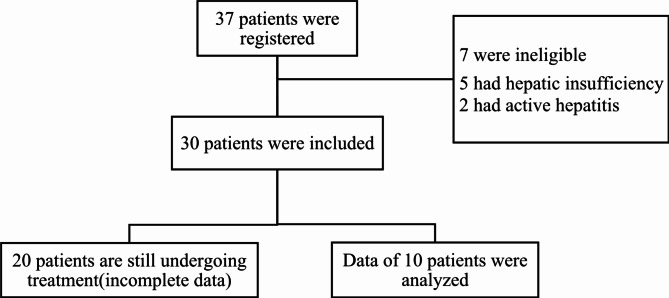
The median age of the 10 patients was 62 (range 55-81) years. R-ISS stage 3 was present in 2 (20%) patients. 3 patients had high risk cytogenetic and 1 patient with plasma cell leukocyte. According to IMWG criteria, the ORR of 10 patients with NDMM was 100%, including 2 stringent complete response (sCR), 2 complete remission (CR), 4 very good partial response (VGPR) and 2 partial response (PR). Median progression-free survival and overall survival were not achieved. The most common grade 3-4 treatment-emergent adverse events (occurring in 10% of patients) were thrombocytopenia. The most common non-hematological adverse events were grade 1 or 2, including nausea (30%), fatigue (40%), and anorexia (20%). Overall, the severe toxicities were manageable.
The XVRd regimen had good efficacy and safety in newly diagnosed multiple myeloma with extramedullary disease.
我们旨在探索塞来昔布联合硼替佐米、来那度胺和地塞米松(XVRd)方案在伴髓外病变的初诊多发性骨髓瘤中的疗效和安全性。
这是一项单臂、开放、观察性临床研究。对于诱导/巩固(21 天周期),患者接受 8 个周期的 XVRd 方案。在维持(28 天周期)中,患者接受 XR(塞来昔布+来那度胺)治疗,至少 2 年,直到疾病进展、死亡或退出。主要终点是总缓解率和微小残留病灶阴性率。
10 例患者的中位年龄为 62 岁(范围 55-81 岁)。R-ISS 分期 3 期患者 2 例(20%)。3 例患者存在高危细胞遗传学异常,1 例患者存在浆细胞白血病。根据 IMWG 标准,10 例 NDMM 患者的 ORR 为 100%,包括 2 例严格完全缓解(sCR)、2 例完全缓解(CR)、4 例非常好的部分缓解(VGPR)和 2 例部分缓解(PR)。中位无进展生存期和总生存期均未达到。最常见的 3-4 级治疗相关不良事件(10%的患者发生)为血小板减少症。最常见的非血液学不良事件为 1 级或 2 级,包括恶心(30%)、疲劳(40%)和厌食(20%)。总体而言,严重毒性可管理。
XVRd 方案在伴髓外病变的初诊多发性骨髓瘤中具有良好的疗效和安全性。