Mathers Kate L, Robinson Christopher T, Hill Matthew, Kowarik Carmen, Heino Jani, Deacon Charl, Weber Christine
Geography and Environment, Loughborough University, Loughborough, Leicestershire, LE11 3TU UK.
Department of Surface Waters Research and Management, Eawag (Swiss Federal Institute of Aquatic Science and Technology), 6047 Kastanienbaum, Switzerland.
Biodivers Conserv. 2024;33(14):3981-4002. doi: 10.1007/s10531-024-02933-7. Epub 2024 Sep 26.
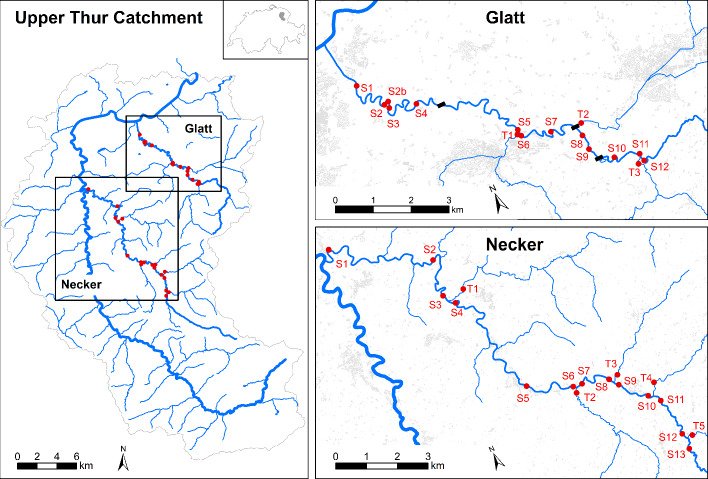
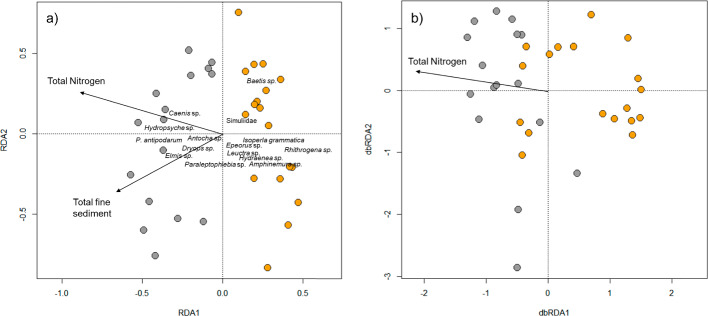
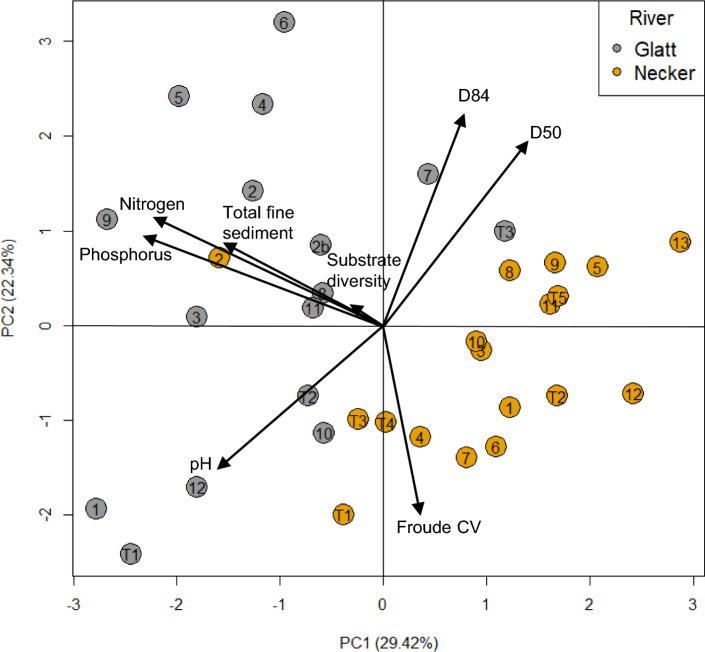
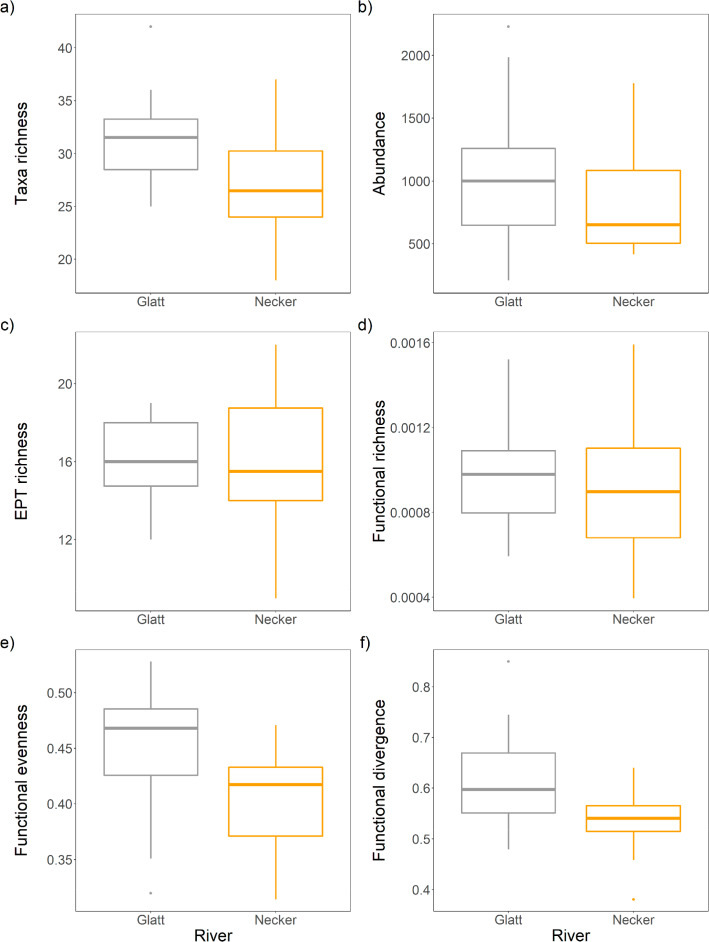
Biodiversity loss is increasing worldwide, necessitating effective approaches to counteract negative trends. Here, we assessed aquatic macroinvertebrate biodiversity in two river catchments in Switzerland; one significantly degraded and associated with urbanisation and instream barriers, and one in a near-natural condition. Contrary to our expectations, environmental heterogeneity was lower in the near-natural stream, with enhanced productivity in the degraded system resulting in a greater range of environmental conditions. At face value, commonly employed alpha, beta and gamma biodiversity metrics suggested both catchments constituted healthy systems, with greater richness or comparable values recorded in the degraded system relative to the near-natural one. Further, functional metrics considered to be early indicators for anthropogenic disturbance, demonstrated no anticipated differences between degraded and near-natural catchments. However, investigating the identity of the taxa unique to each river system showed that anthropogenic degradation led to replacement of specialist, sensitive species indicative of pristine rivers, by generalist, pollution tolerant species. These replacements reflect a major alteration in community composition in the degraded system compared with the near-natural system. Total nitrogen and fine sediment were important in distinguishing the respective communities. We urge caution in biodiversity studies that employ numerical biodiversity metrics alone. Assessing just one aspect of diversity, such as richness, is not sufficient to track biodiversity changes associated with environmental stress. We advocate that biodiversity monitoring for conservation and management purposes must go beyond traditional richness biodiversity metrics, to include indices that incorporate detailed nuances of biotic communities that relates to taxon identity.
The online version contains supplementary material available at 10.1007/s10531-024-02933-7.
全球生物多样性丧失正在加剧,因此需要有效的方法来应对负面趋势。在此,我们评估了瑞士两个河流集水区的水生大型无脊椎动物生物多样性;一个显著退化,与城市化和河道内障碍物相关,另一个处于近自然状态。与我们的预期相反,近自然溪流中的环境异质性较低,退化系统中的生产力提高导致环境条件范围更广。从表面上看,常用的α、β和γ生物多样性指标表明两个集水区都构成健康系统,退化系统中记录的丰富度更高或与近自然集水区相当。此外,被认为是人为干扰早期指标的功能指标,在退化集水区和近自然集水区之间没有显示出预期的差异。然而,调查每个河流系统特有的分类单元的身份表明,人为退化导致指示原始河流的 specialist、敏感物种被 generalist、耐污染物种所取代。与近自然系统相比,这些替代反映了退化系统中群落组成的重大变化。总氮和细沉积物在区分各自的群落方面很重要。我们敦促在仅使用数值生物多样性指标的生物多样性研究中要谨慎。仅评估多样性的一个方面,如丰富度,不足以追踪与环境压力相关的生物多样性变化。我们主张,出于保护和管理目的的生物多样性监测必须超越传统的丰富度生物多样性指标,纳入包含与分类单元身份相关的生物群落详细细微差别的指数。
在线版本包含可在10.1007/s10531-024-02933-7获取的补充材料。