Sanghvi Aarnav Hetan, Manjoo Amarjith, Rajput Prachi, Mahajan Navya, Rajamohan Natarajan, Abrar Iyman
Department of Electrical & Electronics Engineering, Birla Institute of Technology and Science, Pilani - Hyderabad Campus Shameerpet Hyderabad Telangana-500078 India.
Department of Chemical Engineering, Birla Institute of Technology and Science, Pilani - Hyderabad Campus Shameerpet Hyderabad Telangana-500078 India
RSC Adv. 2024 Nov 18;14(49):36868-36885. doi: 10.1039/d4ra06214k. eCollection 2024 Nov 11.
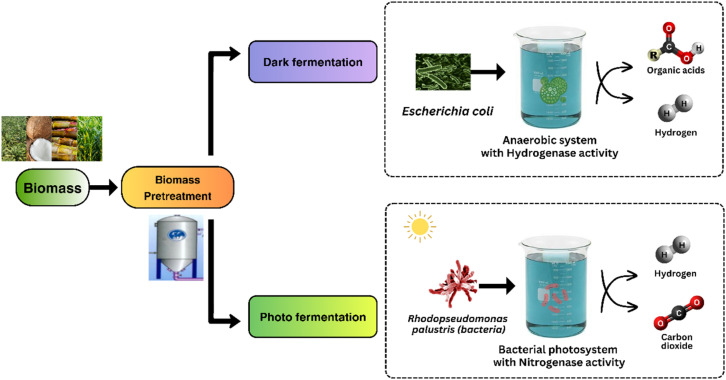
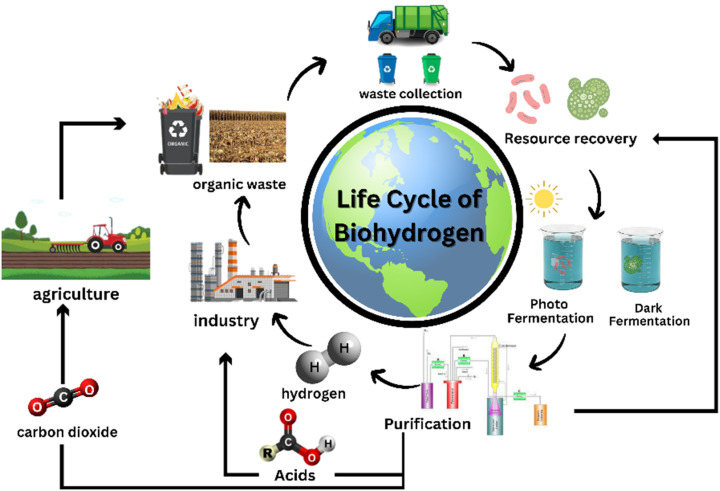
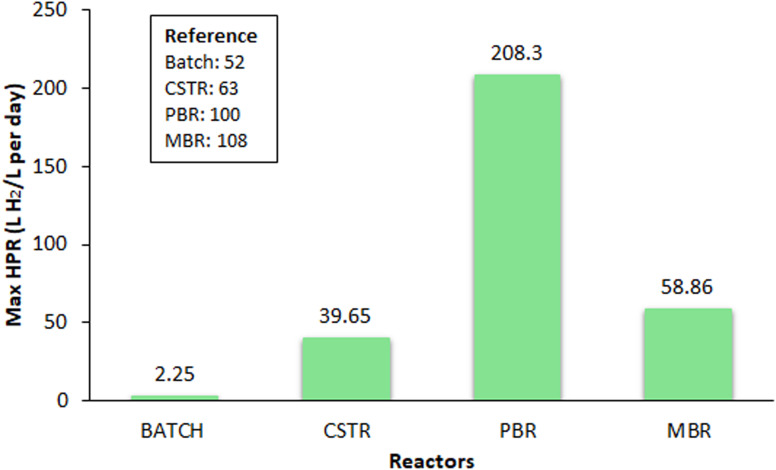
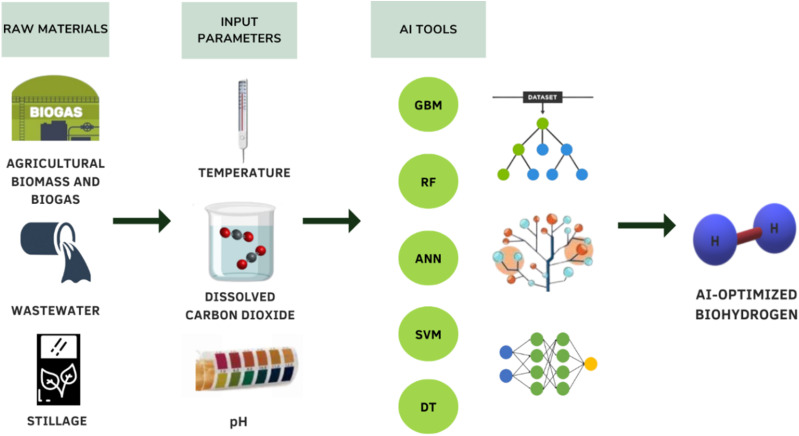
The global shift towards sustainable energy sources, necessitated by climate change concerns, has led to a critical review of biohydrogen production (BHP) processes and their potential as a solution to environmental challenges. This review evaluates the efficiency of various reactors used in BHP, focusing on operational parameters such as substrate type, pH, temperature, hydraulic retention time (HRT), and organic loading rate (OLR). The highest yield reported in batch, continuous, and membrane reactors was in the range of 29-40 L H/L per day at an OLR of 22-120 g/L per day, HRT of 2-3 h and acidic range of 4-6, with the temperature maintained at 37 °C. The highest yield achieved was 208.3 L H/L per day when sugar beet molasses was used as a substrate with at an OLR of 850 g COD/L per day, pH of 4.4, and at 8 h HRT. The integration of artificial intelligence (AI) tools, such as artificial neural networks and support vector machines has emerged as a novel approach for optimizing reactor performance and predicting outcomes. These AI models help in identifying key operational parameters and their optimal ranges, thus enhancing the efficiency and reliability of BHP processes. The review also draws attention to the importance of life cycle and techno-economic analyses in assessing the environmental impact and economic viability of BHP, addressing potential challenges like high operating costs and energy demands during scale-up. Future research should focus on developing more efficient and cost-effective BHP systems, integrating advanced AI techniques for real-time optimization, and conducting comprehensive LCA and TEA to ensure sustainable and economically viable biohydrogen production. By addressing these areas, BHP can become a key component of the transition to sustainable energy sources, contributing to the reduction of greenhouse gas emissions and the mitigation of environmental impacts associated with fossil fuel use.
由于对气候变化的担忧,全球向可持续能源的转变促使人们对生物制氢(BHP)工艺及其作为环境挑战解决方案的潜力进行了批判性审视。本综述评估了BHP中使用的各种反应器的效率,重点关注诸如底物类型、pH值、温度、水力停留时间(HRT)和有机负荷率(OLR)等操作参数。在间歇式、连续式和膜反应器中报告的最高产率范围为每天29 - 40升氢气/升,OLR为每天22 - 120克/升,HRT为2 - 3小时,酸性范围为4 - 6,温度保持在37°C。当以甜菜糖蜜为底物,OLR为每天850克化学需氧量/升,pH值为4.4,HRT为8小时时,实现的最高产率为每天208.3升氢气/升。人工智能(AI)工具,如人工神经网络和支持向量机的整合,已成为优化反应器性能和预测结果的一种新方法。这些AI模型有助于识别关键操作参数及其最佳范围,从而提高BHP工艺的效率和可靠性。该综述还提请注意生命周期和技术经济分析在评估BHP的环境影响和经济可行性方面的重要性,解决扩大规模期间的高运营成本和能源需求等潜在挑战。未来的研究应侧重于开发更高效、更具成本效益的BHP系统,整合先进的AI技术进行实时优化,并进行全面的生命周期评估(LCA)和技术经济分析(TEA),以确保可持续且经济可行的生物制氢。通过解决这些领域的问题,BHP可以成为向可持续能源过渡的关键组成部分,有助于减少温室气体排放,并减轻与化石燃料使用相关的环境影响。