Shanxi Key Lab for Modernization of TCVM, College of Basic Sciences, Shanxi Agricultural University, Taigu, 030801, China.
School of Traditional Chinese Medicine, Beijing University of Chinese Medicine, Beijing, 100029, China.
BMC Bioinformatics. 2024 Nov 19;25(1):361. doi: 10.1186/s12859-024-05976-3.
Identification of drug-target interactions is an indispensable part of drug discovery. While conventional shallow machine learning and recent deep learning methods based on chemogenomic properties of drugs and target proteins have pushed this prediction performance improvement to a new level, these methods are still difficult to adapt to novel structures. Alternatively, large-scale biological and pharmacological data provide new ways to accelerate drug-target interaction prediction.
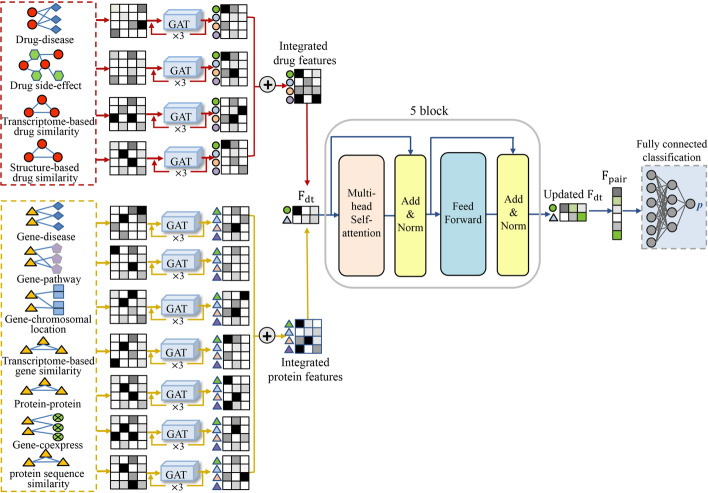
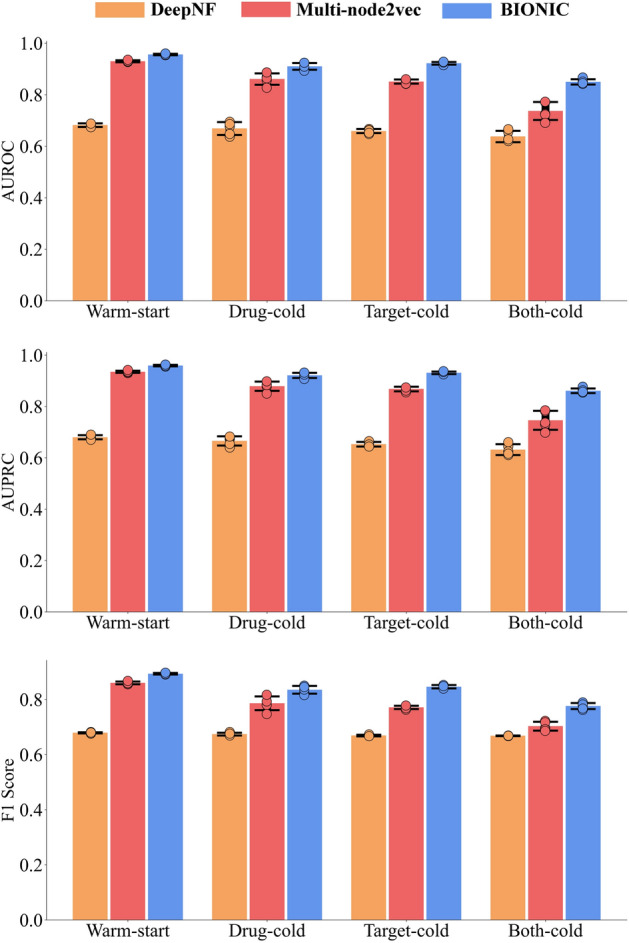
Here, we propose DrugMAN, a deep learning model for predicting drug-target interaction by integrating multiplex heterogeneous functional networks with a mutual attention network (MAN). DrugMAN uses a graph attention network-based integration algorithm to learn network-specific low-dimensional features for drugs and target proteins by integrating four drug networks and seven gene/protein networks collected by a certain screening conditions, respectively. DrugMAN then captures interaction information between drug and target representations by a mutual attention network to improve drug-target prediction.
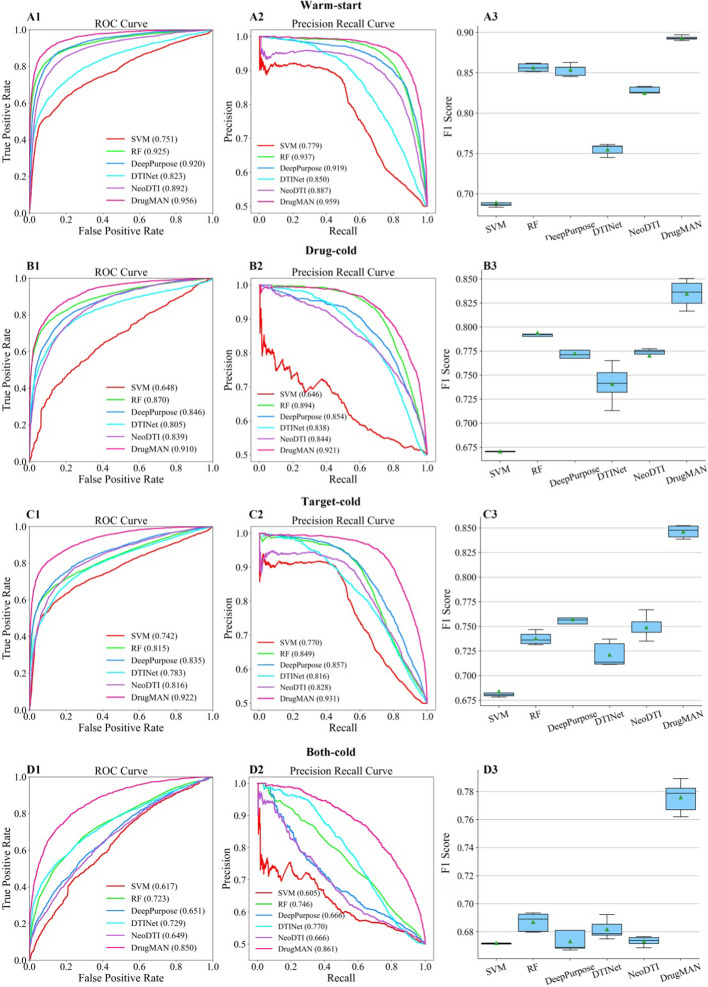
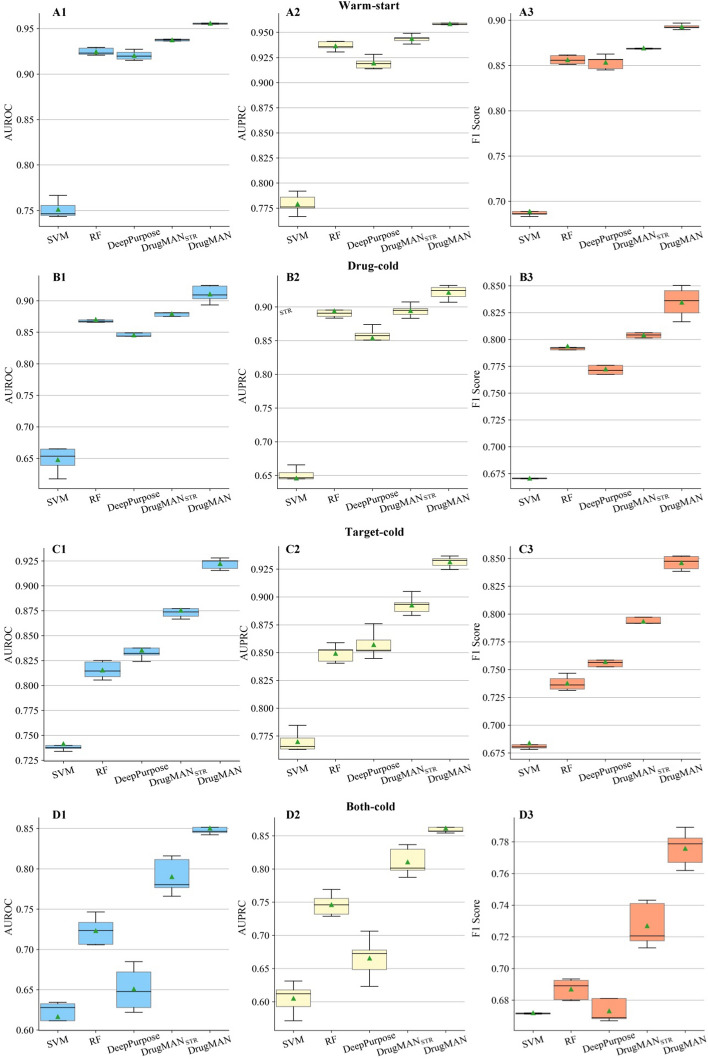
DrugMAN achieved the best performance compared with cheminformation-based methods SVM, RF, DeepPurpose and network-based deep learing methods DTINet and NeoDT in four different scenarios, especially in real-world scenarios. Compared with SVM, RF, deepurpose, DTINet, and NeoDT, DrugMAN showed the smallest decrease in AUROC, AUPRC, and F1-Score from warm-start to Both-cold scenarios. This result is attributed to DrugMAN's learning from heterogeneous data and indicates that DrugMAN has a good generalization ability. Taking together, DrugMAN spotlights heterogeneous information to mine drug-target interactions and can be a powerful tool for drug discovery and drug repurposing.
药物-靶标相互作用的鉴定是药物发现不可或缺的一部分。虽然传统的浅层机器学习和基于药物和靶蛋白的化学生物组学特性的最近的深度学习方法将这种预测性能的提高推到了一个新的水平,但这些方法仍然难以适应新的结构。另一方面,大规模的生物和药理学数据为加速药物-靶标相互作用预测提供了新的途径。
在这里,我们提出了 DrugMAN,这是一种通过整合多异质功能网络和互注意网络(MAN)来预测药物-靶标相互作用的深度学习模型。DrugMAN 使用基于图注意网络的集成算法,通过整合四个药物网络和七个根据特定筛选条件收集的基因/蛋白质网络,分别学习药物和靶蛋白的网络特定低维特征。然后,DrugMAN 通过互注意网络捕获药物和靶标表示之间的相互作用信息,以提高药物-靶标预测。
在四个不同的场景中,与基于化学信息的方法 SVM、RF、DeepPurpose 和基于网络的深度学习方法 DTINet 和 NeoDT 相比,DrugMAN 达到了最佳性能,特别是在现实场景中。与 SVM、RF、DeepPurpose、DTINet 和 NeoDT 相比,DrugMAN 从 Warm-start 到 Both-cold 场景的 AUROC、AUPRC 和 F1-Score 下降幅度最小。这一结果归因于 DrugMAN 从异质数据中学习,表明 DrugMAN具有良好的泛化能力。综合来看,DrugMAN 突出了异质信息,挖掘药物-靶标相互作用,可作为药物发现和药物再利用的有力工具。