The 1st Institute of Clinical Medicine, Guangzhou University of Chinese Medicine, Guangzhou, Guangdong, China.
Shenzhen Hospital, Beijing University of Chinese Medicine Orthopedics, Shenzhen, China.
J Orthop Surg Res. 2024 Nov 20;19(1):773. doi: 10.1186/s13018-024-05281-y.
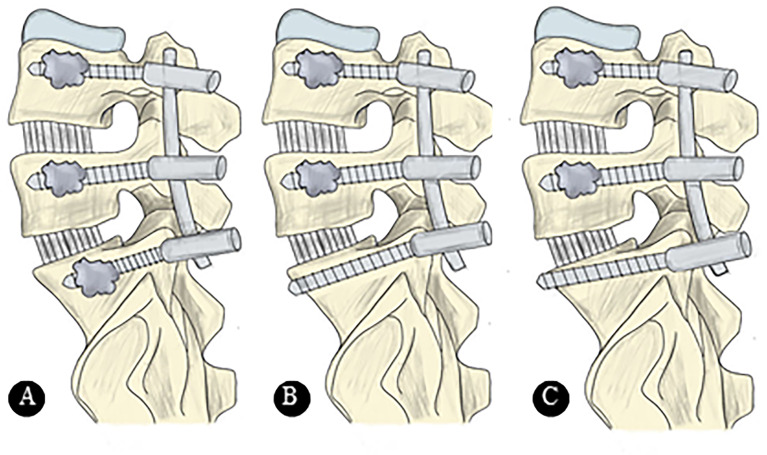
Patients with L4-S1 lumbar degenerative disease (LDD) with osteoporosis are prone to sacral-screw loosening during spinal internal fixation. We aimed to compare the clinical efficacy and imaging results of sacral bicortical, tricortical, and polymethylmethacrylate (PMMA)-augmented pedicle-screw fixation in the treatment of L4-S1 LDD with osteoporosis.
This is a retrospective study, 72 patients were enrolled and divided into three groups according to the S1-screw fixation method: PMMA-augmented pedicle-screw fixation (Group A, n = 26), bicortical fixation (Group B, n = 22), and tricortical fixation (Group C, n = 24). The visual analog scale (VAS) and Oswestry disability index (ODI) were recorded preoperatively and at the last follow-up, and the postoperative complications, screw-loosening rate, and fusion rate were compared between the three groups.
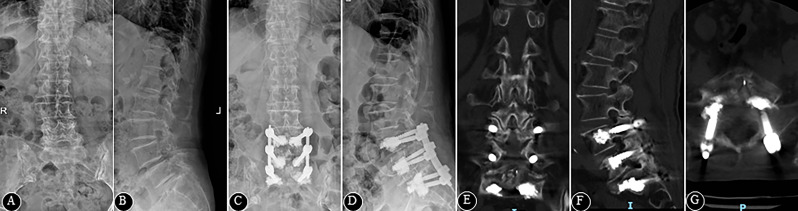
Upon the last follow-up, the VAS and ODI scores of the three groups were significantly improved compared with those recorded preoperatively. The VAS and ODI scores of Group A were significantly smaller than those of Groups B and C (P < 0.05), with no significant difference between Groups B and C. Moreover, the screw-loosening rate of Group A was significantly lower than that of Groups B and C (P < 0.05), with no significant difference between Groups B and C. No significant difference was noted in postoperative complications, bone-cement leakage rates, and intervertebral fusion rates among the three groups. Furthermore, we found that osteoporosis and change of lumbar lordosis(LL) value were independent risk factors for sacral-screw loosening in patients with L4-S1 LDD with osteoporosis.
When patients with L4-S1 LDD with osteoporosis undergo lumbosacral fusion and fixation, the use of S1 pedicle screws with PMMA augmentation has better stability and less screw loosening. Furthermore, we recommend this surgery for patients with osteoporosis, and the LL should be increased as much as possible during the operation to restore the matching of lumbar and pelvic parameters.
患有骨质疏松症的 L4-S1 腰椎退行性疾病(LDD)的患者在脊柱内固定期间容易发生骶骨螺钉松动。我们旨在比较骶骨双皮质、三皮质和聚甲基丙烯酸甲酯(PMMA)增强椎弓根螺钉固定治疗骨质疏松性 L4-S1 LDD 的临床疗效和影像学结果。
这是一项回顾性研究,共纳入 72 例患者,根据 S1 螺钉固定方法分为三组:PMMA 增强椎弓根螺钉固定组(A 组,n=26)、双皮质固定组(B 组,n=22)和三皮质固定组(C 组,n=24)。记录术前和末次随访时的视觉模拟量表(VAS)和 Oswestry 功能障碍指数(ODI),比较三组术后并发症、螺钉松动率和融合率。
末次随访时,三组 VAS 和 ODI 评分均较术前明显改善。A 组 VAS 和 ODI 评分明显小于 B 组和 C 组(P<0.05),B 组和 C 组间差异无统计学意义。此外,A 组螺钉松动率明显低于 B 组和 C 组(P<0.05),B 组和 C 组间差异无统计学意义。三组术后并发症、骨水泥渗漏率和椎间融合率差异无统计学意义。此外,我们发现骨质疏松症和腰椎前凸(LL)值变化是骨质疏松性 L4-S1 LDD 患者骶骨螺钉松动的独立危险因素。
当骨质疏松症合并 L4-S1 LDD 的患者接受腰骶融合固定时,使用 PMMA 增强的 S1 椎弓根螺钉具有更好的稳定性和更少的螺钉松动。此外,我们建议对骨质疏松症患者进行这种手术,并且在手术中应尽可能增加 LL,以恢复腰椎和骨盆参数的匹配。