Department of Cardiology, The Second Xiangya Hospital of Central South University, Changsha, 410011, China.
Department of Radiology, The Second Xiangya Hospital, Central South University, Changsha, 410011, China.
Sci Rep. 2024 Nov 21;14(1):28909. doi: 10.1038/s41598-024-80464-5.
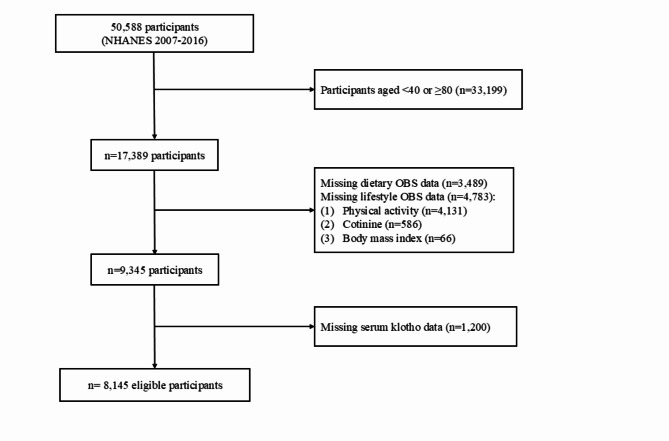
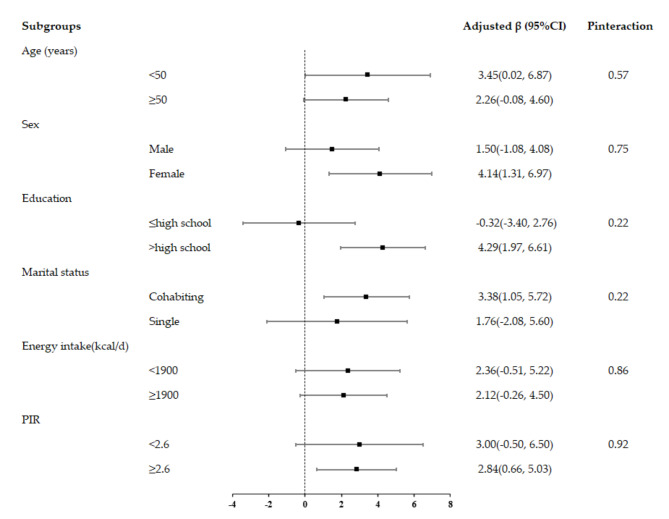
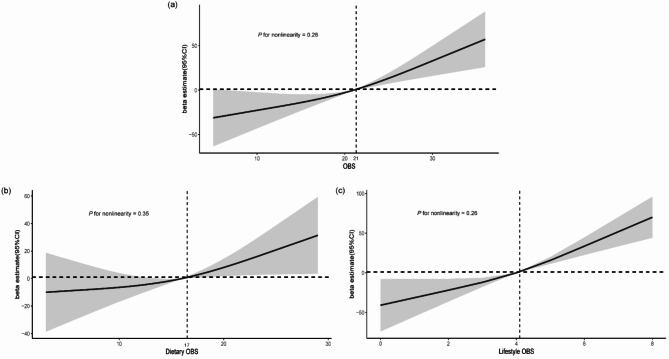
The relationship between the oxidative balance score (OBS) and the serum Klotho level has yet to be defined. We sought to investigate the potential relationship between OBS and the serum Klotho level in the U.S. population aged 40-79 years. This study included 8,145 participants from the National Health and Nutrition Examination Surveys (NHANES) database spanning from 2007 to 2016. The OBS consisted of the dietary OBS and the lifestyle OBS, based on 16 dietary components and 4 lifestyle components. Weighted multiple linear regressions were performed to explore the association between OBS and serum Klotho level. Furthermore, nonlinear relationships were analyzed through the application of restricted cubic splines (RCS). In the multivariate linear regression model with adjustment for such as demographics, economic income and dietary intake, a higher OBS was associated with a higher serum Klotho, with the beta estimate and 95%CI of 2.85 (1.03-4.68, p < 0.01). Compared with the lowest tertile group, the highest group was associated with a higher Klotho level (30.35, 3.43-57.28, p < 0.05). Furthermore, higher dietary OBS and lifestyle OBS were similarly associated with higher Klotho level (beta (95%CI): 1.27 (0.79-3.32); 14.23 (9.53-18.92), respectively). The RCS exhibited a linear dose-response association between OBS, dietary OBS and lifestyle OBS with serum Klotho concentration (P>0.05). The association between OBS and serum Klotho level was consistent across age, sex, education, marital status, energy intake and poverty income ratio (PIR) (P>0.05). The study reported significant association between OBS and klotho, indicating that adherence to antioxidant behaviors may be linked to slower aging and better health.
氧化平衡评分(OBS)与血清 Klotho 水平之间的关系尚未确定。我们旨在研究美国 40-79 岁人群中 OBS 与血清 Klotho 水平之间的潜在关系。本研究纳入了 2007 年至 2016 年国家健康和营养调查(NHANES)数据库中的 8145 名参与者。OBS 由基于 16 种饮食成分和 4 种生活方式成分的饮食 OBS 和生活方式 OBS 组成。采用加权多元线性回归探讨 OBS 与血清 Klotho 水平之间的关联。此外,还通过限制立方样条(RCS)分析了非线性关系。在调整人口统计学、经济收入和饮食摄入等因素的多元线性回归模型中,较高的 OBS 与较高的血清 Klotho 水平相关,β估计值和 95%CI 为 2.85(1.03-4.68,p<0.01)。与最低三分位组相比,最高组与较高的 Klotho 水平相关(30.35,3.43-57.28,p<0.05)。此外,较高的饮食 OBS 和生活方式 OBS 与较高的 Klotho 水平也呈正相关(β(95%CI):1.27(0.79-3.32);14.23(9.53-18.92))。RCS 显示 OBS、饮食 OBS 和生活方式 OBS 与血清 Klotho 浓度之间呈线性剂量反应关系(P>0.05)。OBS 与血清 Klotho 水平之间的关联在年龄、性别、教育程度、婚姻状况、能量摄入和贫困收入比(PIR)方面具有一致性(P>0.05)。该研究报告了 OBS 与 klotho 之间的显著关联,表明抗氧化行为的依从性可能与衰老速度较慢和健康状况较好有关。