Neuromusculoskeletal Rehabilitation Research Center, University of Social Welfare and Rehabilitation Sciences, 5th Floor, Building No 2, Kodakyar Ave., Daneshjo Blvd., Evin, Tehran City, 1985713871, Iran.
University of Social Welfare and Rehabilitation Sciences, 1st Floor, Building No 1, Kodakyar Ave., Daneshjo Blvd., Evin, Tehran City, Iran.
BMC Musculoskelet Disord. 2024 Nov 21;25(1):941. doi: 10.1186/s12891-024-08064-y.
To evaluate the feasibility of using dynamic MRI to measure the features of cranial rhythmic impulse (CRI).
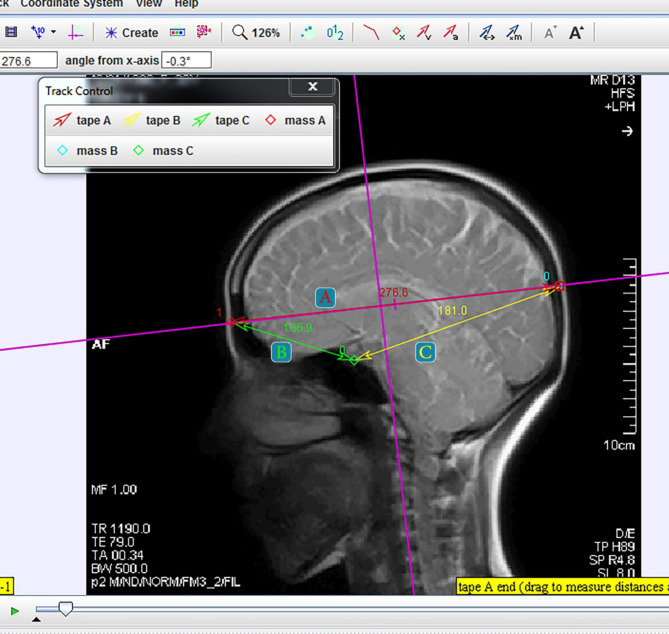
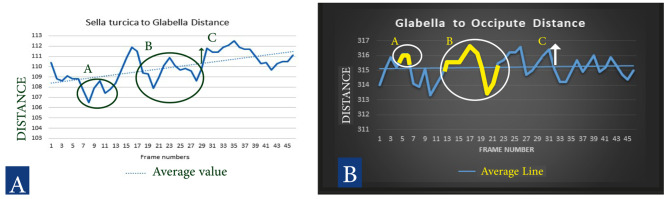
Fifteen healthy participants (9 females and 6 males, aged 25 to 77) underwent dynamic MRI in a sagittal T2 HASTE view at a rate of 0.60 Hz for 30 s. The MRI videos were analyzed using video tracking software. Three points were marked: the glabella, the midpoint of the sella turcica, and a symmetrical point of the glabella on the occiput. The distances between these points were measured across 46 frames. Amplitudes and rates of asymmetrical CRI waves were calculated using Excel formulas.
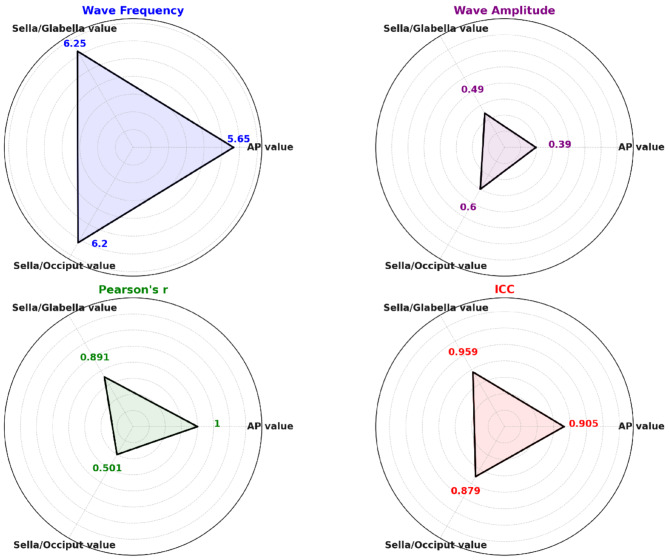
The mean wave frequencies were 5.65 Hz for the anteroposterior distance, 6.2 Hz from sella turcica to occiput, and 6.76 Hz from sella turcica to glabella. The mean wave amplitudes were 0.39 mm, 0.6 mm, and 0.49 mm for the respective distances. Both intraclass correlation coefficients (ICC) and reliability coefficient (R) indicated excellent reliability (R, ICC > 0.90). The technical error of measurement (TEM) exceeded 1 mm for the anteroposterior and sella-to-occiput distances, while it was 0.32 mm for the sella-to-glabella distance.
Dynamic MRI demonstrates potential in measuring the features of CRI, particularly in assessing CRI wave rate. While the ICC values indicate high reliability, the TEM values suggest that using MRI to measure CRI wave amplitude may only be dependable for the distance from the sella to the glabella.
评估使用动态 MRI 测量颅节律脉冲(CRI)特征的可行性。
15 名健康参与者(9 名女性和 6 名男性,年龄 25 至 77 岁)在矢状 T2 HASTE 视图中以 0.60 Hz 的速率进行 30 s 的动态 MRI。使用视频跟踪软件分析 MRI 视频。标记 3 个点:眉间、蝶鞍中点和枕骨上与眉间对称的点。在 46 个帧中测量这些点之间的距离。使用 Excel 公式计算不对称 CRI 波的幅度和速率。
前-后距离的平均波频率为 5.65 Hz,蝶鞍至枕骨的距离为 6.2 Hz,蝶鞍至眉间的距离为 6.76 Hz。相应距离的平均波幅度分别为 0.39mm、0.6mm 和 0.49mm。组内相关系数(ICC)和可靠性系数(R)均表明具有极好的可靠性(R、ICC>0.90)。前-后和蝶鞍至枕骨距离的测量技术误差(TEM)超过 1mm,而蝶鞍至眉间距离的 TEM 为 0.32mm。
动态 MRI 显示出测量 CRI 特征的潜力,特别是在评估 CRI 波速率方面。虽然 ICC 值表明可靠性高,但 TEM 值表明使用 MRI 测量 CRI 波幅度可能仅适用于蝶鞍至眉间的距离。