Department of Military Cognitive Psychology, School of Psychology,, Third Military Medical University (Army Medical University), Chongqing, 40038, China.
Battalion 22 of the Cadet Brigade, School of Basic Medical Sciences, Third Military Medical University (Army Medical University), Chongqing, 40038, China.
BMC Med Educ. 2024 Nov 21;24(1):1342. doi: 10.1186/s12909-024-06291-4.
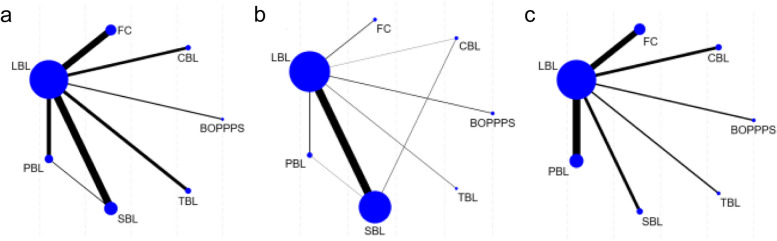
There is no conclusive evidence which one is the optimal methodology for enhancing the quality and efficacy of learning for medical students. Therefore, this systematic review and network meta-analysis aims to evaluate and prioritize various teaching strategies in medical education, including simulation-based learning (SBL), flipped classrooms (FC), problem-based learning (PBL), team-based learning (TBL), case-based learning (CBL), and bridge-in, objective, pre-assessment, participatory learning, post-assessment, and summary (BOPPPS).
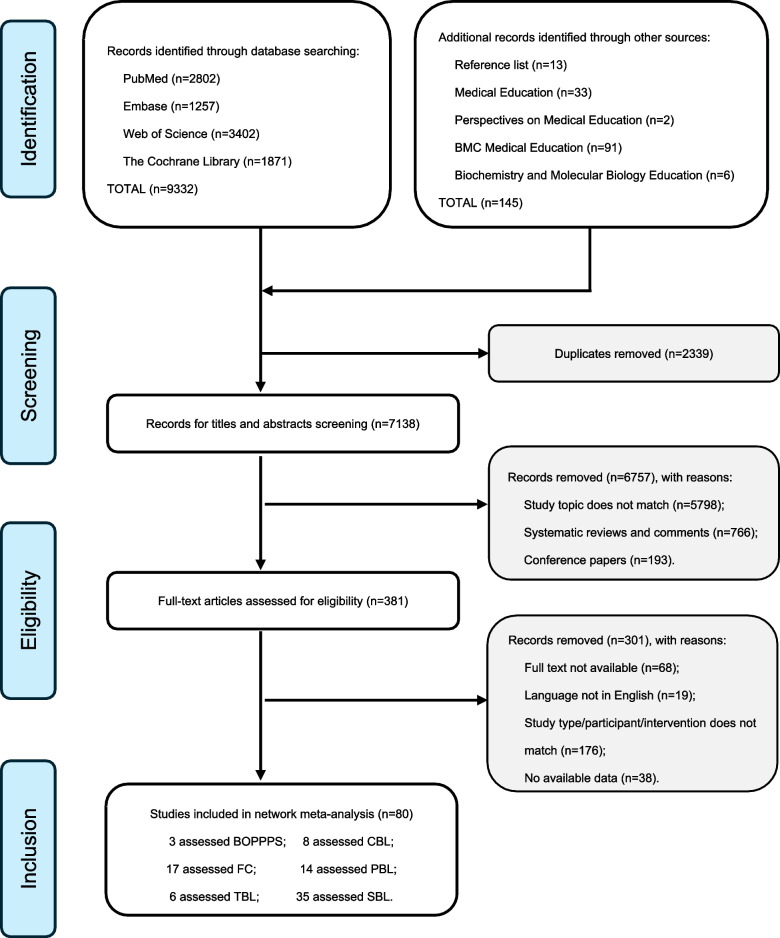
We conducted a comprehensive systematic search of PubMed, Embase, Web of Science, the Cochrane Library, and some key medical education journals up to November 31, 2023. The following keywords were searched in MeSH: ("medical students") AND ("problem-based learning" OR "problem solving") AND ("Randomized Controlled Trials as Topic"). Two authors independently carried out data extraction and quality assessment from the final selection of records following a full-text assessment based on strict eligibility criteria. Pairwise and network meta-analyses were then applied to calculate pooled standardized mean differences (SMDs) and 95% confidence intervals (95%CIs) using a random-effects model. Statistical analysis was performed by R software (4.3.1) and Stata 14 software.
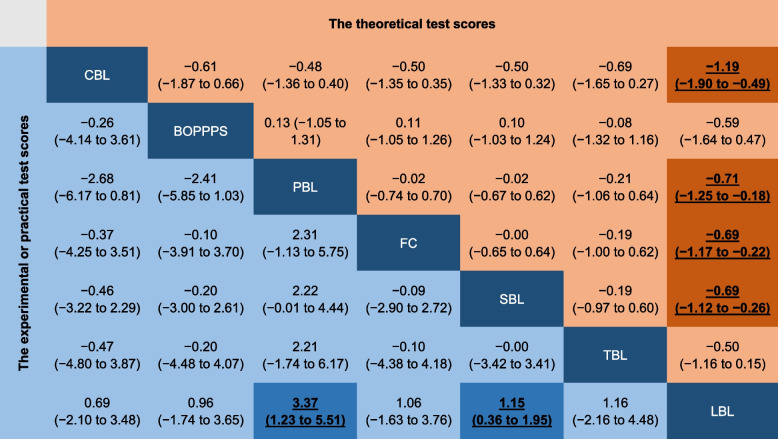
A total of 80 randomized controlled trials with 6,180 students were included in the study. Compared to LBL, CBL (SMD = 1.19; 95% CI 0.49-1.90; p < 0.05; SUCRA = 89.4%), PBL (SMD = 3.37; 95% CI 1.23-5.51; p < 0.05; SUCRA = 93.3%), and SBL (SMD = 2.64; 95% CI 1.28-4.00; p < 0.05; SUCRA = 96.2%) were identified as the most effective methods in enhancing theoretical test scores, experimental or practical test scores, and students' satisfaction scores, respectively. Furthermore, subgroup analysis indicated that CBL (SUCRA = 97.7%) and PBL (SUCRA = 60.3%) were the most effective method for enhancing learning effectiveness within clinical curricula.
Among the six novel teaching strategies evaluated, CBL and PBL are more effective in enhancing the quality and efficacy of learning for medical students; SBL was determined to offer a superior learning experience throughout the educational process. However, this analysis revealed only minor differences among those novel teaching strategies.
目前尚无确凿证据表明哪种方法最适合提高医学生的学习质量和效果。因此,本系统评价和网络荟萃分析旨在评估和优先考虑医学教育中的各种教学策略,包括基于模拟的学习(SBL)、翻转课堂(FC)、以问题为基础的学习(PBL)、小组为基础的学习(TBL)、基于案例的学习(CBL)以及桥梁式、目标式、预评估式、参与式、后评估式和总结式(BOPPPS)。
我们对 PubMed、Embase、Web of Science、Cochrane 图书馆和一些主要的医学教育期刊进行了全面的系统检索,检索时间截至 2023 年 11 月 31 日。在 MeSH 中使用了以下关键词:(“医学生”)和(“以问题为基础的学习”或“解决问题”)和(“随机对照试验作为主题”)。两位作者根据严格的入选标准,在对最终入选记录进行全文评估后,独立进行数据提取和质量评估。然后使用随机效应模型对配对和网络荟萃分析进行计算,以得出合并后的标准化均数差(SMD)和 95%置信区间(95%CI)。统计分析使用 R 软件(4.3.1)和 Stata 14 软件进行。
共有 80 项随机对照试验纳入了 6180 名学生。与 LBL 相比,CBL(SMD=1.19;95%CI 0.49-1.90;p<0.05;SUCRA=89.4%)、PBL(SMD=3.37;95%CI 1.23-5.51;p<0.05;SUCRA=93.3%)和 SBL(SMD=2.64;95%CI 1.28-4.00;p<0.05;SUCRA=96.2%)被确定为提高理论考试成绩、实验或实践考试成绩和学生满意度的最有效方法。此外,亚组分析表明,在临床课程中,CBL(SUCRA=97.7%)和 PBL(SUCRA=60.3%)是提高学习效果的最有效方法。
在评估的六种新教学策略中,CBL 和 PBL 在提高医学生的学习质量和效果方面更有效;SBL 被确定为整个教育过程中提供更好学习体验的方法。然而,本分析仅揭示了这些新教学策略之间的细微差异。