Nguyen Uyen Thy, Salamzade Rauf, Sandstrom Shelby, Swaney Mary Hannah, Townsend Liz, Wu Sherrie Y, Cheong J Z Alex, Sardina Joseph A, Ludwikoski Isabelle, Rybolt Mackinnley, Wan Hanxiao, Carlson Caitlin, Zarnowski Robert, Andes David, Currie Cameron, Kalan Lindsay
Department of Medical Microbiology and Immunology, School of Medicine and Public Health, University of Wisconsin-Madison, Madison, Wisconsin, USA.
Microbiology Doctoral Training Program, University of Wisconsin-Madison, Madison, Wisconsin, USA.
bioRxiv. 2024 Nov 4:2024.11.04.621544. doi: 10.1101/2024.11.04.621544.
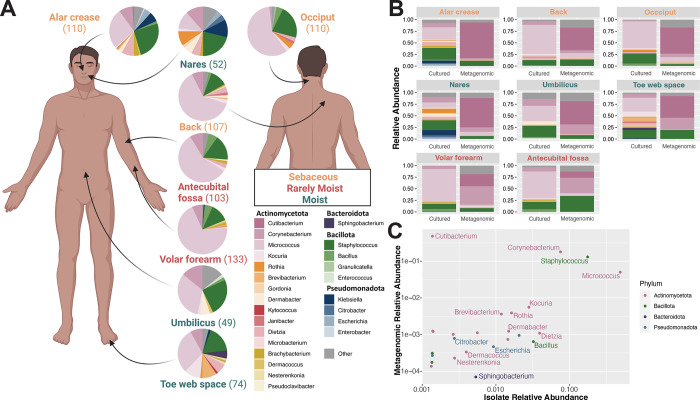
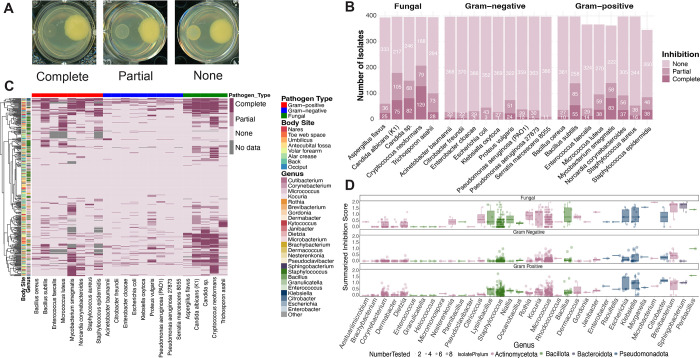
The human skin microbiome constitutes a dynamic barrier that can impede pathogen invasion by producing antimicrobial natural products. Gene clusters encoding for production of secondary metabolites, biosynthetic gene clusters (BGCs), that are enriched in the human skin microbiome relative to other ecological settings, position this niche as a promising source for new natural product mining. Here, we introduce a new human microbiome isolate collection, the EPithelial Isolate Collection (EPIC). It includes a large phylogenetically diverse set of human skin-derived bacterial strains from eight body sites. This skin collection, consisting of 980 strains is larger and more diverse than existing resources, includes hundreds of rare and low-abundance strains, and hundreds of unique BGCs. Using a large-scale co-culture screen to assess 8,756 pairwise interactions between skin-associated bacteria and potential pathogens, we reveal broad antifungal activity by skin microbiome members. Integrating 287 whole isolate genomes and 268 metagenomes from sampling sites demonstrates that while the distribution of BGC types is stable across body sites, specific gene cluster families (GCFs), each predicted to encode for a distinct secondary metabolite, can substantially vary. Sites that are dry or rarely moist harbor the greatest potential for discovery of novel bioactive metabolites. Among our discoveries are four novel bacterial species, three of which exert significant and broad-spectrum antifungal activity. This comprehensive isolate collection advances our understanding of the skin microbiomes biosynthetic capabilities and pathogen-fighting mechanisms, opening new avenues towards antimicrobial drug discovery and microbiome engineering.
人类皮肤微生物群构成了一道动态屏障,可通过产生抗菌天然产物来阻碍病原体入侵。相对于其他生态环境,在人类皮肤微生物群中富集的编码次生代谢产物的基因簇,即生物合成基因簇(BGCs),使这一生态位成为新天然产物挖掘的一个有前景的来源。在此,我们引入了一个新的人类微生物群分离株集合,即上皮分离株集合(EPIC)。它包括来自八个身体部位的大量系统发育多样的人类皮肤衍生细菌菌株。这个由980个菌株组成的皮肤集合比现有资源更大且更多样化,包括数百个稀有和低丰度菌株以及数百个独特的BGCs。通过大规模共培养筛选来评估皮肤相关细菌与潜在病原体之间的8756对相互作用,我们揭示了皮肤微生物群成员具有广泛的抗真菌活性。整合来自采样点的287个全分离株基因组和268个宏基因组表明,虽然BGC类型的分布在身体各部位是稳定的,但每个预测编码一种独特次生代谢产物的特定基因簇家族(GCFs)可能会有很大差异。干燥或很少潮湿的部位发现新型生物活性代谢物的潜力最大。我们的发现包括四个新细菌物种,其中三个具有显著的广谱抗真菌活性。这个全面的分离株集合推进了我们对皮肤微生物群生物合成能力和抗病原体机制的理解,为抗菌药物发现和微生物群工程开辟了新途径。