Rendina Matthew, Turnbaugh Peter J, Bradley Patrick H
Department of Microbiology, The Ohio State University, Columbus, OH 43210, USA.
Infectious Diseases Institute, The Ohio State University, Columbus, OH 43210, USA.
bioRxiv. 2024 Nov 8:2024.11.06.622278. doi: 10.1101/2024.11.06.622278.
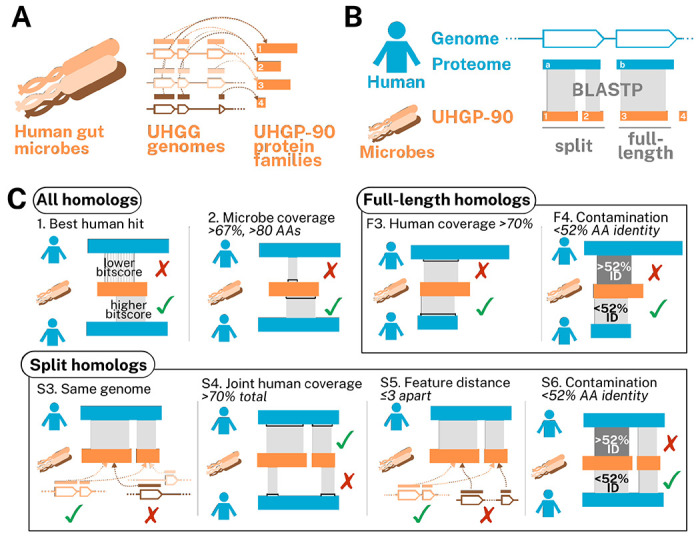
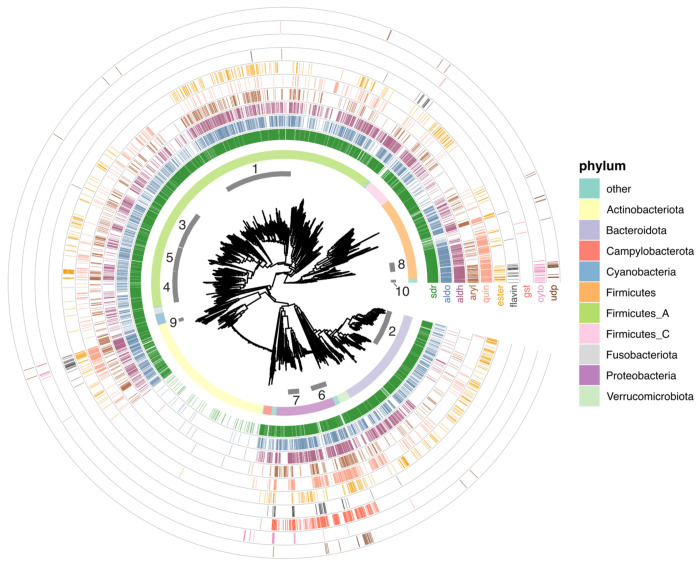
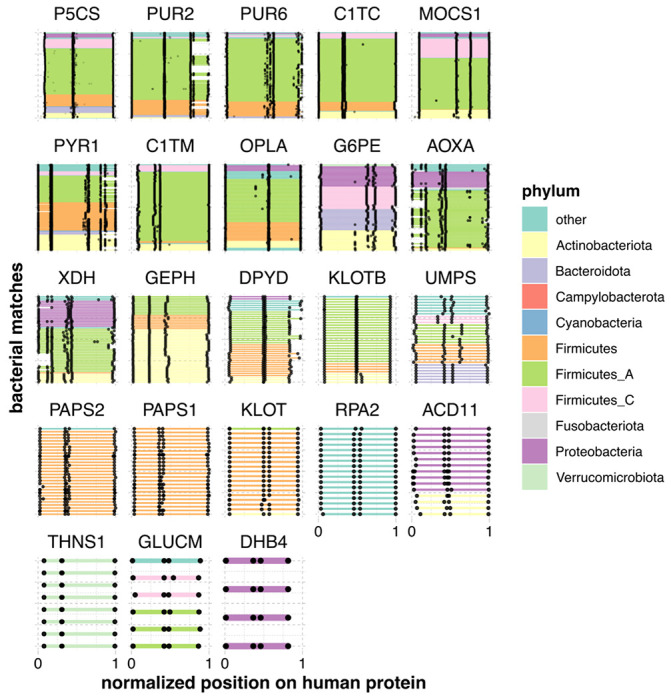
Xenobiotics, including pharmaceutical drugs, can be metabolized by both host and microbiota, in some cases by homologous enzymes. We conducted a systematic search for all human proteins with gut microbial homologs. Because gene fusion and fission can obscure homology detection, we built a pipeline to identify not only full-length homologs, but also cases where microbial homologs were split across multiple adjacent genes in the same neighborhood or operon ("split homologs"). We found that human proteins with full-length gut microbial homologs disproportionately participate in xenobiotic metabolism. While this included many different enzyme classes, short-chain and aldo-keto reductases were the most frequently detected, especially in prevalent gut microbes, while cytochrome P450 homologs were largely restricted to lower-prevalence facultative anaerobes. In contrast, human proteins with split homologs tended to play roles in central metabolism, especially of nucleobase-containing compounds. We identify twelve specific drugs that gut microbial split homologs may metabolize; two of these, 6-mercaptopurine by xanthine dehydrogenase (XDH) and 5-fluorouracil by dihydropyrimidine dehydrogenase (DPYD), have been recently confirmed in mouse models. This work provides a comprehensive map of homology between the human and gut microbial proteomes, indicates which human xenobiotic enzyme classes are most likely to be shared by gut microorganisms, and finally demonstrates that split homology may be an underappreciated explanation for microbial contributions to drug metabolism.
包括药物在内的外源性物质可由宿主和微生物群共同代谢,在某些情况下由同源酶进行代谢。我们对所有具有肠道微生物同源物的人类蛋白质进行了系统搜索。由于基因融合和裂变会掩盖同源性检测,我们构建了一个流程,不仅可以识别全长同源物,还能识别微生物同源物在同一邻域或操纵子中的多个相邻基因间分裂的情况(“分裂同源物”)。我们发现,具有全长肠道微生物同源物的人类蛋白质过多地参与外源性物质代谢。虽然这包括许多不同的酶类,但短链和醛酮还原酶是最常检测到的,尤其是在常见的肠道微生物中,而细胞色素P450同源物在很大程度上限于低丰度的兼性厌氧菌。相比之下,具有分裂同源物的人类蛋白质往往在中心代谢中发挥作用,尤其是含核碱基化合物的代谢。我们确定了肠道微生物分裂同源物可能代谢的12种特定药物;其中两种,即黄嘌呤脱氢酶(XDH)对6-巯基嘌呤的代谢以及二氢嘧啶脱氢酶(DPYD)对5-氟尿嘧啶的代谢,最近已在小鼠模型中得到证实。这项工作提供了人类和肠道微生物蛋白质组之间同源性的全面图谱,指出了哪些人类外源性物质酶类最有可能由肠道微生物共享,最终证明分裂同源性可能是微生物对药物代谢贡献的一个未被充分认识的解释。