Amorim Gustavo Moreira, Ricardo Werner Castro Gláucio, Carneiro Sueli
Division of Dermatology and Pathology, Federal University of Rio de Janeiro Faculty of Medicine, Clementino Fraga Filho University Hospital, Rio de Janeiro, Brazil.
Divison of Dermatology, Santa Teresa Hospital, São Pedro de Alcântara, Brazil.
Eur J Rheumatol. 2024 Sep 5;11(2):46-52. doi: 10.5152/eurjrheum.2024.23080.
Gut dysbiosis may play a role in immune-mediated diseases, such as psoriasis. There is a growing interest in understanding microbiome influence, with speculations around the importance of an altered gut microbiome linked to the progression to psoriatic arthritis in psoriasis. The objective of this study is to study the gut microbiome in patients with severe psoriatic disease with or without psoriatic arthritis.
V3/V4 16S rRNA gene sequencing and bioinformatics analyses were performed with the total DNA extracted from the stool samples of 30 patients with psoriatic disease, 15 of whom had documented psoriatic arthritis.
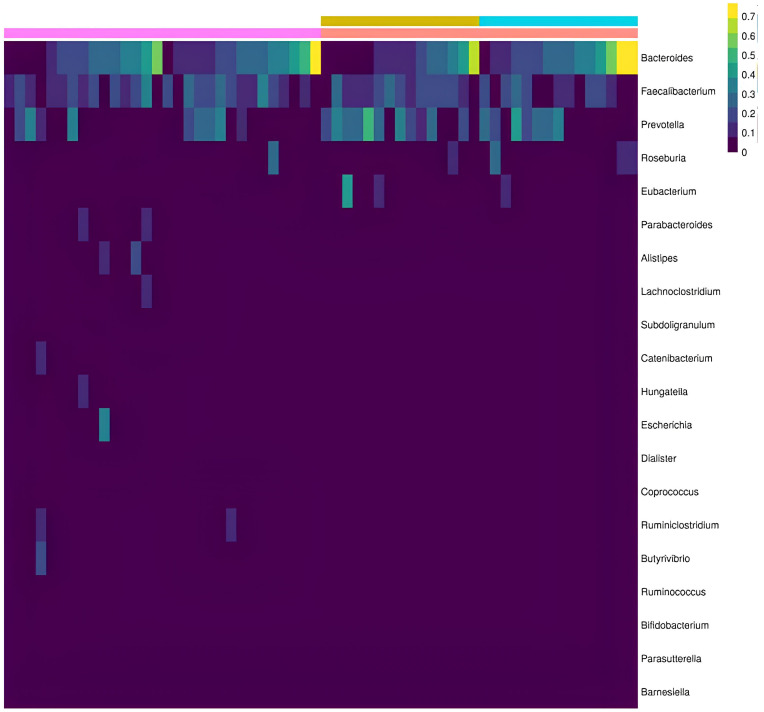
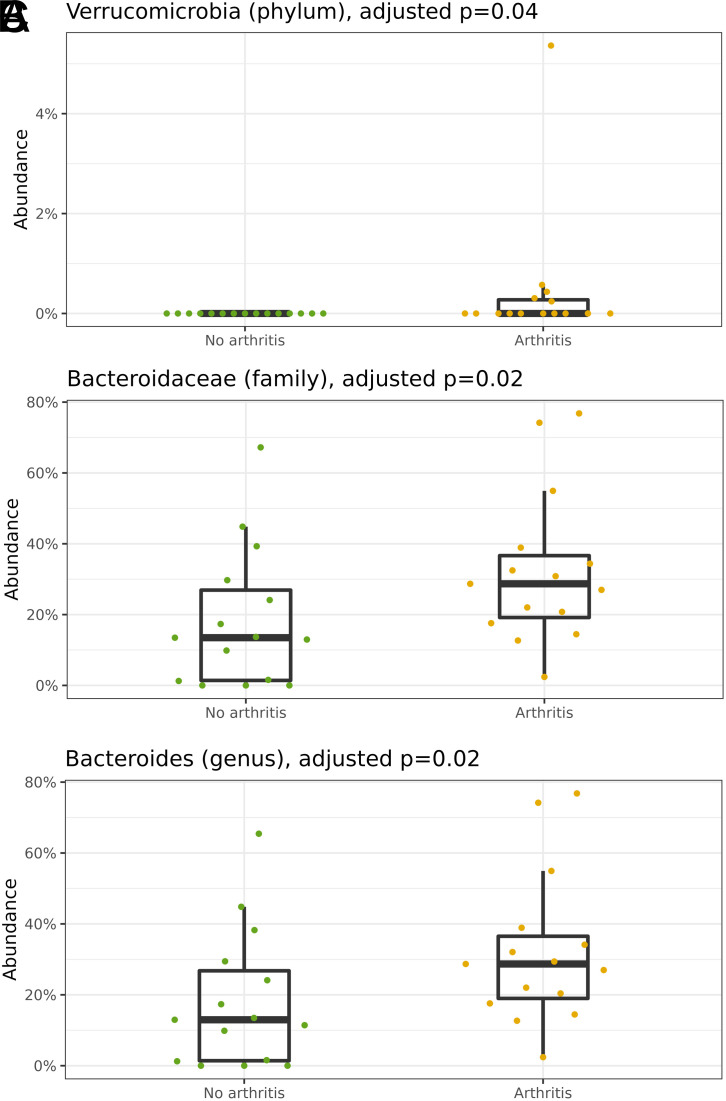
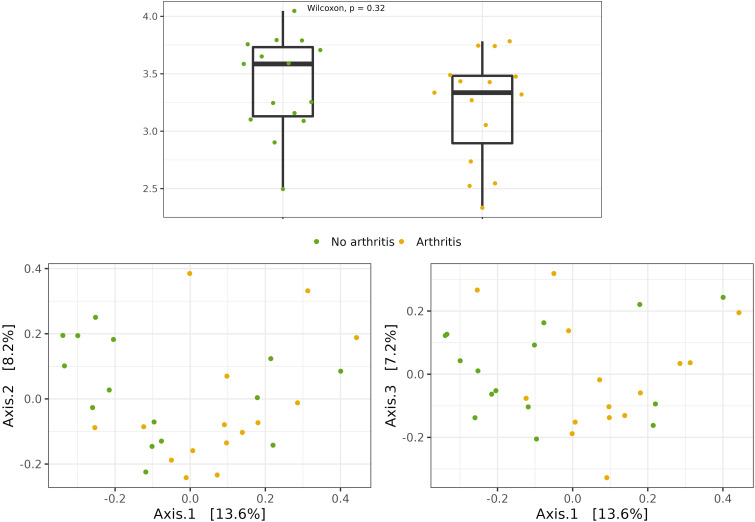
We found differences in gut microbiome composition in psoriatic arthritis patients when looking for relative and especially differential abundances. Bacteroidaceae family (P = .02), Bacteroides genus (P=.02), and Bacteroides uniformis (P=.03) were more abundant in psoriatic arthritis patients on differential abundance, adjusted for each taxonomic level. However, the present study did not show significant differences in alpha or beta diversity.
This study shows different patterns of gut microbiome composition in patients with psoriatic arthritis, with significant overexpression of the Bacteroides genus. This reinforces the microbiome as a field of interest in psoriasis. Nevertheless, it should be noted that some previously described findings related to lower diversity and different clustering between groups could not be demonstrated, probably due to the small number of patients. Additionally, it remains difficult to understand the magnitude of the gut microbiome influence. Is dysbiosis a cause or consequence of the disease? However, the microbiome deserves our attention, especially since it brings different opportunities for intervention through diet, prebiotics and probiotics, pretreatment analysis, prognosis, and even microbiome modulation and transplantation.
肠道微生物群失调可能在免疫介导的疾病中起作用,如银屑病。人们对了解微生物组的影响越来越感兴趣,有人推测肠道微生物组改变与银屑病进展为银屑病关节炎的重要性有关。本研究的目的是研究患有或未患有银屑病关节炎的重度银屑病患者的肠道微生物组。
对30例银屑病患者粪便样本中提取的总DNA进行V3/V4 16S rRNA基因测序和生物信息学分析,其中15例有记录的银屑病关节炎患者。
在寻找相对丰度尤其是差异丰度时,我们发现银屑病关节炎患者的肠道微生物组组成存在差异。在差异丰度分析中,经各分类水平校正后,拟杆菌科(P = 0.02)、拟杆菌属(P = 0.02)和单形拟杆菌(P = 0.03)在银屑病关节炎患者中更为丰富。然而,本研究未显示α或β多样性存在显著差异。
本研究显示银屑病关节炎患者的肠道微生物组组成模式不同,拟杆菌属有显著过表达。这强化了微生物组作为银屑病研究领域的重要性。然而,应该注意的是,一些先前描述的与较低多样性和组间不同聚类相关的发现未能得到证实,可能是由于患者数量较少。此外,仍然难以理解肠道微生物组影响的程度。微生物群失调是疾病的原因还是结果?然而,微生物组值得我们关注,特别是因为它为通过饮食、益生元和益生菌、预处理分析、预后,甚至微生物组调节和移植进行干预带来了不同的机会。