Turgay Altunalan,Department of Physical Therapy and Rehabilitation, Karadeniz Technical University, Farabi Street, Trabzon, 61080, Turkey.
Department of Physical Therapy and Rehabilitation, Uskudar University, İstanbul, Turkey.
BMC Public Health. 2024 Nov 28;24(1):3261. doi: 10.1186/s12889-024-20708-1.
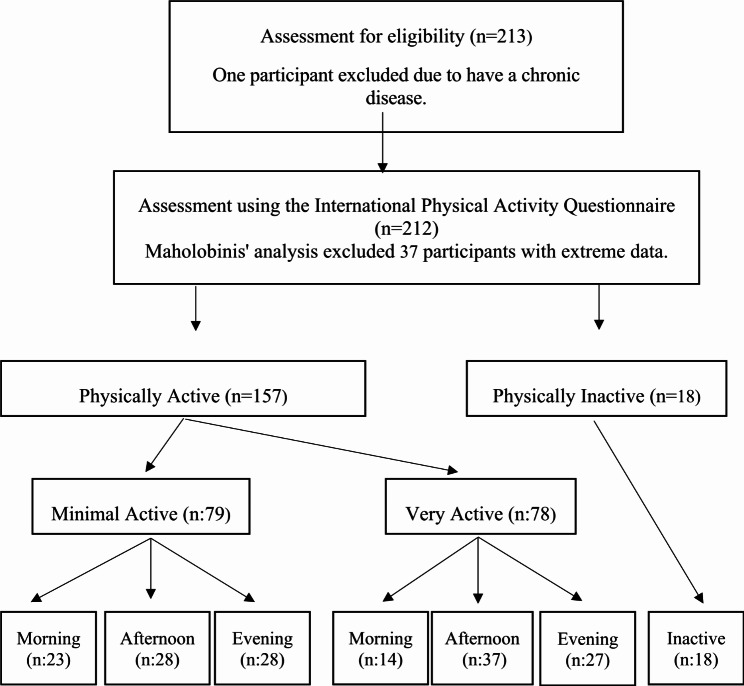
The current study focused on investigating the relationship between level and timing of physical activity and sleep quality and hygiene in healthy individuals. This cross-sectional study design recruited 175 participants (male: 98, 56%, female: 77, 44%, and BMI: 23.87 ± 3.92) aged between 18 and 65, 157 of whom were physically active and 18 of whom were physically inactive. The study recruited healthy participants from various sports facilities, fitness centers, and walking parks to ensure a diverse sample of physically active individuals in a metropolitan city. The study excluded people with sleep disorders, rheumatoid arthritis, heart or neurological problems, and those who had shift work. The study employed the Demographic Information Form, International Physical Activity Questionnaire (Short Form), Pittsburgh Sleep Quality Scale, and Sleep Hygiene Questionnaire. A one-way MANOVA was employed to compare sleep quality and hygiene in different physical activity levels. A second MANOVA compared sleep quality and hygiene in different physical activity timing, including only the minimally active and very active participants. One-way MANOVA showed a significant difference F (4, 171) = 7.532, Pillai's trace = 0.161, partial eta squared = 0.081 between sleep quality and hygiene scores among inactive, minimally active, and very active participants. A post hoc analysis showed sleep quality was significantly better in minimal active (6.42 ± 2.55, p = 0.002, Cohen's d = 0.867) and very active participants (5.99 ± 2.29, p < 0.001, Cohen's d = 1.092) than inactive (8.61 ± 2.50) participants. Also, sleep hygiene was significantly better in minimal active (28.50 ± 6.74, p = 0.001, Cohen's d = 0.867) and very active participants (29.52 ± 6.56, p < 0.001, Cohen's d = 0.992) than inactive (36.05 ± 8.39) participants. The one-way MANOVA revealed no statistically significant differences in sleep quality and hygiene scores based on physical activity time. Our study showed that physically active individuals had significantly better sleep quality and hygiene scores, while there was no difference based on the timing of physical activity. Healthy individuals may be encouraged to participate in physical activity in the morning, afternoon, or evening to improve sleep parameters.
本研究旨在探讨健康个体中身体活动水平和时间与睡眠质量和卫生之间的关系。这项横断面研究设计招募了 175 名参与者(男性:98 名,56%,女性:77 名,44%,BMI:23.87±3.92),年龄在 18 至 65 岁之间,其中 157 名参与者为身体活跃者,18 名参与者为身体不活跃者。研究从各种体育设施、健身中心和步行公园招募健康参与者,以确保在大都市中获得身体活跃者的多样化样本。该研究排除了有睡眠障碍、类风湿关节炎、心脏或神经系统问题以及轮班工作的人。研究采用了人口统计学信息表、国际体力活动问卷(短表)、匹兹堡睡眠质量量表和睡眠卫生问卷。采用单因素方差分析(MANOVA)比较不同身体活动水平的睡眠质量和卫生情况。第二次 MANOVA 比较了不同身体活动时间的睡眠质量和卫生情况,仅包括最不活跃和非常活跃的参与者。单因素方差分析显示,在不活跃、最不活跃和非常活跃的参与者之间,睡眠质量和卫生评分的差异具有统计学意义 F(4,171)=7.532,Pillai 的迹 =0.161,偏 eta 平方 =0.081。事后分析显示,最不活跃参与者(6.42±2.55,p=0.002,Cohen's d=0.867)和非常活跃参与者(5.99±2.29,p<0.001,Cohen's d=1.092)的睡眠质量明显优于不活跃参与者(8.61±2.50)。此外,最不活跃参与者(28.50±6.74,p=0.001,Cohen's d=0.867)和非常活跃参与者(29.52±6.56,p<0.001,Cohen's d=0.992)的睡眠卫生情况明显优于不活跃参与者(36.05±8.39)。单因素方差分析显示,根据身体活动时间,睡眠质量和卫生评分没有统计学上的显著差异。我们的研究表明,身体活跃的个体睡眠质量和卫生评分明显更好,而身体活动时间没有差异。健康个体可能会被鼓励在早上、下午或晚上参加身体活动,以改善睡眠参数。