Meuth Sven G, Wolff Stephanie, Mück Anna, Willison Alice, Kleinschnitz Konstanze, Räuber Saskia, Pawlitzki Marc, Konen Franz Felix, Skripuletz Thomas, Grothe Matthias, Ruck Tobias, Huttner Hagen B, Kleinschnitz Christoph, Bopp Tobias, Pul Refik, Cree Bruce A C, Hartung Hans-Peter, Möllenhoff Kathrin, Pfeuffer Steffen
Department of Neurology, University Hospital Duesseldorf, Heinrich-Heine-University Duesseldorf, Duesseldorf, Germany.
Department of Neurology, University Hospital Giessen and Marburg, Justus-Liebig-University Giessen, Giessen, Germany.
Ann Neurol. 2025 Mar;97(3):583-595. doi: 10.1002/ana.27143. Epub 2024 Nov 25.
B-cell-depletion via CD20 antibodies is a safe and effective treatment for active relapsing multiple sclerosis (RMS). Both ocrelizumab (OCR) and ofatumumab (OFA) have demonstrated efficacy in randomized controlled trials and are approved for treatment of RMS, yet nothing is known on their comparative effectiveness, especially in the real-world setting.
This prospective cohort study includes patients that were started on either OCR or OFA between September 2021 and December 2023. Patients were followed until June 2024 and recruited at 3 large tertiary centers in Germany (Duesseldorf, Essen, and Giessen). Propensity-score-matching was used to address baseline imbalances among patients. Clinical relapses, presence of new or enlarging MRI lesions and 6-month confirmed disability worsening were evaluated. Non-inferiority of OFA compared to OCR was evaluated through comparison of Kaplan-Meier-estimates.
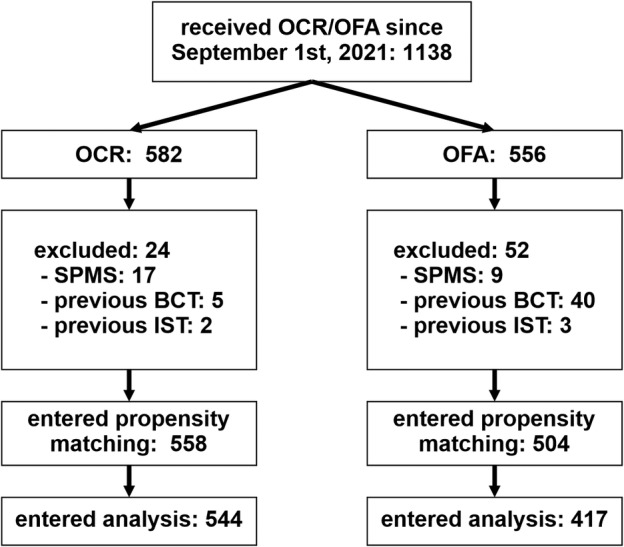
A total of 1,138 patients were initially enrolled in the cohort. Following patient selection and propensity-score-matching, 544 OCR and 417 OFA patients were included in the final analysis. In our primary analysis, OFA was non-inferior to OCR in terms of relapses, disability progression, and accrual of MRI lesions. Subgroup analyses confirmed findings in previously naïve and platform-treated patients. Potential differences between OFA and OCR were seen in patients switching from S1P receptor modulators or natalizumab.
We here provide comparative data on the effectiveness of OCR and OFA in patients with active RMS. OFA was non-inferior to OCR in the overall cohort. Potential differences observed in patients switching from S1P receptor modulators or natalizumab require further validation. ANN NEUROL 2025;97:583-595.
通过CD20抗体清除B细胞是活动性复发型多发性硬化症(RMS)的一种安全有效的治疗方法。奥瑞珠单抗(OCR)和奥法妥木单抗(OFA)在随机对照试验中均已证明有效,并被批准用于治疗RMS,但它们的比较效果尚不清楚,尤其是在真实世界环境中。
这项前瞻性队列研究纳入了2021年9月至2023年12月期间开始使用OCR或OFA治疗的患者。对患者进行随访至2024年6月,并在德国的3个大型三级中心(杜塞尔多夫、埃森和吉森)招募患者。采用倾向得分匹配法来解决患者之间的基线不平衡问题。评估临床复发、新的或扩大的MRI病变的出现以及6个月确诊的残疾恶化情况。通过比较Kaplan-Meier估计值来评估OFA与OCR相比的非劣效性。
共有1138名患者最初纳入该队列。经过患者选择和倾向得分匹配后,最终分析纳入了544名OCR患者和417名OFA患者。在我们的初步分析中,就复发、残疾进展和MRI病变的累积而言,OFA不劣于OCR。亚组分析证实了在既往未治疗和接受平台治疗的患者中的研究结果。在从S1P受体调节剂或那他珠单抗转换治疗的患者中观察到了OFA和OCR之间的潜在差异。
我们在此提供了OCR和OFA在活动性RMS患者中有效性的比较数据。在整个队列中,OFA不劣于OCR。在从S1P受体调节剂或那他珠单抗转换治疗的患者中观察到的潜在差异需要进一步验证。《神经病学年鉴》2025年;97:583 - 595。