Krishnan Deepak, Asokan Arthi, Muthalu Arunkumar, Suganya Srinivasan, Sujatha Chinthavali
Department of Anaesthesiology and Critical Care, Sri Venkateshwaraa Medical College Hospital and Research Centre, Puducherry, IND.
Department of Anaesthesiology and Critical Care, Sri Venkateshwaraa Medical College and Research Centre, Puducherry, IND.
Cureus. 2024 Oct 23;16(10):e72214. doi: 10.7759/cureus.72214. eCollection 2024 Oct.
The most troublesome complaint after general anaesthesia and surgery, especially laparoscopic surgeries, is postoperative nausea and vomiting (PONV). We routinely use pharmacologic prophylaxis to prevent PONV. In patients undergoing laparoscopic procedures, we assessed the effectiveness of palonosetron compared to ondansetron combined with dexamethasone in preventing the incidence of PONV.
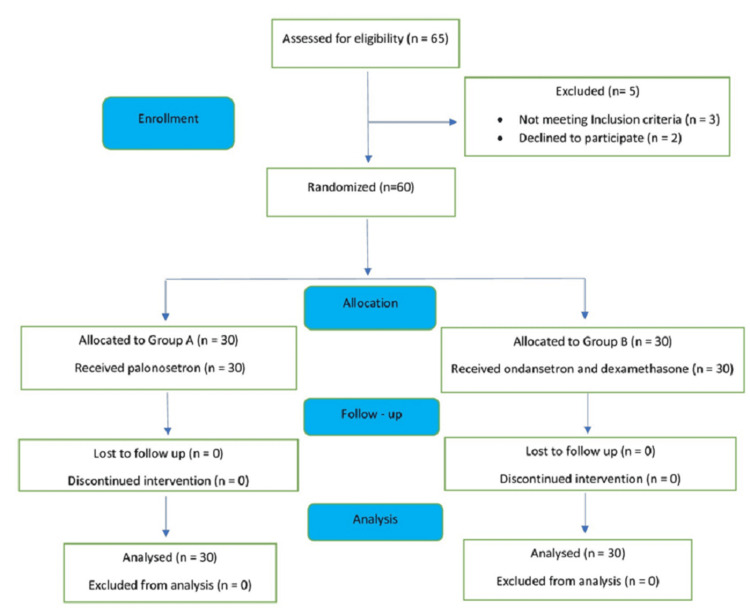
This was a prospective, randomised, double-blind study that included 60 patients aged 18 to 60 years of either sex belonging to ASA physical status I or II undergoing elective laparoscopic surgeries. Before induction of anaesthesia, patients were randomised into two equal groups to receive either 0.075mg of palonosetron (group 1) or 4mg of ondansetron with 4mg of dexamethasone (group 2). Any incidence of nausea or vomiting along with the severity was assessed using the visual analogue scale, and the need for the rescue antiemetic was noted. Statistical analysis was done using an independent sample T-test, chi-square test, and Fisher's exact test. P-value <0.05 was considered statistically significant.
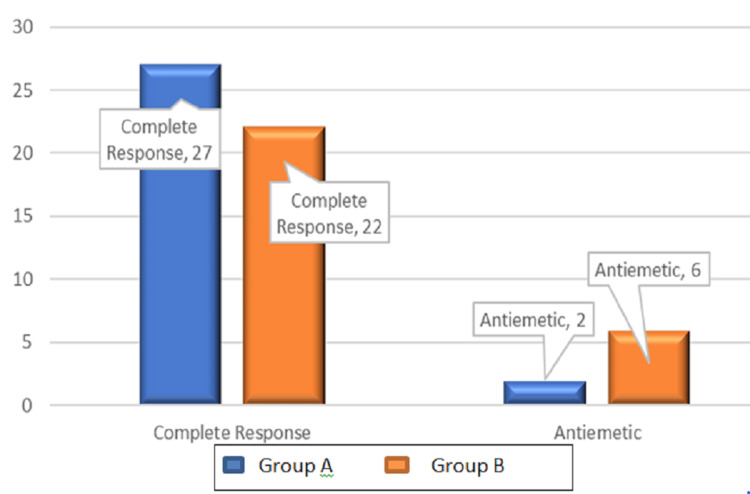
The overall incidence of PONV was 18% (11 patients), all of which were of mild to moderate severity. The palonosetron group had a lesser incidence of PONV, in three patients (10%) when compared to eight patients (26.6%) in the ondansetron and dexamethasone combination group over a period of 48 hours, but the difference was not statistically significant (P=0.854). The need for the rescue antiemetic was also comparable between both the groups (P=0.129), two patients required the rescue antiemetic (6.66%) in the palonosetron group, while in the ondansetron and dexamethasone group, six patients required the rescue antiemetic (20%).
Both palonosetron and ondansetron with dexamethasone prove to be comparably effective in preventing PONV in laparoscopic surgeries and achieving a complete response for a longer period, thus requiring fewer rescue medications with no adverse reaction.
全身麻醉和手术后,尤其是腹腔镜手术后,最棘手的问题是术后恶心呕吐(PONV)。我们常规使用药物预防措施来预防PONV。在接受腹腔镜手术的患者中,我们评估了帕洛诺司琼与昂丹司琼联合地塞米松相比在预防PONV发生率方面的有效性。
这是一项前瞻性、随机、双盲研究,纳入了60例年龄在18至60岁之间、性别不限、ASA身体状况为I或II级、接受择期腹腔镜手术的患者。在麻醉诱导前,患者被随机分为两组,每组人数相等,分别接受0.075mg帕洛诺司琼(第1组)或4mg昂丹司琼加4mg地塞米松(第2组)。使用视觉模拟量表评估恶心或呕吐的任何发生率及其严重程度,并记录使用抢救性止吐药的情况。采用独立样本T检验、卡方检验和Fisher精确检验进行统计分析。P值<0.05被认为具有统计学意义。
PONV的总体发生率为18%(11例患者),所有病例的严重程度均为轻度至中度。在48小时内,帕洛诺司琼组的PONV发生率较低,为3例(10%),而昂丹司琼与地塞米松联合组为8例(26.6%),但差异无统计学意义(P = 0.854)。两组使用抢救性止吐药的情况也相当(P = 0.129),帕洛诺司琼组有2例患者需要使用抢救性止吐药(6.66%),而在昂丹司琼与地塞米松组,有6例患者需要使用抢救性止吐药(20%)。
帕洛诺司琼和昂丹司琼联合地塞米松在预防腹腔镜手术中的PONV方面效果相当,且能在较长时间内实现完全缓解,因此所需的抢救药物较少,且无不良反应。