Puleio Francesco, Tosco Vincenzo, Pirri Rosario, Simeone Michele, Monterubbianesi Riccardo, Lo Giudice Giorgio, Lo Giudice Roberto
Department of Biomedical and Dental Sciences and Morphofunctional Imaging, Messina University, 98100 Messina, Italy.
Department of Clinical Sciences and Stomatology (DISCO), Università Politecnica delle Marche, 60126 Ancona, Italy.
Clin Pract. 2024 Oct 28;14(6):2267-2283. doi: 10.3390/clinpract14060178.
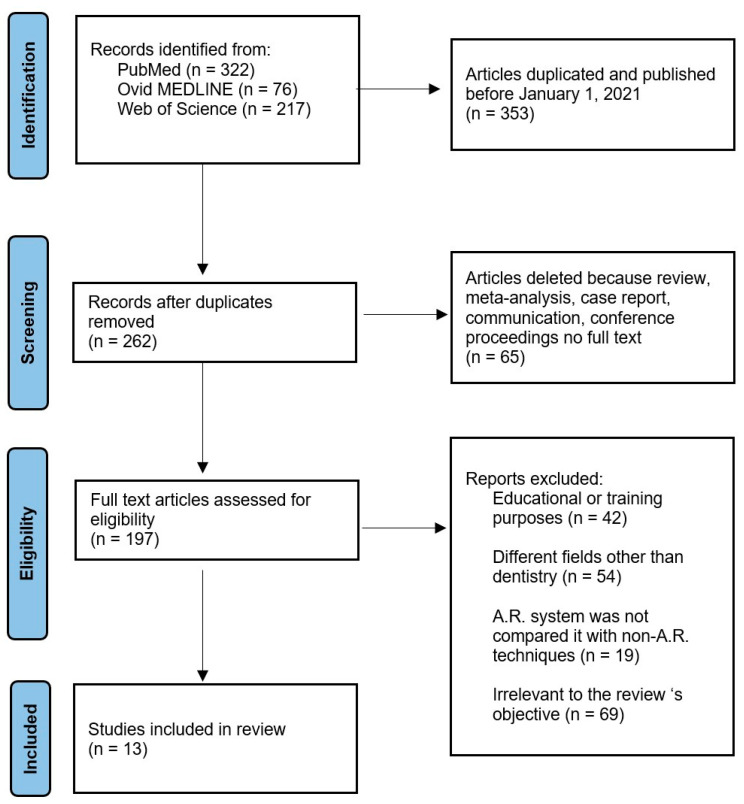
Augmented reality (AR) enhances sensory perception by adding extra information, improving anatomical localization and simplifying treatment views. In dentistry, digital planning on bidimensional screens lacks real-time feedback, leading to potential errors. However, it is not clear if AR can improve the clinical treatment precision. The aim of this research is to evaluate if the use of AR-based instruments could improve dental procedure precision. This review covered studies from January 2018 to June 2023, focusing on AR in dentistry. The PICO question was "Does AR increase the precision of dental interventions compared to non-AR techniques?". The systematic review was carried out on electronic databases, including Ovid MEDLINE, PubMed, and the Web of Science, with the following inclusion criteria: studies comparing the variation in the precision of interventions carried out with AR instruments and non-AR techniques. Thirteen studies were included. The results of this systematic review demonstrate that AR enhances the precision of various dental procedures. The authors advise clinicians to use AR-based tools in order to improve the precision of their therapies.
增强现实(AR)通过添加额外信息来增强感官感知,改善解剖定位并简化治疗视野。在牙科领域,二维屏幕上的数字规划缺乏实时反馈,可能导致潜在错误。然而,目前尚不清楚AR是否能提高临床治疗精度。本研究的目的是评估使用基于AR的器械是否能提高牙科手术的精度。本综述涵盖了2018年1月至2023年6月的研究,重点关注牙科领域的AR。PICO问题是“与非AR技术相比,AR是否能提高牙科干预的精度?”。在电子数据库(包括Ovid MEDLINE、PubMed和科学网)上进行了系统综述,纳入标准如下:比较使用AR器械和非AR技术进行干预时精度差异的研究。共纳入13项研究。该系统综述的结果表明,AR可提高各种牙科手术的精度。作者建议临床医生使用基于AR的工具,以提高治疗的精度。