Jeong Eugene, Su Yu, Li Lang, Chen You
Department of Biomedical Informatics, School of Medicine, Vanderbilt University Medical Center, Nashville, Tennessee, USA.
Department of Computer Science and Engineering, College of Engineering, The Ohio State University, Columbus, Ohio, USA.
Clin Pharmacol Ther. 2025 Apr;117(4):1078-1087. doi: 10.1002/cpt.3500. Epub 2024 Nov 25.
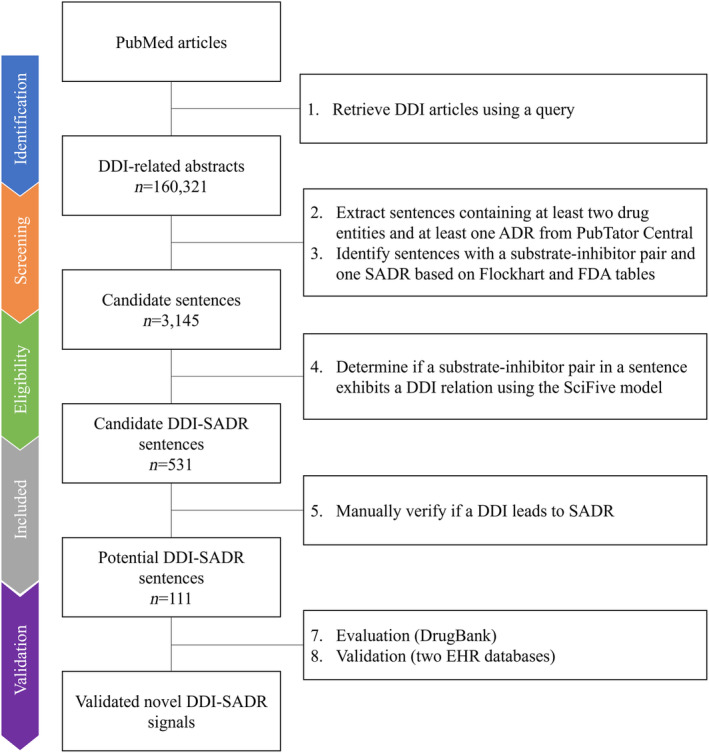
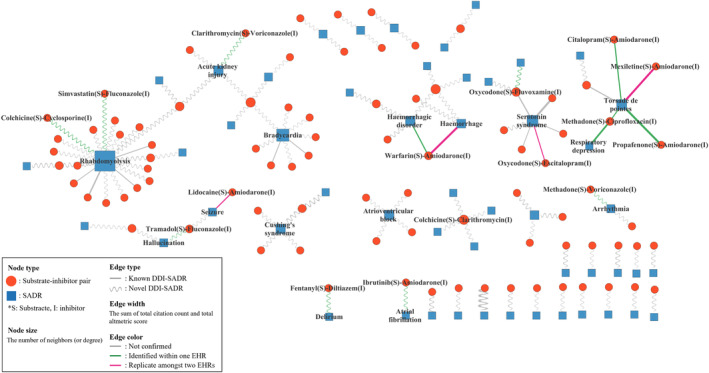
While drug-drug interactions (DDIs) and their pharmacokinetic (PK) mechanisms are well-studied prior to drug approval, severe adverse drug reactions (SADRs) caused by DDIs often remain underrecognized due to limitations in pre-marketing clinical trials. To address this gap, our study utilized a literature database, applied natural language processing (NLP) techniques, and conducted multi-source electronic health record (EHR) validation to uncover underrecognized DDI-SADR signals that warrant further investigation. PubMed abstracts related to DDIs from January 1962 to December 2023 were retrieved. We utilized PubTator Central for Named Entity Recognition (NER) to identify drugs and SADRs and employed SciFive for Relation Extraction (RE) to extract DDI-SADR signals. The extracted signals were cross-referenced with the DrugBank database and validated using logistic regression, considering risk factors including patient demographics, drug usage, and comorbidities, based on EHRs from Vanderbilt University Medical Center (VUMC) and the All of Us research program. From 160,321 abstracts, we identified 111 DDI-SADR signals. Seventeen were statistically significant (13 by one EHR and 4 by both EHR databases), with 9 being previously not recorded in the DrugBank. These included methadone-ciprofloxacin-respiratory depression, oxycodone-fluvoxamine-clonus, tramadol-fluconazole-hallucination, simvastatin-fluconazole-rhabdomyolysis, ibrutinib-amiodarone-atrial fibrillation, fentanyl-diltiazem-delirium, clarithromycin-voriconazole-acute kidney injury, colchicine-cyclosporine-rhabdomyolysis, and methadone-voriconazole-arrhythmia (odds ratios (ORs) ranged from 1.9 to 35.83, with P-values ranging from < 0.001 to 0.017). Utilizing NLP to extract DDI-SADRs from Biomedical Literature and validating these findings through multiple-source EHRs represents a pioneering approach in pharmacovigilance. This method uncovers clinically relevant SADRs resulting from DDIs that were not evident in pre-marketing trials or the existing DDI knowledge base.
虽然药物相互作用(DDIs)及其药代动力学(PK)机制在药物批准前已得到充分研究,但由于上市前临床试验的局限性,由药物相互作用引起的严重药物不良反应(SADRs)往往仍未得到充分认识。为了填补这一空白,我们的研究利用文献数据库,应用自然语言处理(NLP)技术,并进行多源电子健康记录(EHR)验证,以发现值得进一步研究的未被充分认识的药物相互作用-严重药物不良反应信号。检索了1962年1月至2023年12月与药物相互作用相关的PubMed摘要。我们利用PubTator Central进行命名实体识别(NER)来识别药物和严重药物不良反应,并使用SciFive进行关系提取(RE)来提取药物相互作用-严重药物不良反应信号。提取的信号与DrugBank数据库进行交叉引用,并基于范德比尔特大学医学中心(VUMC)和“我们所有人”研究项目的电子健康记录,使用逻辑回归进行验证,同时考虑患者人口统计学、药物使用和合并症等风险因素。从160321篇摘要中,我们识别出111个药物相互作用-严重药物不良反应信号。其中17个具有统计学意义(13个通过一个电子健康记录数据库,4个通过两个电子健康记录数据库),9个以前未记录在DrugBank中。这些包括美沙酮-环丙沙星-呼吸抑制、羟考酮-氟伏沙明-阵挛、曲马多-氟康唑-幻觉、辛伐他汀-氟康唑-横纹肌溶解、伊布替尼-胺碘酮-心房颤动、芬太尼-地尔硫卓-谵妄、克拉霉素-伏立康唑-急性肾损伤、秋水仙碱-环孢素-横纹肌溶解和美沙酮-伏立康唑-心律失常(优势比(ORs)范围为1.9至35.83,P值范围为<0.001至0.017)。利用自然语言处理从生物医学文献中提取药物相互作用-严重药物不良反应,并通过多源电子健康记录验证这些发现,代表了药物警戒中的一种开创性方法。这种方法揭示了由药物相互作用导致的临床相关严重药物不良反应,这些反应在上市前试验或现有的药物相互作用知识库中并不明显。