Allied Health Sciences, School of Health Sciences and Technology, University of Petroleum and Energy Studies, Dehradun 248007, Uttarakhand, India.
Mahavir Cancer Sansthan, and Research Centre, Patna 801505, Bihar, India.
Biosensors (Basel). 2024 Nov 4;14(11):534. doi: 10.3390/bios14110534.
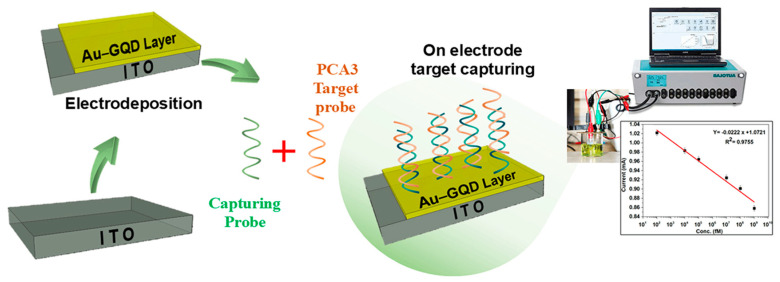
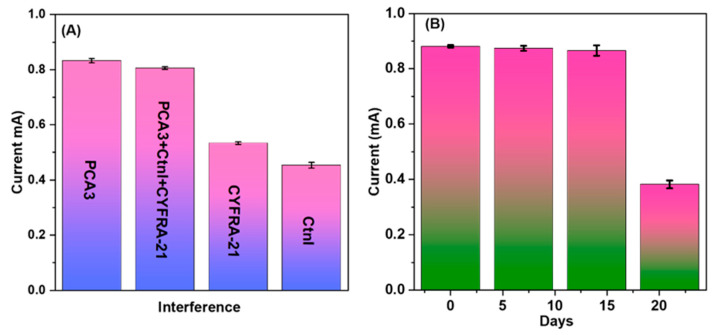
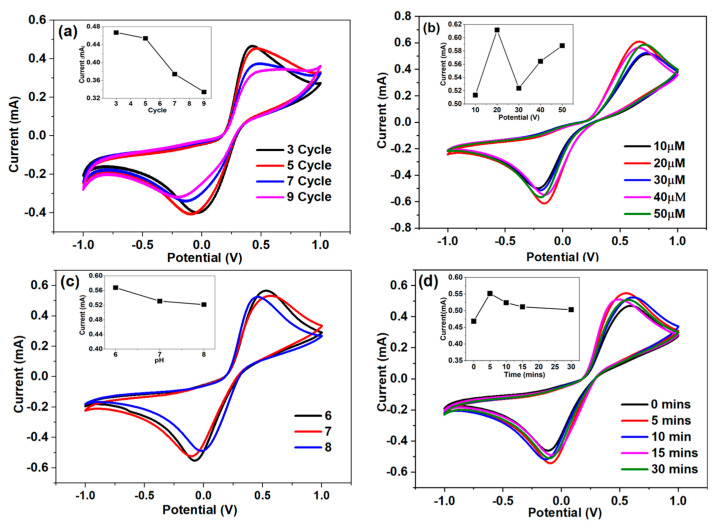
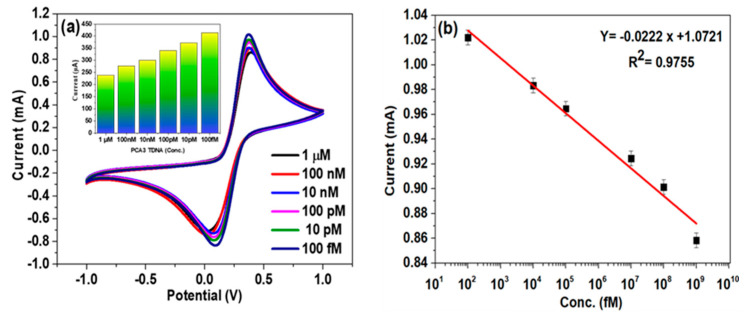
Prostate cancer is one of the most prevalent cancers afflicting men worldwide, often detected at advanced stages, leading to increased mortality rates. Addressing this challenge, we present an innovative approach employing electrochemical biosensing for early-stage prostate cancer detection. This study used Indium-Tin Oxide (ITO) as a substrate and a deposited gold-graphene quantum dot (Au-GQD) nanohybrid to establish electrochemical sensing platforms for DNA-hybridization assays. A capturing DNA probe, PCA3, was covalently immobilized on the surface of the Au-GQDs and deposited electrochemically onto the ITO electrode surface. The Au-GQDs enabled the capturing of the target PCA3 biomarker probe. The sensor achieved a limit of detection (LoD) of up to 211 fM and presented a linear detection range spanning 1 µM to 100 fM. A rapid 5-min response time was also achieved. The tested shelf life of the pre-immobilized sensor was approximately 19 ± 1 days, with pronounced selectivity for its intended target amidst various interferants. The sensing device has the potential to revolutionize prostate cancer management by facilitating early-stage detection and screening with enhanced treatment efficacy.
前列腺癌是全球男性最常见的癌症之一,通常在晚期才被发现,导致死亡率上升。针对这一挑战,我们提出了一种创新的方法,利用电化学生物传感进行早期前列腺癌检测。本研究使用氧化铟锡(ITO)作为基底,并采用沉积的金-石墨烯量子点(Au-GQD)纳米杂化材料构建用于 DNA 杂交分析的电化学生物传感平台。捕获 DNA 探针 PCA3 通过共价键固定在 Au-GQDs 表面,并通过电化学沉积在 ITO 电极表面。Au-GQDs 能够捕获目标 PCA3 生物标志物探针。该传感器的检测限(LoD)高达 211 fM,并呈现出 1 µM 至 100 fM 的线性检测范围。此外,该传感器还实现了快速的 5 分钟响应时间。预固定传感器的保质期约为 19 ± 1 天,对其预期目标具有明显的选择性,同时对各种干扰物也具有明显的选择性。该传感装置有望通过促进早期检测和筛查,以及提高治疗效果,彻底改变前列腺癌的管理方式。