Department of Physical Medicine and Rehabilitation, Linkou Chang Gung Memorial Hospital, Taoyuan City, Taiwan.
Master of Science Degree Program in Innovation for Smart Medicine, Chang Gung University, Taoyuan City, Taiwan.
J Neuroeng Rehabil. 2024 Nov 26;21(1):206. doi: 10.1186/s12984-024-01510-x.
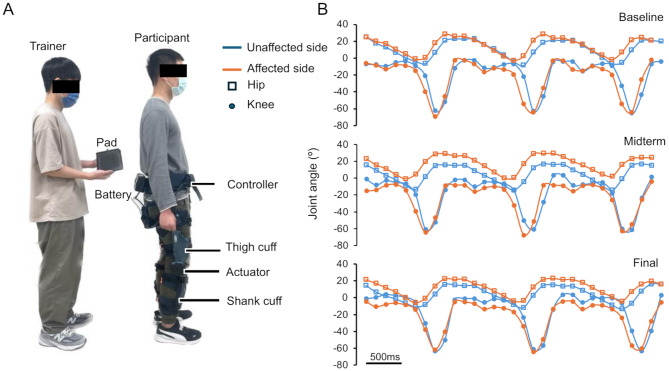
Robot-assisted rehabilitation is considered beneficial for functional recovery in patients with stroke, but the therapeutic effect remains inconclusive. The present study investigated the therapeutic effects of gait training assisted by a user-initiated powered exoskeletal robot (UIPER) in patients in the early stage after stroke. We also characterized patients' improvement by analyzing chronological changes in clinical measurements together with gait parameters obtained from internal sensors in the exoskeletal robot.
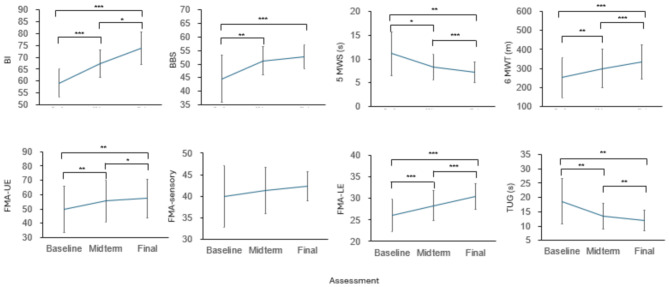
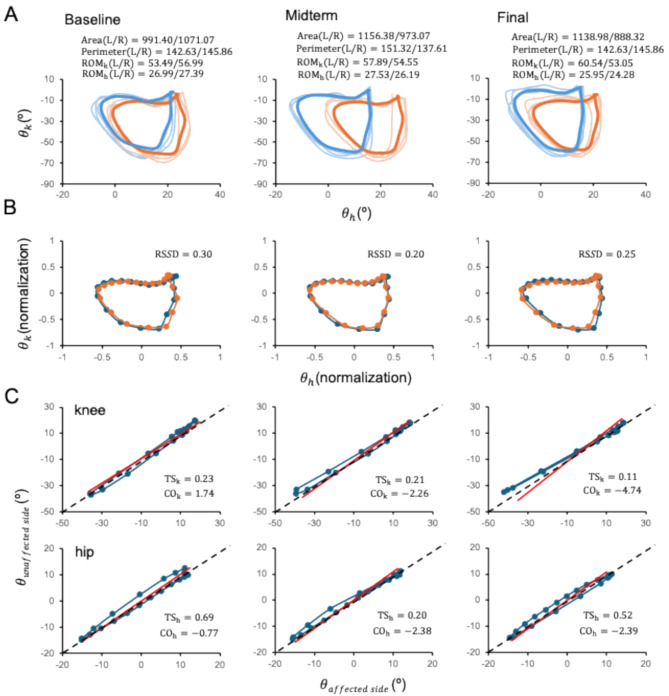
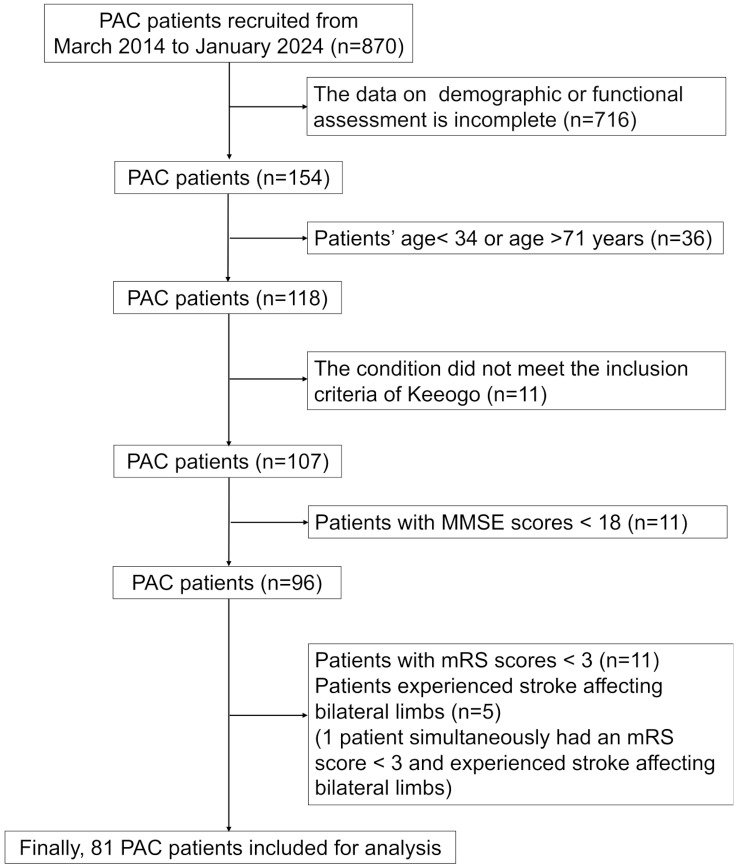
In this pilot case-controlled study, 17 and 81 patients with stroke onset durations of < 3 months were included in the robot-assisted combined with conventional treatment (RT + CT) group and conventional treatment only (CT) group, respectively. The UIPER, which provides knee flexion and extension support and has hip and knee sensors, was applied to guide gait performance in the RT + CT group. The patients in the RT + CT group received robot-assisted gait training for 40 min/ session, 1 session a day, and 2-3 sessions a week (6 sessions in total). The primary outcome was the proportion of patients reaching the minimum clinically important difference (MCID) in the 5-meter walking speed (5MWS) assessment, and the secondary outcomes were the MCID for the six-minute walking test, the Berg Balance Scale, the Barthel Index, the Fugl-Meyer assessment, and the timed up and go test before, during, and after the interventions. Gait parameters of the hip and knee were evaluated at baseline, midterm, and final sessions.
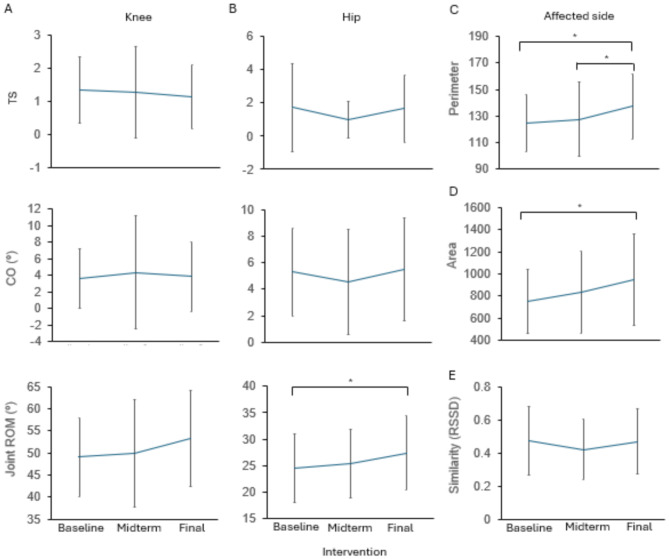
Gait function improved in both groups after the intervention (both P < 0.05). The primary outcome showed that a greater proportion of patients reached the MCID for the 5MWS in the RT + CT group than in the CT group (70.6 vs. 43.2%, P = 0.040; [Formula: see text] = 0.208). Similarly, in terms of the secondary outcomes, more patients in the RT + CT group reached the MCID for the Barthel index as compared with the CT group (41.2 vs. 17.3%, P = 0.047, [Formula: see text] = 0.220). Gait analysis revealed improvements in gait in the RT + CT group, as indicated by increases in the perimeter and area of the hip-knee cyclogram, as well as the range of motion in the hip joint.
Gait training assisted by UIPER facilitates the recovery of walking speed and activities of daily living in patients with stroke, and these improvements may be related to improvements in gait parameters. Randomized controlled studies with larger sample sizes are needed to confirm these findings.
This trial was approved by the Institutional Review Board of Chang Gung Medical Foundation (No. 202200822B0).
机器人辅助康复被认为有利于中风患者的功能恢复,但治疗效果仍不确定。本研究旨在探讨早期中风患者使用用户启动动力外骨骼机器人(UIPER)进行步态训练的治疗效果。我们还通过分析临床测量的时间变化以及外骨骼机器人内部传感器获得的步态参数,来描述患者的改善情况。
在这项初步的病例对照研究中,分别将病程<3 个月的 17 名和 81 名中风患者纳入机器人辅助联合常规治疗(RT+CT)组和仅常规治疗(CT)组。UIPER 提供膝关节屈伸支撑,并具有髋关节和膝关节传感器,用于指导 RT+CT 组的步态表现。RT+CT 组患者接受 40 分钟/次的机器人辅助步态训练,每天 1 次,每周 2-3 次(共 6 次)。主要结局是在 5 米步行速度(5MWS)评估中达到最小临床重要差异(MCID)的患者比例,次要结局是 6 分钟步行试验、伯格平衡量表、巴氏指数、Fugl-Meyer 评估和计时起立行走试验的 MCID,以及干预前后的测试。在基线、中期和最后一次治疗时评估髋关节和膝关节的步态参数。
两组患者在干预后步态功能均有所改善(均 P<0.05)。主要结局显示,与 CT 组相比,RT+CT 组达到 5MWS MCID 的患者比例更高(70.6%比 43.2%,P=0.040;[Formula: see text]=0.208)。同样,在次要结局方面,与 CT 组相比,更多的 RT+CT 组患者达到了巴氏指数的 MCID(41.2%比 17.3%,P=0.047,[Formula: see text]=0.220)。步态分析显示,RT+CT 组的步态得到了改善,表现为髋关节-膝关节环图的周长和面积增加,以及髋关节活动范围增加。
UIPER 辅助的步态训练有助于中风患者恢复步行速度和日常生活活动能力,这些改善可能与步态参数的改善有关。需要更大样本量的随机对照研究来证实这些发现。
本试验经长庚医疗基金会机构审查委员会批准(编号 202200822B0)。