Huo Congcong, Shao Guangjian, Chen Tiandi, Li Wenhao, Wang Jue, Xie Hui, Wang Yan, Li Zengyong, Zheng Pengyuan, Li Liguo, Li Luya
Beijing Key Laboratory of Rehabilitation Technical Aids for Old-Age Disability, National Research Center for Rehabilitation Technical Aids, Beijing, 100176, P.R. China.
Key Laboratory of Neuro-Functional Information and Rehabilitation Engineering of the Ministry of Civil Affairs, Beijing, 100176, P.R. China.
J Neuroeng Rehabil. 2024 Dec 5;21(1):213. doi: 10.1186/s12984-024-01493-9.
Impaired balance and gait in stroke survivors are associated with decreased functional independence. This study aimed to evaluate the effectiveness of unilateral lower-limb exoskeleton robot-assisted overground gait training compared with conventional treatment and to explore the relationship between neuroplastic changes and motor function recovery in subacute stroke patients.
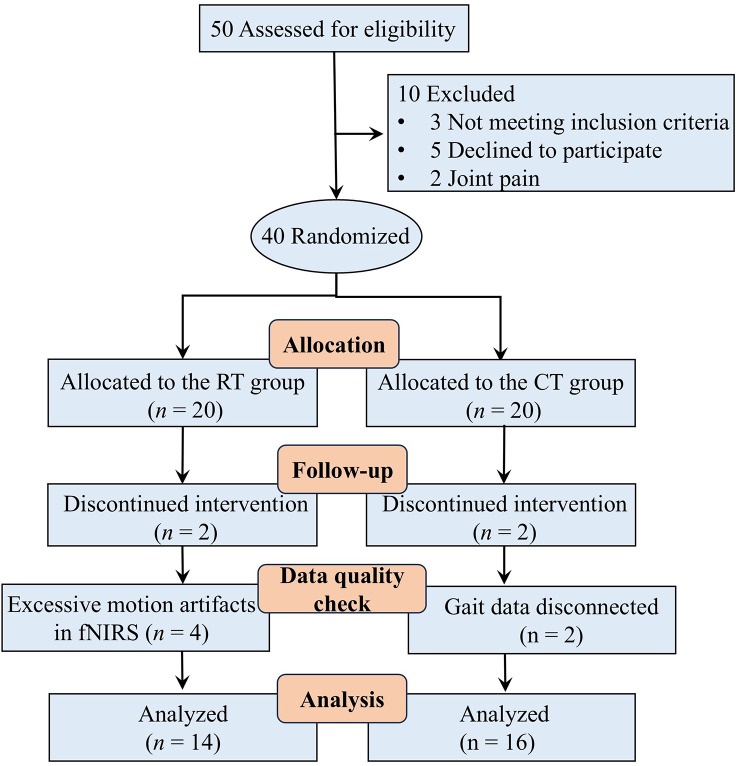
In this randomized, single-blind clinical trial, 40 patients with subacute stroke were recruited and randomly assigned to either a robot-assisted training (RT) group or a conventional training (CT) group. All outcome measures were assessed at the enrollment baseline (T0), 2nd week (T1) and 4th week (T2) of the treatment. The primary outcome was the between-group difference in the change in the Berg balance scale (BBS) score from baseline to T2. The secondary measures included longitudinal changes in the Fugl-Meyer assessment of the lower limb (FMA-LE), modified Barthel index (mBI), functional ambulation category (FAC), and locomotion assessment with gait analysis. In addition, the cortical activation pattern related to robot-assisted training was measured before and after intervention via functional near-infrared spectroscopy.
A total of 30 patients with complete data were included in this study. Clinical outcomes improved after 4 weeks of training in both groups, with significantly better BBS (F = 6.341, p = 0.018, partial η2 = 0.185), FMA-LE (F = 5.979, p = 0.021, partial η2 = 0.176), FAC (F = 7.692, p = 0.010, partial η2 = 0.216), and mBI scores (F = 7.255, p = 0.042, partial η2 = 0.140) in the RT group than in the CT group. Both groups showed significant improvement in gait speed and stride cadence on the locomotion assessment. Only the RT group presented a significantly increased stride length (F = 4.913, p = 0.015, partial η2 = 0.267), support phase (F = 5.335, p = 0.011, partial η2 = 0.283), and toe-off angle (F = 3.829, p = 0.035, partial η2 = 0.228) on the affected side after the intervention. The RT group also showed increased neural activity response over the ipsilesional motor area and bilateral prefrontal cortex during robot-assisted weight-shift and gait training following 4 weeks of treatment.
Overground gait training with a unilateral exoskeleton robot showed improvements in balance and gait functions, resulting in better gait patterns and increased gait stability for stroke patients. The increased cortical response related to the ipsilesional motor areas and their related functional network is crucial in the rehabilitation of lower limb gait in post-stroke patients.
中风幸存者的平衡和步态受损与功能独立性下降有关。本研究旨在评估单侧下肢外骨骼机器人辅助地面步态训练与传统治疗相比的有效性,并探讨亚急性中风患者神经可塑性变化与运动功能恢复之间的关系。
在这项随机、单盲临床试验中,招募了40例亚急性中风患者,并将其随机分为机器人辅助训练(RT)组或传统训练(CT)组。在治疗的入组基线(T0)、第2周(T1)和第4周(T2)评估所有结局指标。主要结局是从基线到T2时Berg平衡量表(BBS)评分变化的组间差异。次要指标包括下肢Fugl-Meyer评估(FMA-LE)、改良Barthel指数(mBI)、功能步行分类(FAC)以及步态分析的运动评估的纵向变化。此外,通过功能近红外光谱在干预前后测量与机器人辅助训练相关的皮质激活模式。
本研究共纳入30例有完整数据的患者。两组经过4周训练后临床结局均有改善,RT组的BBS(F = 6.341,p = 0.018,偏η2 = 0.185)、FMA-LE(F = 5.979,p = 0.021,偏η2 = 0.176)、FAC(F = 7.692,p = 0.010,偏η2 = 0.216)和mBI评分(F = 7.255,p = 0.042,偏η2 = 0.140)均显著优于CT组。两组在运动评估中的步态速度和步频均有显著改善。干预后,仅RT组患侧的步长(F = 4.913,p = 0.015,偏η2 = 0.267)、支撑期(F = 5.335,p = 0.011,偏η2 = 0.283)和离地角度(F = 3.829,p = 0.035,偏η2 = 0.228)显著增加。治疗4周后,RT组在机器人辅助的体重转移和步态训练期间,同侧运动区和双侧前额叶皮质的神经活动反应也增加。
使用单侧外骨骼机器人进行地面步态训练可改善中风患者的平衡和步态功能,从而产生更好的步态模式并提高步态稳定性。与同侧运动区及其相关功能网络相关的皮质反应增加在中风后患者下肢步态康复中至关重要。