Nekoui Mahdiar, Seyed Bolouri Seyed Ehsan, Forouzandeh Amir, Dehghan Masood, Zonoobi Dornoosh, Jaremko Jacob L, Buchanan Brian, Nagdev Arun, Kapur Jeevesh
Exo Imaging, Santa Clara, CA 95054, USA.
Department of Radiology & Diagnostic Imaging, University of Alberta, Edmonton, AB T6G 2R3, Canada.
Diagnostics (Basel). 2024 Nov 12;14(22):2526. doi: 10.3390/diagnostics14222526.
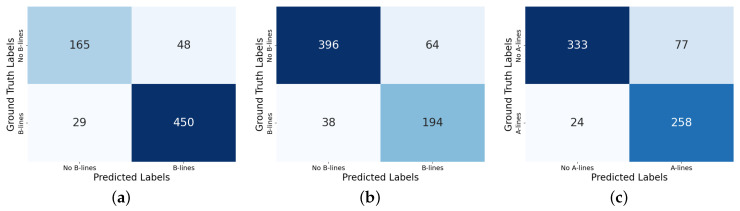
A-lines and B-lines are key ultrasound markers that differentiate normal from abnormal lung conditions. A-lines are horizontal lines usually seen in normal aerated lungs, while B-lines are linear vertical artifacts associated with lung abnormalities such as pulmonary edema, infection, and COVID-19, where a higher number of B-lines indicates more severe pathology. This paper aimed to evaluate the effectiveness of a newly released lung ultrasound AI tool (ExoLungAI) in the detection of A-lines and quantification/detection of B-lines to help clinicians in assessing pulmonary conditions. : The algorithm is evaluated on 692 lung ultrasound scans collected from 48 patients (65% males, aged: 55 ± 12.9) following their admission to an Intensive Care Unit (ICU) for COVID-19 symptoms, including respiratory failure, pneumonia, and other complications. : ExoLungAI achieved a sensitivity of 91% and specificity of 81% for A-line detection. For B-line detection, it attained a sensitivity of 84% and specificity of 86%. In quantifying B-lines, the algorithm achieved a weighted kappa score of 0.77 (95% CI 0.74 to 0.80) and an ICC of 0.87 (95% CI 0.85 to 0.89), showing substantial agreement between the ground truth and predicted B-line counts. : ExoLungAI demonstrates a reliable performance in A-line detection and B-line detection/quantification. This automated tool has greater objectivity, consistency, and efficiency compared to manual methods. Many healthcare professionals including intensivists, radiologists, sonographers, medical trainers, and nurse practitioners can benefit from such a tool, as it assists the diagnostic capabilities of lung ultrasound and delivers rapid responses.
A线和B线是区分正常与异常肺部状况的关键超声标志物。A线是通常在正常充气肺中可见的水平线,而B线是与肺部异常(如肺水肿、感染和新冠肺炎)相关的线性垂直伪像,B线数量越多表明病理情况越严重。本文旨在评估新发布的肺部超声人工智能工具(ExoLungAI)在检测A线以及定量/检测B线方面的有效性,以帮助临床医生评估肺部状况。该算法在从48名患者(65%为男性,年龄:55±12.9岁)收集的692份肺部超声扫描图像上进行评估,这些患者因新冠肺炎症状(包括呼吸衰竭、肺炎和其他并发症)入住重症监护病房(ICU)。ExoLungAI在A线检测方面的灵敏度为91%,特异性为81%。在B线检测方面,其灵敏度为84%,特异性为86%。在定量B线时,该算法的加权kappa评分为0.77(95%置信区间0.74至0.80),组内相关系数为0.87(95%置信区间0.85至0.89),表明真实情况与预测的B线数量之间具有高度一致性。ExoLungAI在A线检测以及B线检测/定量方面表现出可靠的性能。与手动方法相比,这种自动化工具具有更高的客观性、一致性和效率。许多医疗保健专业人员,包括重症监护医生、放射科医生、超声检查技师、医学培训师和执业护士,都可以从这样一种工具中受益,因为它有助于提高肺部超声的诊断能力并能快速给出结果。