Basic Medical Sciences Department, College of Medicine, Ajman University, Ajman 346, United Arab Emirates.
Centre of Medical and Bio-Allied Health Sciences Research, Ajman University, Ajman 346, United Arab Emirates.
Cells. 2024 Nov 7;13(22):1846. doi: 10.3390/cells13221846.
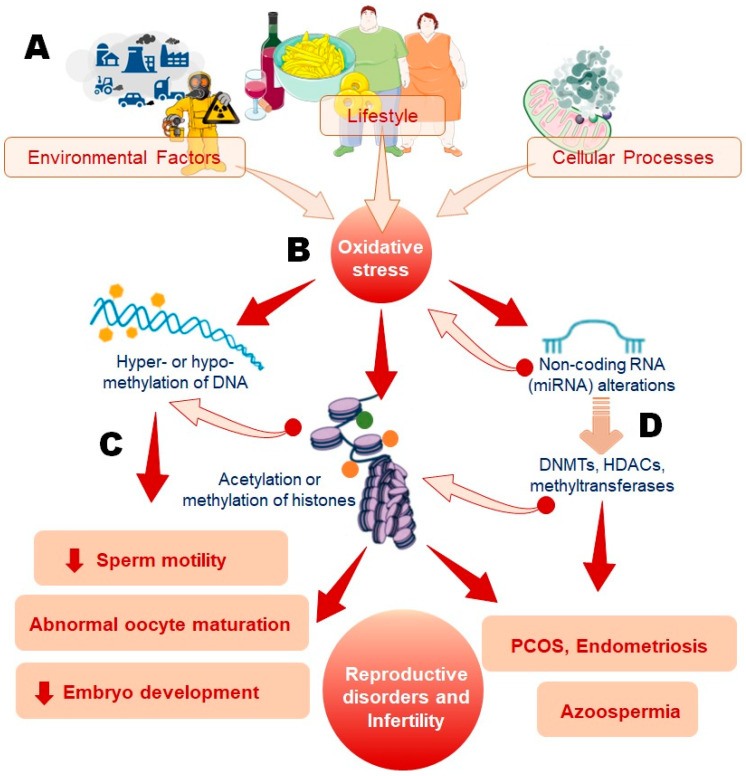
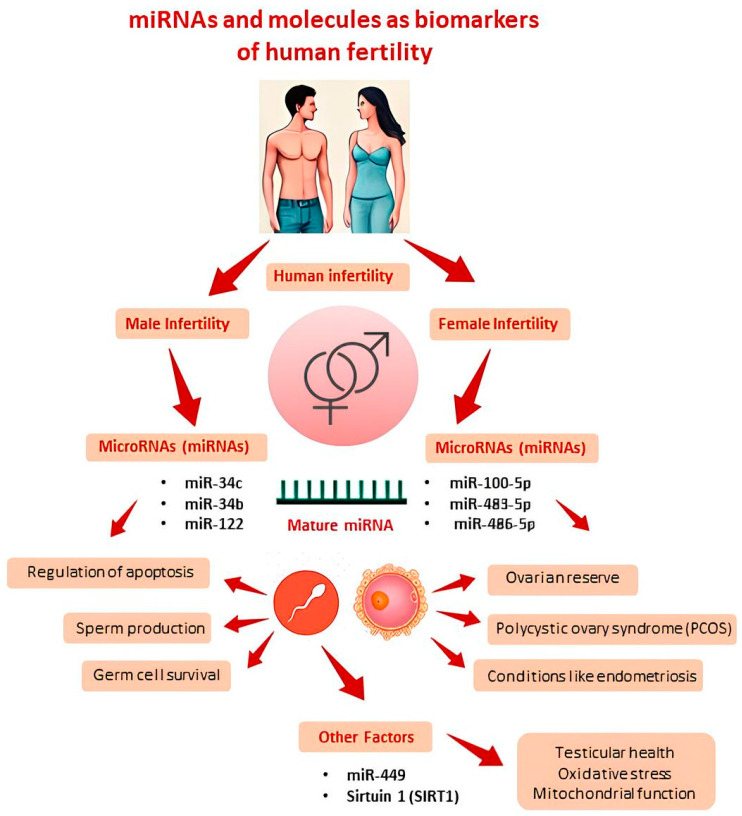
The correlation between epigenetic alterations and the pathophysiology of human infertility is progressively being elucidated with the discovery of an increasing number of target genes that exhibit altered expression patterns linked to reproductive abnormalities. Several genes and molecules are emerging as important for the future management of human infertility. In men, microRNAs (miRNAs) like miR-34c, miR-34b, and miR-122 regulate apoptosis, sperm production, and germ cell survival, while other factors, such as miR-449 and sirtuin 1 (SIRT1), influence testicular health, oxidative stress, and mitochondrial function. In women, miR-100-5p, miR-483-5p, and miR-486-5p are linked to ovarian reserve, PCOS, and conditions like endometriosis. Mechanisms such as DNA methylation, histone modification, chromatin restructuring, and the influence of these non-coding RNA (ncRNA) molecules have been identified as potential perturbators of normal spermatogenesis and oogenesis processes. In fact, alteration of these key regulators of epigenetic processes can lead to reproductive disorders such as defective spermatogenesis, failure of oocyte maturation and embryonic development alteration. One of the primary factors contributing to changes in the key epigenetic regulators appear to be oxidative stress, which arises from environmental exposure to toxic substances or unhealthy lifestyle choices. This evidence-based study, retracing the major epigenetic processes, aims to identify and discuss the main epigenetic biomarkers of male and female fertility associated with an oxidative imbalance, providing future perspectives in the diagnosis and management of infertile couples.
随着越来越多的靶基因的发现,其表达模式与生殖异常相关联,表观遗传改变与人类不育症的病理生理学之间的相关性逐渐得到阐明。一些基因和分子被认为对未来人类不育症的治疗具有重要意义。在男性中,miRNA(miR-34c、miR-34b 和 miR-122)等 microRNAs 调节细胞凋亡、精子发生和生殖细胞存活,而其他因素,如 miR-449 和 SIRT1(sirtuin 1),影响睾丸健康、氧化应激和线粒体功能。在女性中,miR-100-5p、miR-483-5p 和 miR-486-5p 与卵巢储备、PCOS 和子宫内膜异位症等情况有关。DNA 甲基化、组蛋白修饰、染色质重塑和这些非编码 RNA(ncRNA)分子的影响等机制已被确定为正常精子发生和卵子发生过程的潜在干扰因素。事实上,这些表观遗传过程关键调节剂的改变可能导致生殖障碍,如精子发生缺陷、卵母细胞成熟失败和胚胎发育改变。导致关键表观遗传调节剂变化的一个主要因素似乎是氧化应激,它是由环境暴露于有毒物质或不健康的生活方式选择引起的。这项基于证据的研究追溯了主要的表观遗传过程,旨在确定和讨论与氧化失衡相关的男性和女性生育的主要表观遗传生物标志物,为不孕夫妇的诊断和管理提供未来的展望。