• 文献检索
  • 文档翻译
  • 深度研究
  • 学术资讯
  • Suppr Zotero 插件Zotero 插件
  • 邀请有礼
  • 套餐&价格
  • 历史记录
应用&插件
Suppr Zotero 插件Zotero 插件浏览器插件Mac 客户端Windows 客户端微信小程序
定价
高级版会员购买积分包购买API积分包
服务
文献检索文档翻译深度研究API 文档MCP 服务
关于我们
关于 Suppr公司介绍联系我们用户协议隐私条款
关注我们

Suppr 超能文献

核心技术专利:CN118964589B侵权必究
粤ICP备2023148730 号-1Suppr @ 2026

文献检索

告别复杂PubMed语法,用中文像聊天一样搜索,搜遍4000万医学文献。AI智能推荐,让科研检索更轻松。

立即免费搜索

文件翻译

保留排版,准确专业,支持PDF/Word/PPT等文件格式,支持 12+语言互译。

免费翻译文档

深度研究

AI帮你快速写综述,25分钟生成高质量综述,智能提取关键信息,辅助科研写作。

立即免费体验

身体活动、神经可持续性和脑健康的环境可供性:通过达到代谢当量(METs)来量化建成环境维持脑源性神经营养因子(BDNF)释放的能力。

Environmental Affordance for Physical Activity, Neurosustainability, and Brain Health: Quantifying the Built Environment's Ability to Sustain BDNF Release by Reaching Metabolic Equivalents (METs).

作者信息

Khalil Mohamed Hesham

机构信息

Department of Architecture, University of Cambridge, Cambridge CB2 1PX, UK.

出版信息

Brain Sci. 2024 Nov 10;14(11):1133. doi: 10.3390/brainsci14111133.

DOI:10.3390/brainsci14111133
PMID:39595896
原文链接:https://pmc.ncbi.nlm.nih.gov/articles/PMC11592236/
Abstract

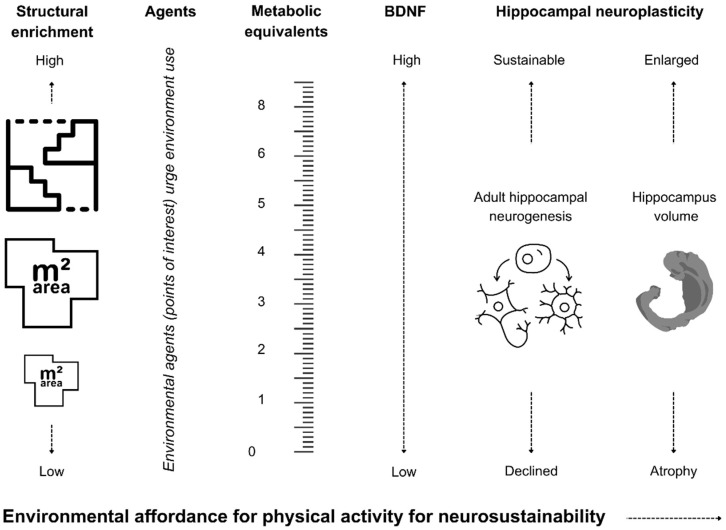
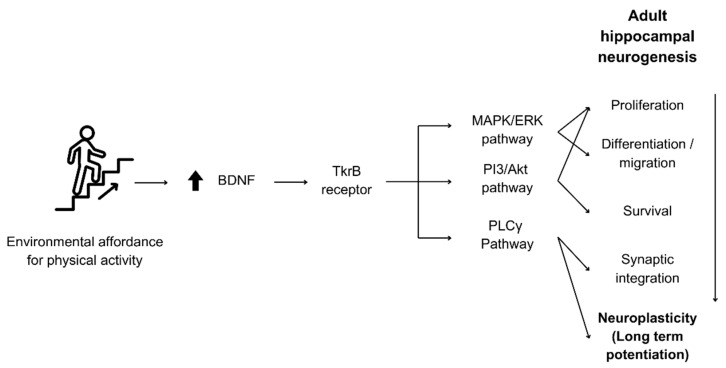
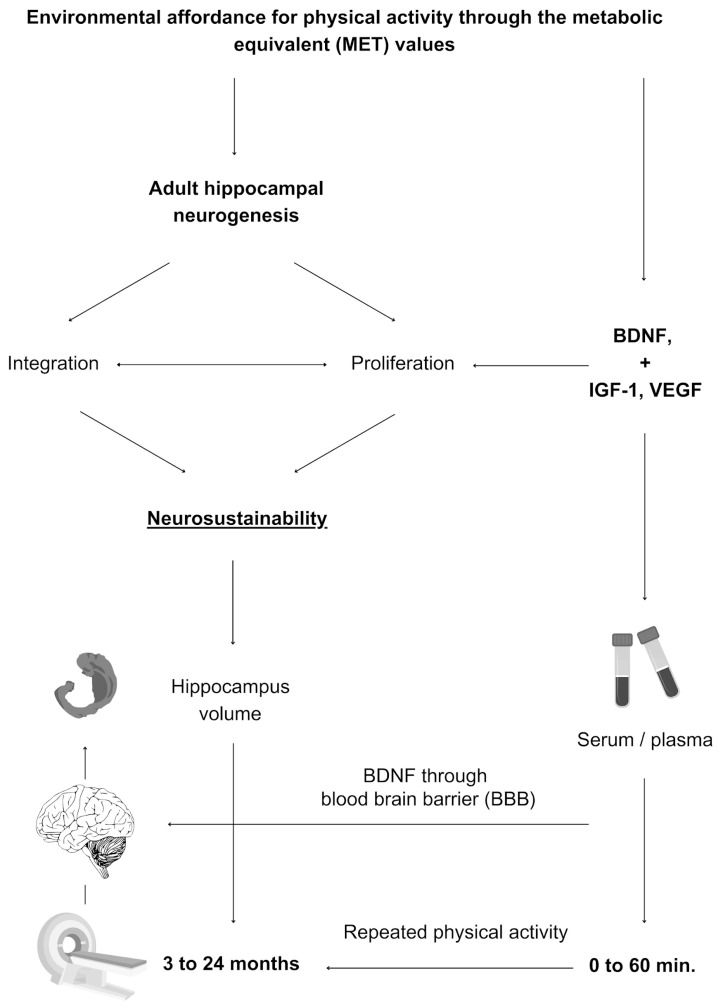
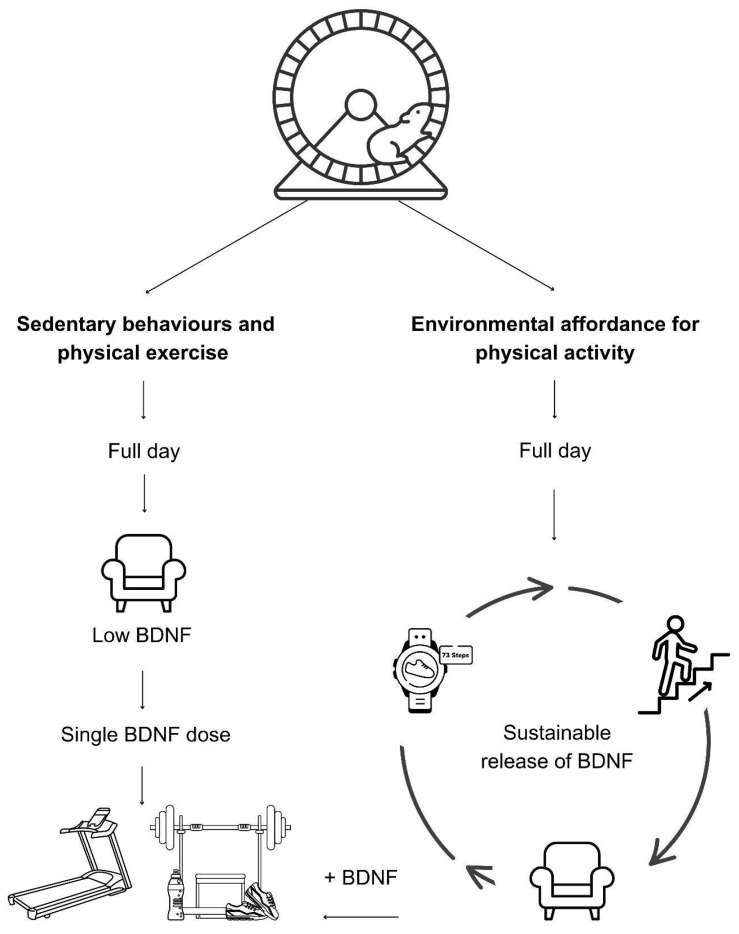
Unlike enriched environments for rodents, human-built environments often hinder neuroplasticity through sedentary lifestyles, to which exercise can merely overcome its adverse effects. This paper introduces "environmental affordance for physical activity" to quantify the potential of spatial layout designs to stimulate activity and sustain neuroplasticity, mainly hippocampal neurogenesis. A novel framework links metabolic equivalents (METs) that can be afforded by the spatial layout of the built environment to its role in increasing the brain-derived neurotrophic factor (BDNF)-a biomarker that promotes and sustains adult hippocampal neurogenesis and synaptic plasticity. Equations are developed to assess the built environment's affordance for physical activity through BDNF changes measurable after brief exposure to the built environment for 20-35 min. The developed equations are evidenced to be feasible to cause BDNF release through low- to moderate-intensity physical activity. This model provides a feasible assessment tool to test the built environment's effectiveness towards neurosustainability. By sustaining neurogenesis, the environmental affordance for physical activity holds promise for improving mental health and preventing cognitive decline.

摘要

与啮齿动物的丰富环境不同,人类建造的环境往往通过久坐不动的生活方式阻碍神经可塑性,而运动只能克服其不利影响。本文引入“身体活动的环境可供性”来量化空间布局设计刺激活动和维持神经可塑性(主要是海马体神经发生)的潜力。一个新的框架将建筑环境的空间布局所能提供的代谢当量(METs)与其在增加脑源性神经营养因子(BDNF)方面的作用联系起来,BDNF是一种促进和维持成年海马体神经发生及突触可塑性的生物标志物。通过短暂暴露于建筑环境20 - 35分钟后可测量的BDNF变化,建立了评估建筑环境对身体活动可供性的方程。所建立的方程被证明通过低至中等强度的身体活动来引起BDNF释放是可行的。该模型提供了一个可行的评估工具,以测试建筑环境对神经可持续性的有效性。通过维持神经发生,身体活动的环境可供性有望改善心理健康并预防认知衰退。
https://cdn.ncbi.nlm.nih.gov/pmc/blobs/b597/11592236/c2d7f1cf9c93/brainsci-14-01133-g005.jpg
https://cdn.ncbi.nlm.nih.gov/pmc/blobs/b597/11592236/017742457583/brainsci-14-01133-g001.jpg
https://cdn.ncbi.nlm.nih.gov/pmc/blobs/b597/11592236/85c21aa3e34f/brainsci-14-01133-g002.jpg
https://cdn.ncbi.nlm.nih.gov/pmc/blobs/b597/11592236/be763ef95ca8/brainsci-14-01133-g003.jpg
https://cdn.ncbi.nlm.nih.gov/pmc/blobs/b597/11592236/b86fe801a15a/brainsci-14-01133-g004.jpg
https://cdn.ncbi.nlm.nih.gov/pmc/blobs/b597/11592236/c2d7f1cf9c93/brainsci-14-01133-g005.jpg
https://cdn.ncbi.nlm.nih.gov/pmc/blobs/b597/11592236/017742457583/brainsci-14-01133-g001.jpg
https://cdn.ncbi.nlm.nih.gov/pmc/blobs/b597/11592236/85c21aa3e34f/brainsci-14-01133-g002.jpg
https://cdn.ncbi.nlm.nih.gov/pmc/blobs/b597/11592236/be763ef95ca8/brainsci-14-01133-g003.jpg
https://cdn.ncbi.nlm.nih.gov/pmc/blobs/b597/11592236/b86fe801a15a/brainsci-14-01133-g004.jpg
https://cdn.ncbi.nlm.nih.gov/pmc/blobs/b597/11592236/c2d7f1cf9c93/brainsci-14-01133-g005.jpg

相似文献

1
Environmental Affordance for Physical Activity, Neurosustainability, and Brain Health: Quantifying the Built Environment's Ability to Sustain BDNF Release by Reaching Metabolic Equivalents (METs).身体活动、神经可持续性和脑健康的环境可供性:通过达到代谢当量(METs)来量化建成环境维持脑源性神经营养因子(BDNF)释放的能力。
Brain Sci. 2024 Nov 10;14(11):1133. doi: 10.3390/brainsci14111133.
2
The Impact of Walking on BDNF as a Biomarker of Neuroplasticity: A Systematic Review.步行对作为神经可塑性生物标志物的脑源性神经营养因子的影响:一项系统评价。
Brain Sci. 2025 Feb 27;15(3):254. doi: 10.3390/brainsci15030254.
3
The BDNF-Interactive Model for Sustainable Hippocampal Neurogenesis in Humans: Synergistic Effects of Environmentally-Mediated Physical Activity, Cognitive Stimulation, and Mindfulness.人类海马体可持续神经发生的BDNF交互模型:环境介导的体育活动、认知刺激和正念的协同作用。
Int J Mol Sci. 2024 Dec 1;25(23):12924. doi: 10.3390/ijms252312924.
4
Neurosustainability.神经可持续性
Front Hum Neurosci. 2024 Aug 29;18:1436179. doi: 10.3389/fnhum.2024.1436179. eCollection 2024.
5
Environmental enrichment: a systematic review on the effect of a changing spatial complexity on hippocampal neurogenesis and plasticity in rodents, with considerations for translation to urban and built environments for humans.环境丰富化:关于空间复杂性变化对啮齿动物海马体神经发生和可塑性影响的系统综述,并考虑向人类城市和建筑环境转化的相关因素。
Front Neurosci. 2024 Jun 11;18:1368411. doi: 10.3389/fnins.2024.1368411. eCollection 2024.
6
Housing Environmental Enrichment, Lifestyles, and Public Health Indicators of Neurogenesis in Humans: A Pilot Study.人类神经发生的住房环境丰富化、生活方式及公共卫生指标:一项初步研究
Int J Environ Res Public Health. 2024 Nov 25;21(12):1553. doi: 10.3390/ijerph21121553.
7
The relationship of the built and food environments with the metabolic syndrome in the Athens metropolitan area: a sex-stratified spatial analysis in the context of the ATTICA epidemiological study.雅典大都市区建成环境与食物环境与代谢综合征的关系:阿提卡流行病学研究背景下的性别分层空间分析
Hormones (Athens). 2021 Dec;20(4):723-734. doi: 10.1007/s42000-021-00293-3. Epub 2021 Apr 16.
8
Architecturally Mediated Allostasis and Neurosustainability: A Proposed Theoretical Framework for the Impact of the Built Environment on Neurocognitive Health.建筑介导的异稳态与神经可持续性:关于建筑环境对神经认知健康影响的一个理论框架
Brain Sci. 2025 Feb 15;15(2):201. doi: 10.3390/brainsci15020201.
9
The built environment and child obesity: A review of Australian policies.建筑环境与儿童肥胖:澳大利亚政策述评。
Obes Rev. 2024 Jan;25(1):e13650. doi: 10.1111/obr.13650. Epub 2023 Oct 7.
10
[Changes in structural and functional plasticity of the brain induced by environmental enrichment].[环境富集诱导的大脑结构和功能可塑性变化]
Vestn Ross Akad Med Nauk. 2013(6):39-48. doi: 10.15690/vramn.v68i6.672.

引用本文的文献

1
Urban physical activity for neurogenesis: infrastructure limitations.城市促进神经发生的体育活动:基础设施限制
Front Public Health. 2025 Aug 18;13:1638934. doi: 10.3389/fpubh.2025.1638934. eCollection 2025.
2
The Impact of Walking on BDNF as a Biomarker of Neuroplasticity: A Systematic Review.步行对作为神经可塑性生物标志物的脑源性神经营养因子的影响:一项系统评价。
Brain Sci. 2025 Feb 27;15(3):254. doi: 10.3390/brainsci15030254.
3
Architecturally Mediated Allostasis and Neurosustainability: A Proposed Theoretical Framework for the Impact of the Built Environment on Neurocognitive Health.
建筑介导的异稳态与神经可持续性:关于建筑环境对神经认知健康影响的一个理论框架
Brain Sci. 2025 Feb 15;15(2):201. doi: 10.3390/brainsci15020201.
4
Walking and Hippocampal Formation Volume Changes: A Systematic Review.步行与海马结构体积变化:一项系统综述
Brain Sci. 2025 Jan 8;15(1):52. doi: 10.3390/brainsci15010052.
5
Borderline in a linear city: Urban living brings borderline personality disorder to crisis through neuroplasticity-an urgent call to action.线性城市中的边缘状态:城市生活通过神经可塑性使边缘型人格障碍陷入危机——紧急行动呼吁。
Front Psychiatry. 2025 Jan 6;15:1524531. doi: 10.3389/fpsyt.2024.1524531. eCollection 2024.
6
Housing Environmental Enrichment, Lifestyles, and Public Health Indicators of Neurogenesis in Humans: A Pilot Study.人类神经发生的住房环境丰富化、生活方式及公共卫生指标:一项初步研究
Int J Environ Res Public Health. 2024 Nov 25;21(12):1553. doi: 10.3390/ijerph21121553.
7
The BDNF-Interactive Model for Sustainable Hippocampal Neurogenesis in Humans: Synergistic Effects of Environmentally-Mediated Physical Activity, Cognitive Stimulation, and Mindfulness.人类海马体可持续神经发生的BDNF交互模型:环境介导的体育活动、认知刺激和正念的协同作用。
Int J Mol Sci. 2024 Dec 1;25(23):12924. doi: 10.3390/ijms252312924.