Section of Pathology, Department of Human Pathology in Adult and Developmental Age "Gaetano Barresi", University of Messina, 98125 Messina, Italy.
Section of Gynecology and Obstetrics, Department of Human Pathology in Adult and Developmental Age "Gaetano Barresi", University of Messina, 98125 Messina, Italy.
Int J Mol Sci. 2024 Nov 12;25(22):12118. doi: 10.3390/ijms252212118.
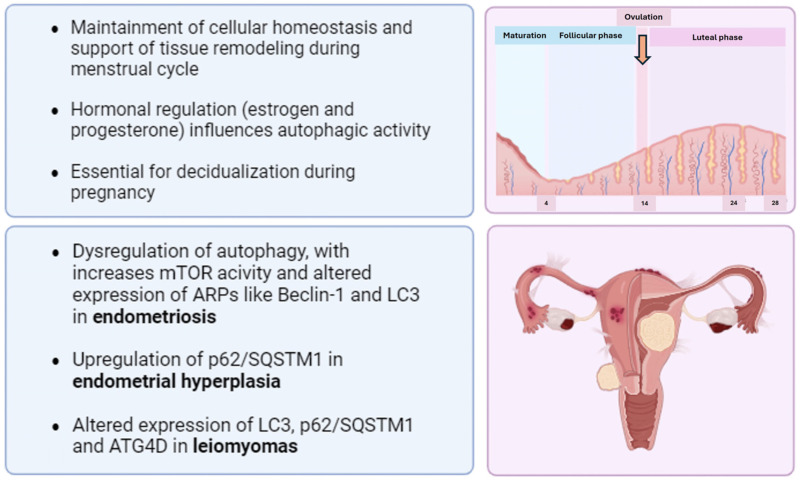
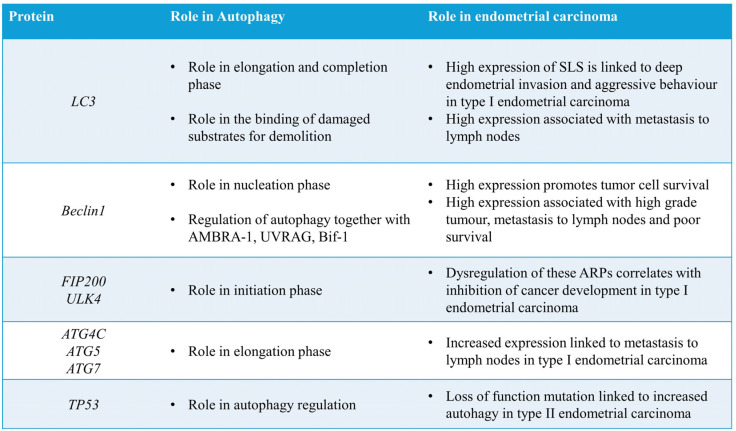
Autophagy is a cellular process crucial for maintaining homeostasis by degrading damaged proteins and organelles. It is stimulated in response to stress, recycling nutrients and generating energy for cell survival. In normal endometrium, it suppresses tumorigenesis by preventing toxic accumulation and maintaining cellular homeostasis. It is involved in the cyclic remodelling of the endometrium during the menstrual cycle and contributes to decidualisation for successful pregnancy. Such a process is regulated by various signalling pathways, including PI3K/AKT/mTOR, AMPK/mTOR, and p53. Dysregulation of autophagy has been associated with benign conditions like endometriosis and endometrial hyperplasia but also with malignant neoplasms such as endometrial carcinoma. In fact, it has emerged as a crucial player in endometrial carcinoma biology, exhibiting a dual role in both tumour suppression and tumour promotion, providing nutrients during metabolic stress and allowing cancer cell survival. It also regulates cancer stem cells, metastasis and therapy resistance. Targeting autophagy is therefore a promising therapeutic strategy in endometrial carcinoma and potential for overcoming resistance to standard treatments. The aim of this review is to delve into the intricate details of autophagy's role in endometrial pathology, exploring its mechanisms, signalling pathways and potential therapeutic implications.
自噬是一种细胞过程,通过降解受损的蛋白质和细胞器来维持细胞内的平衡。它会在受到压力时被刺激,回收营养物质并为细胞生存生成能量。在正常的子宫内膜中,它通过防止有毒物质积累和维持细胞内平衡来抑制肿瘤的发生。它参与了月经周期中子宫内膜的周期性重塑,并有助于蜕膜化以实现成功的妊娠。这个过程受到多种信号通路的调节,包括 PI3K/AKT/mTOR、AMPK/mTOR 和 p53。自噬的失调与良性疾病如子宫内膜异位症和子宫内膜增生有关,但也与恶性肿瘤如子宫内膜癌有关。事实上,它已成为子宫内膜癌生物学中的一个关键参与者,在肿瘤抑制和肿瘤促进中发挥双重作用,在代谢应激期间提供营养物质并允许癌细胞存活。它还调节癌症干细胞、转移和治疗耐药性。因此,靶向自噬是治疗子宫内膜癌的一种有前途的治疗策略,并有可能克服对标准治疗的耐药性。本综述的目的是深入探讨自噬在子宫内膜病理学中的作用的复杂细节,探讨其机制、信号通路和潜在的治疗意义。