Department of Southern Area Crop Science, National Institute of Crop Science, Rural Development Administration, Milyang 50424, Republic of Korea.
Int J Mol Sci. 2024 Nov 12;25(22):12119. doi: 10.3390/ijms252212119.
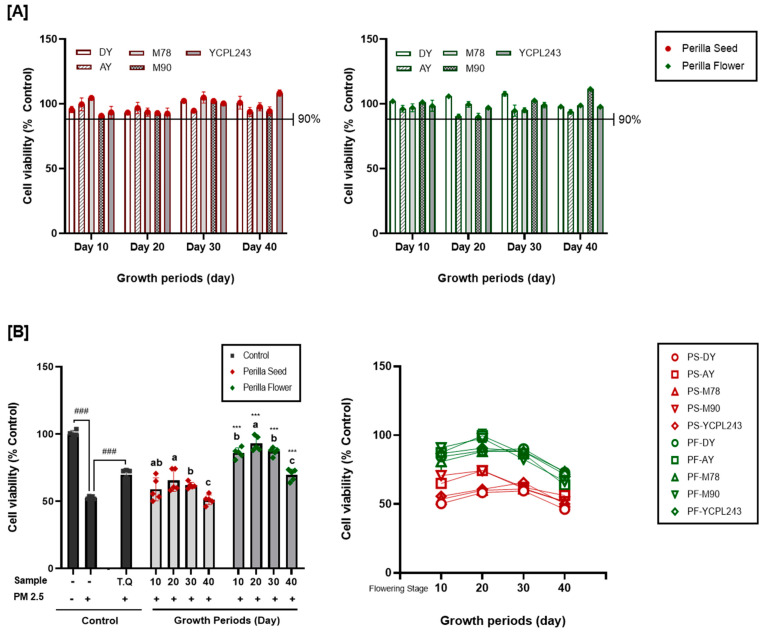
Fine particulate matter (PM2.5) exposure worsens chronic respiratory diseases through oxidative stress and inflammation. (L.) has potential respiratory protective properties, but the impact of growth stages on its beneficial metabolites is unclear. We aimed to evaluate how different growth stages affect phenolic acids, flavonoids, and polycosanols in perilla seeds and flowers and their efficacy in countering PM2.5-induced damage. Perilla seeds and flowers from five varieties at 10, 20, 30, and 40 days post-flowering were analyzed for metabolite content. Their antioxidant, anti-inflammatory, and respiratory protective effects were tested in RPMI 2650 cells. Our findings indicated that perilla flowers contained higher levels of functional components than seeds and exhibited significant variation with maturation. Phenolic acids of perilla flowers were highest at the early stages of maturation after flowering. However, individual flavones of perilla flowers were the highest at the late maturation stages after flowering. Extracts from perilla flowers harvested 20 days after flowering exhibited significant respiratory protection, effectively inhibiting inflammatory cytokines, mucus secretion, and oxidative stress markers. In conclusion, the flower parts of perilla, particularly those harvested 20 days after flowering, are useful materials for obtaining phenolic compounds, including rosmarinic acid, with high antioxidant and respiratory enhancement effects.
细颗粒物(PM2.5)暴露通过氧化应激和炎症使慢性呼吸道疾病恶化。(L.)具有潜在的呼吸道保护特性,但不同生长阶段对其有益代谢物的影响尚不清楚。我们旨在评估不同生长阶段如何影响紫苏种子和花中的酚酸、类黄酮和多糖醇,并评估其对抗 PM2.5 诱导损伤的功效。分析了来自五个品种的紫苏种子和花在开花后 10、20、30 和 40 天的代谢物含量。在 RPMI 2650 细胞中测试了它们的抗氧化、抗炎和呼吸道保护作用。我们的研究结果表明,紫苏花比种子含有更高水平的功能成分,并且随着成熟而表现出显著的变化。紫苏花中的酚酸在开花后早期成熟阶段含量最高。然而,紫苏花中的个别类黄酮在开花后晚期成熟阶段含量最高。开花后 20 天收获的紫苏花提取物表现出显著的呼吸道保护作用,有效抑制炎症细胞因子、粘液分泌和氧化应激标志物。总之,紫苏的花部分,特别是那些在开花后 20 天收获的部分,是获得具有高抗氧化和呼吸增强作用的酚酸化合物(包括迷迭香酸)的有用材料。