Kim Min Young, Kim Jung In, Kim Sang Woo, Kim Sungup, Oh Eunyoung, Lee Jeongeun, Lee Eunsoo, An Yeon Ju, Han Chae-Yeon, Lee Heungsu, Lee Myoung Hee
Department of Southern Area Crop Science National Institute of Crop Science, Rural Development Administration Milyang Korea.
Food Sci Nutr. 2024 Dec 22;13(1):e4708. doi: 10.1002/fsn3.4708. eCollection 2025 Jan.
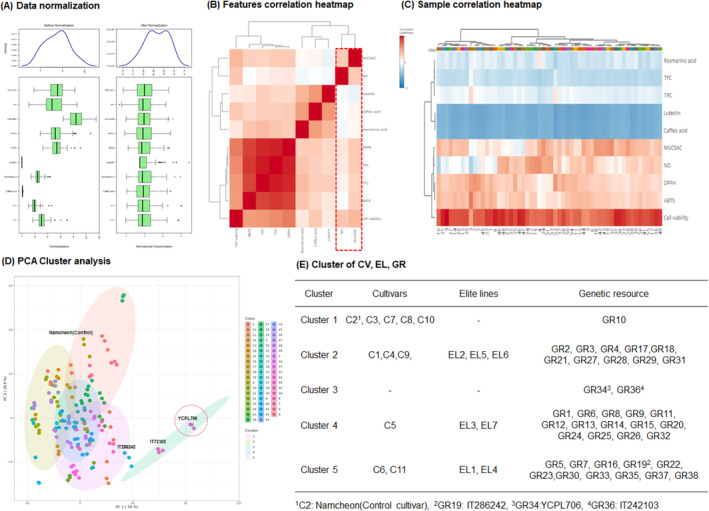
Fine particulate matter (PM2.5) is known to exacerbate chronic respiratory disorders, primarily by inducing inflammatory responses and mucus overproduction. Perilla leaves are reported to have significant health benefits, such as antioxidant, antibacterial, and antiallergic properties, attributed to phenolic compounds that vary depending on genetic diversity. In this study, flavonoid-rich extracts (FRE) from 56 perilla leaf varieties and genetic resources were prepared and screened using a mass screening system. The screening focused on evaluating their anti-inflammatory, mucus-reducing, and respiratory protective effects against PM2.5-induced damage in human nasal cells (RPMI2650). Parameters such as cell viability, nitric oxide (NO) levels, and mucus secretion factor (MUC5AC) concentrations were assessed. Among the 56 varieties, (YCPL706), sourced from Ulleung Island, Korea, exhibited the highest cell viability (112.50%, 100 μg/mL), lowest NO concentration (9.98 μM, 100 μg/mL), and MUC5AC level (78.65 ng/mL, 100 μg/mL). Further evaluation of YCPL706 FRE demonstrated significant respiratory protective effects, including the inhibition of pro-inflammatory cytokines (TNF-α, IL-6, and IL-1β), MUC5AC, and oxidative stress factors (MDA and ROS), compared to the control cultivar Namcheon. YCPL706 also showed strong antibacterial activity against (minimum inhibitory concentration: 5 mg/mL). These findings suggest that the genetic resource YCPL706 is a promising candidate for combating PM2.5-induced respiratory damage due to its potent anti-inflammatory, antioxidant, and antibacterial properties.
众所周知,细颗粒物(PM2.5)主要通过引发炎症反应和黏液过度分泌来加剧慢性呼吸系统疾病。据报道,紫苏叶具有显著的健康益处,如抗氧化、抗菌和抗过敏特性,这归因于因遗传多样性而有所不同的酚类化合物。在本研究中,制备了来自56个紫苏叶品种和遗传资源的富含黄酮类化合物的提取物(FRE),并使用大规模筛选系统进行筛选。筛选重点是评估它们对人鼻细胞(RPMI2650)中PM2.5诱导损伤的抗炎、减少黏液和呼吸保护作用。评估了细胞活力、一氧化氮(NO)水平和黏液分泌因子(MUC5AC)浓度等参数。在这56个品种中,来自韩国郁陵岛的(YCPL706)表现出最高的细胞活力(112.50%,100μg/mL)、最低的NO浓度(9.98μM,100μg/mL)和MUC5AC水平(78.65ng/mL,100μg/mL)。与对照品种南川相比,对YCPL706 FRE的进一步评估显示出显著的呼吸保护作用,包括抑制促炎细胞因子(TNF-α、IL-6和IL-1β)、MUC5AC和氧化应激因子(MDA和ROS)。YCPL706对(最低抑菌浓度:5mg/mL)也表现出较强的抗菌活性。这些发现表明,遗传资源YCPL706因其强大的抗炎、抗氧化和抗菌特性,是对抗PM2.5诱导的呼吸损伤的有前途的候选者。