Scientific Institute for Research, Hospitalization and Healthcare, IRCCS Istituto Romagnolo per lo Studio dei Tumori (IRST) "Dino Amadori", 40121 Meldola, Italy.
Centro Trial Oncoematologico, Department of "Onco-Ematologia e Terapia Cellulare e Genica Bambino" Gesù Children's Hospital, IRCCS, 00165 Rome, Italy.
Int J Mol Sci. 2024 Nov 13;25(22):12201. doi: 10.3390/ijms252212201.
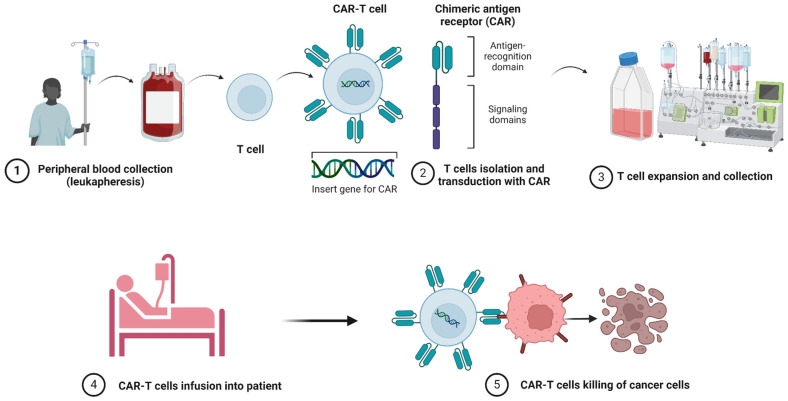
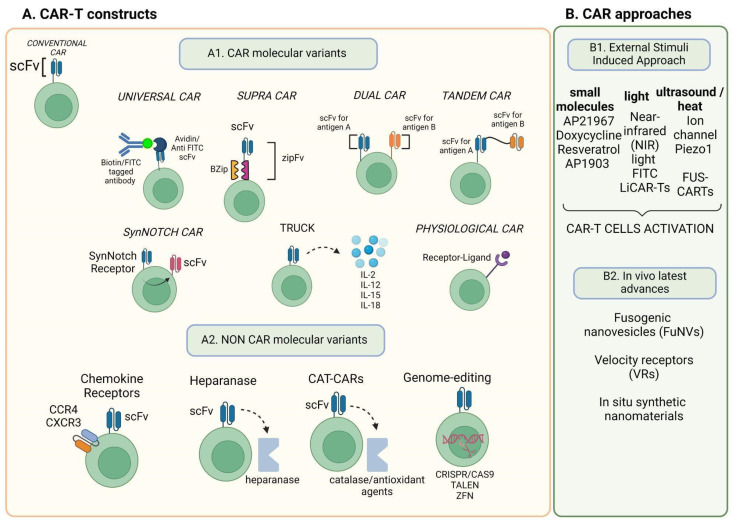
Recent times have witnessed remarkable progress in cancer immunotherapy, drastically changing the cancer treatment landscape. Among the various immunotherapeutic approaches, adoptive cell therapy (ACT), particularly chimeric antigen receptor (CAR) T cell therapy, has emerged as a promising strategy to tackle cancer. CAR-T cells are genetically engineered T cells with synthetic receptors capable of recognising and targeting tumour-specific or tumour-associated antigens. By leveraging the intrinsic cytotoxicity of T cells and enhancing their tumour-targeting specificity, CAR-T cell therapy holds immense potential in achieving long-term remission for cancer patients. However, challenges such as antigen escape and cytokine release syndrome underscore the need for the continued optimisation and refinement of CAR-T cell therapy. Here, we report on the challenges of CAR-T cell therapies and on the efforts focused on innovative CAR design, on diverse therapeutic strategies, and on future directions for this emerging and fast-growing field. The review highlights the significant advances and changes in CAR-T cell therapy, focusing on the design and function of CAR constructs, systematically categorising the different CARs based on their structures and concepts to guide researchers interested in ACT through an ever-changing and complex scenario. UNIVERSAL CARs, engineered to recognise multiple tumour antigens simultaneously, DUAL CARs, and SUPRA CARs are some of the most advanced instances. Non-molecular variant categories including CARs capable of secreting enzymes, such as catalase to reduce oxidative stress in situ, and heparanase to promote infiltration by degrading the extracellular matrix, are also explained. Additionally, we report on CARs influenced or activated by external stimuli like light, heat, oxygen, or nanomaterials. Those strategies and improved CAR constructs in combination with further genetic engineering through CRISPR/Cas9- and TALEN-based approaches for genome editing will pave the way for successful clinical applications that today are just starting to scratch the surface. The frontier lies in bringing those approaches into clinical assessment, aiming for more regulated, safer, and effective CAR-T therapies for cancer patients.
近年来,癌症免疫疗法取得了显著进展,彻底改变了癌症治疗格局。在各种免疫治疗方法中,过继细胞疗法(ACT),特别是嵌合抗原受体(CAR)T 细胞疗法,已成为一种有前途的治疗癌症的策略。CAR-T 细胞是经过基因工程改造的 T 细胞,具有合成受体,能够识别和靶向肿瘤特异性或肿瘤相关抗原。通过利用 T 细胞的固有细胞毒性并增强其肿瘤靶向特异性,CAR-T 细胞疗法在实现癌症患者长期缓解方面具有巨大潜力。然而,抗原逃逸和细胞因子释放综合征等挑战突显了需要不断优化和改进 CAR-T 细胞疗法。在这里,我们报告了 CAR-T 细胞疗法面临的挑战,以及专注于创新 CAR 设计、多样化治疗策略的努力,以及这个新兴且快速发展领域的未来方向。本综述重点介绍了 CAR-T 细胞疗法的重大进展和变化,重点关注 CAR 构建体的设计和功能,根据其结构和概念系统地对不同的 CAR 进行分类,为对 ACT 感兴趣的研究人员提供指导,帮助他们在不断变化和复杂的情况下前行。通用 CAR,旨在同时识别多种肿瘤抗原;双 CAR 和 SUPRA CAR 是最先进的实例。非分子变体类别包括能够分泌酶的 CAR,例如过氧化氢酶以减少原位氧化应激,以及肝素酶以通过降解细胞外基质促进浸润。此外,我们还报告了受光、热、氧或纳米材料等外部刺激影响或激活的 CAR。这些策略和改进的 CAR 构建体与通过 CRISPR/Cas9 和 TALEN 基于的方法进行进一步基因工程相结合,将为成功的临床应用铺平道路,而这些应用今天才刚刚开始探索。前沿在于将这些方法引入临床评估,旨在为癌症患者提供更规范、更安全和更有效的 CAR-T 疗法。