Department for Life Quality Studies, University of Bologna, 47921 Rimini, Italy.
Laboratory of Molecular, Cellular and Genomic Biomedicine, Instituto de Investigación Sanitaria La Fe, 46012 Valencia, Spain.
Int J Mol Sci. 2024 Nov 14;25(22):12220. doi: 10.3390/ijms252212220.
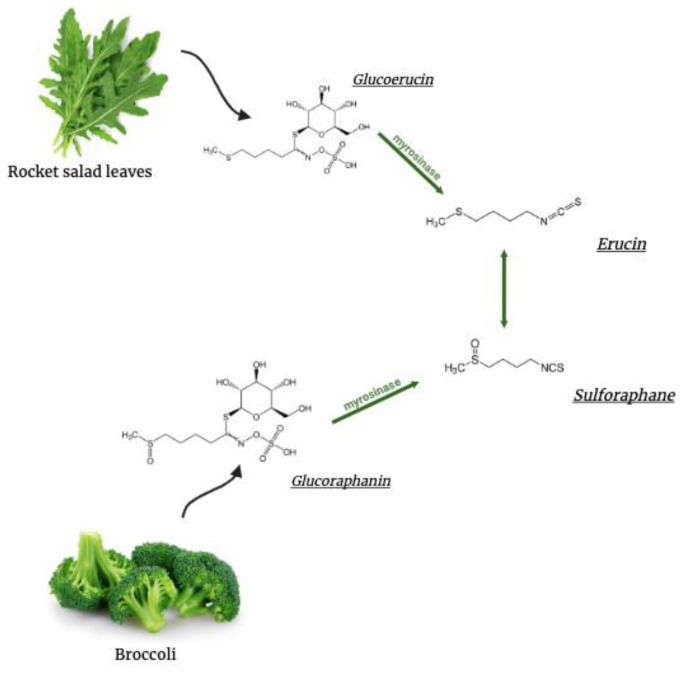
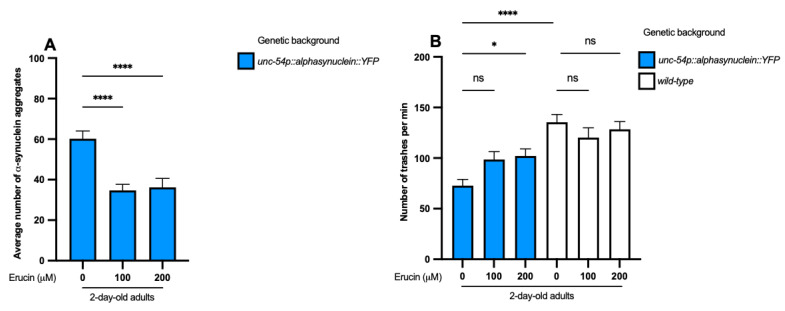
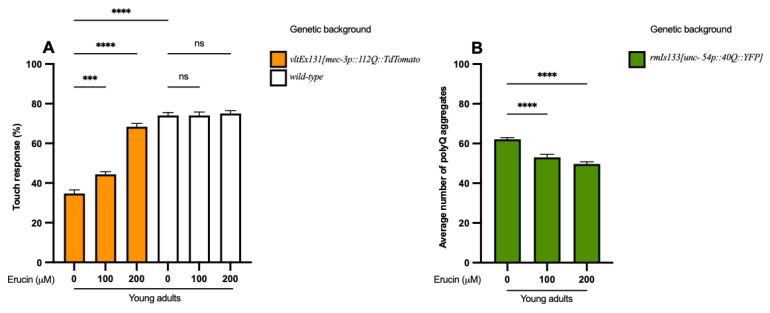
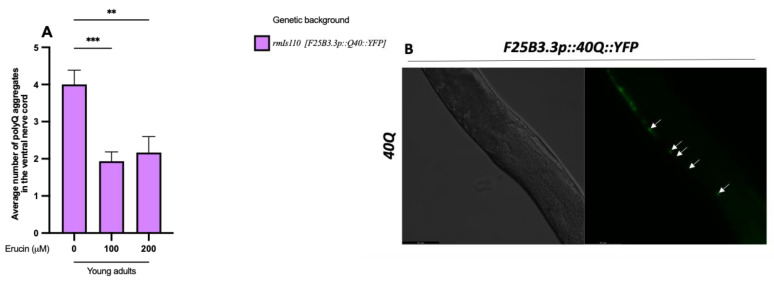
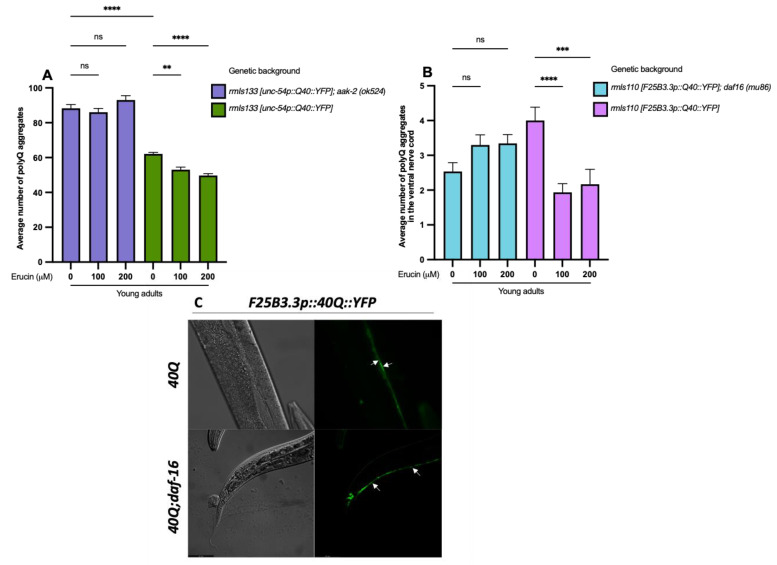
Several neurodegenerative diseases (NDDs), such as Huntington's disease, six of the spinocerebellar ataxias, dentatorubral-pallidoluysian atrophy, and spinobulbar muscular atrophy, are caused by abnormally long polyglutamine (polyQ) tracts. Natural compounds capable of alleviating polyQ-induced toxicity are currently of great interest. In this work, we investigated the modulatory effect against polyQ neurotoxic aggregates exerted by erucin (ERN), an isothiocyanate naturally present in its precursor glucoerucin in rocket salad leaves and in its oxidized form, sulforaphane (SFN), in broccoli. Using models expressing polyQ in different tissues, we demonstrated that ERN protects against polyQ-induced toxicity and that its action depends on the catalytic subunit of AMP-activated protein kinase (/AMPKα2) and, downstream in this pathway, on the /FOXO transcription factor, since nematodes deficient in /AMPKα2 and did not respond to the treatment, respectively. Although triggered by a different source of neurotoxicity than polyQ diseases, i.e., by α-synuclein (α-syn) aggregates, Parkinson's disease (PD) was also considered in our study. Our results showed that ERN reduces α-syn aggregates and slightly improves the motility of worms. Therefore, further preclinical studies in mouse models of protein aggregation are justified and could provide insights into testing whether ERN could be a potential neuroprotective compound in humans.
几种神经退行性疾病(NDDs),如亨廷顿病、六型脊髓小脑共济失调、齿状核红核苍白球路易体萎缩和延髓脊髓性肌萎缩,都是由异常长的多聚谷氨酰胺(polyQ)序列引起的。目前,能够缓解polyQ 诱导毒性的天然化合物备受关注。在这项工作中,我们研究了存在于火箭沙拉叶及其前体葡糖异硫氰酸盐中的异硫氰酸酯——黑芥子硫苷酸钾(ERN)及其氧化形式——萝卜硫素(SFN)对 polyQ 神经毒性聚集体的调节作用。我们使用在不同组织中表达 polyQ 的模型表明,ERN 可以保护细胞免受 polyQ 诱导的毒性,其作用依赖于 AMP 激活的蛋白激酶的催化亚基(/AMPKα2),并且在这条途径的下游,依赖于 /FOXO 转录因子,因为线虫缺乏 /AMPKα2 和 /FOXO 都分别对该治疗没有反应。虽然 ERN 触发的神经毒性与 polyQ 疾病不同,即由α-突触核蛋白(α-syn)聚集体引起,但我们的研究也考虑了帕金森病(PD)。我们的研究结果表明,ERN 减少了α-syn 聚集体并略微改善了线虫的运动能力。因此,在蛋白聚集的小鼠模型中进行进一步的临床前研究是合理的,这可能为测试 ERN 是否可以成为人类潜在的神经保护化合物提供了思路。