Department of Forensic Medicine, University of Health Sciences, Lahore 54600, Pakistan.
School of Computing, Skyline University College, University City Sharjah, Sharjah 1797, United Arab Emirates.
Genes (Basel). 2024 Oct 28;15(11):1384. doi: 10.3390/genes15111384.
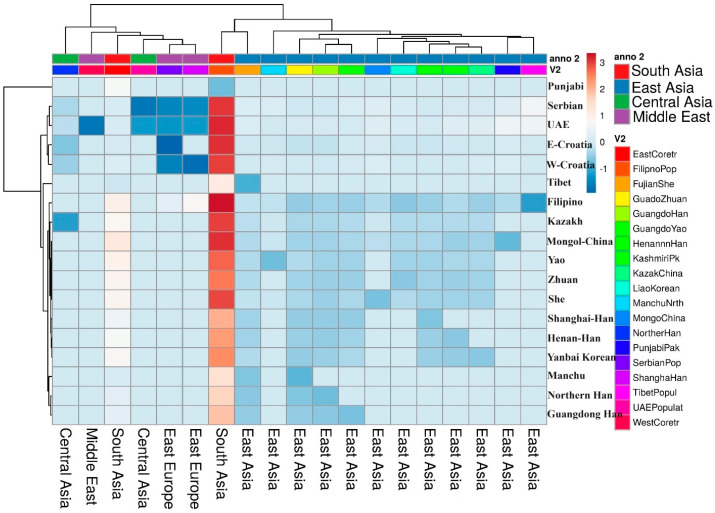
X-chromosomal short tandem repeats (X-STRs) are crucial in forensic applications, particularly in complex kinship cases, and play an important role in population genetics. However, there is limited data on X-STR variation in Pakistani populations, especially among ethnic groups like Kashmiri and Punjabi. This study investigates the forensic and genetic properties of 12 X-STRs from the Investigator Argus X-12 Kit (QIAGEN, Hilden, Germany) in 125 families (75 Kashmiri, 50 Punjabi) from Azad Jammu and Kashmir and Punjab, Pakistan. In both populations, a total of 222 alleles were identified across the 12 X-STR loci (Punjabi 171 alleles, Kashmiri 161 alleles), with allele frequencies ranging from 0.0056 to 0.3033. DXS10148 was the most polymorphic locus with 28 alleles, while DXS7132 was the least polymorphic with 9 alleles. Most loci were in linkage equilibrium, except for the DXS10135/DXS10148 pair in males, with no loci exhibiting significant linkage disequilibrium in females. The combined power of discrimination was 0.999 999 9977 for Kashmiri males, 0.999 999 999 999 9746 for Kashmiri females, and 0.999 999 999 999 9781 for Punjabi females. In Kashmiri males, 34, 31, 28, and 32 haplotypes were observed across the four linkage groups (LG1, LG2, LG3, and LG4), though these groups did not form stable haplotypes, as indicated by Linkage Equilibrium within and significant Linkage Disequilibrium between groups. Genetic structure analysis using Principal Component Analysis and STRUCTURE revealed distinct clustering patterns for the Kashmiri and Punjabi populations, indicating unique genetic backgrounds and ancestry influences, particularly distinguishing them from East Asian populations. This study provides a comprehensive analysis of X-STR variation in Punjabi and Kashmiri populations, offering valuable insights for forensic and population genetic studies.
X 染色体短串联重复序列(X-STRs)在法医应用中至关重要,特别是在复杂的亲属关系案件中,并且在群体遗传学中发挥着重要作用。然而,有关巴基斯坦人群中 X-STR 变异的资料有限,特别是在克什米尔和旁遮普等族群中。本研究调查了来自德国 QIAGEN 的 Investigator Argus X-12 试剂盒(QIAGEN,Hilden)中的 12 个 X-STR 基因座(125 个家庭,75 个克什米尔人,50 个旁遮普人)在阿扎德查谟和克什米尔和旁遮普邦,巴基斯坦的法医和遗传特性。在这两个群体中,总共在 12 个 X-STR 基因座上发现了 222 个等位基因(旁遮普 171 个等位基因,克什米尔 161 个等位基因),等位基因频率范围从 0.0056 到 0.3033。DXS10148 是多态性最高的基因座,有 28 个等位基因,而 DXS7132 是最少多态性的基因座,有 9 个等位基因。除了男性中的 DXS10135/DXS10148 对之外,大多数基因座都处于连锁平衡状态,而女性中的任何基因座都没有表现出显著的连锁不平衡。克什米尔男性的综合鉴别力为 0.999 999 9977,克什米尔女性为 0.999 999 999 999 9746,旁遮普女性为 0.999 999 999 999 9781。在克什米尔男性中,在四个连锁群(LG1、LG2、LG3 和 LG4)中观察到 34、31、28 和 32 个单倍型,尽管这些群没有形成稳定的单倍型,如连锁平衡在群内和组间显著的连锁不平衡所表明的那样。主成分分析和 STRUCTURE 遗传结构分析显示了克什米尔和旁遮普人群的独特聚类模式,表明了独特的遗传背景和祖先影响,特别是将它们与东亚人群区分开来。本研究提供了旁遮普邦和克什米尔邦人群中 X-STR 变异的综合分析,为法医和群体遗传学研究提供了有价值的见解。