Department of Environmental Health, College of Medicine and Health Sciences, Wollo University, Dessie, Ethiopia.
Department of Environmental Health, College of Medicine and Health Sciences, Debre Markos University, Debre Markos, Ethiopia.
Front Public Health. 2024 Nov 13;12:1488028. doi: 10.3389/fpubh.2024.1488028. eCollection 2024.
Air pollution is a significant global public health concern. However, there is a lack of updated and comprehensive evidence regarding the association between exposure to ambient air pollution and adverse birth outcomes (preterm birth, low birth weight, and stillbirth). Furthermore, the existing evidence is highly inconsistent. Therefore, this study aims to estimate the overall association between ambient air pollution and adverse birth outcomes.
In this study, initially a total of 79,356 articles were identified. Finally, a total of 49 articles were included. We conducted compressive literature searches using various databases, including PubMed, Scientific Direct, , and Google Scholar. Data extraction was performed using Microsoft Excel, and the data were exported to STATA 17 software for analysis. We used the Joanna Briggs Institute's quality appraisal tool to ensure the quality of the included studies. A random effects model was employed to estimate the pooled prevalence. Publication bias was assessed using funnel plots and Egger's regression test.
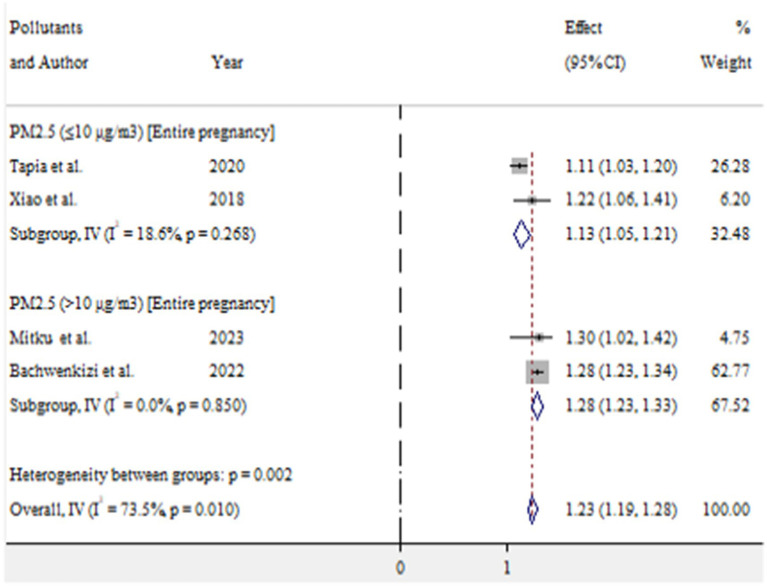
In this study, the pooled prevalence of at least one adverse birth outcome was 7.69% (95% CI: 6.70-8.69), with high heterogeneity ( = 100%, < 0.001). In this meta-analysis, high pooled prevalence was found in preterm birth (6.36%), followed by low birth weights (5.07%) and stillbirth (0.61%). Exposure to PM (≤10 μg/m) throughout the entire pregnancy, PM (≤10 μg/m) in the first trimester, PM (>10 μg/m) during the entire pregnancy, and O (≤10 μg/m) during the entire pregnancy increased the risk of preterm birth by 4% (OR = 1.04, 95% CI: 1.03-1.05), 5% (OR = 1.05, 95% CI: 1.01-1.09), 49% (OR = 1.49, 95% CI: 1.41-1.56), and 5% (OR = 1.05, 95% CI: 1.04-1.07), respectively. For low birth weight, exposure to PM (≤10 μg/m) and PM (>10 μg/m) throughout the entire pregnancy was associated with an increased risk of 13% (OR = 1.13, 95% CI: 1.05-1.21) and 28% (OR = 1.28, 95% CI: 1.23-1.33), respectively.
This study highlighted a significant association between ambient air pollution and adverse birth outcomes. Therefore, it is crucial to implement a compressive public health intervention.
The review protocol was registered with the record ID of CRD42024578630.
空气污染是一个严重的全球公共卫生问题。然而,关于接触环境空气污染与不良出生结局(早产、低出生体重和死产)之间的关联,目前缺乏最新和全面的证据。此外,现有的证据非常不一致。因此,本研究旨在估计环境空气污染与不良出生结局之间的总体关联。
本研究最初共确定了 79356 篇文章。最终共纳入了 49 篇文章。我们使用各种数据库,包括 PubMed、Science Direct、和 Google Scholar,进行了全面的文献检索。使用 Microsoft Excel 进行数据提取,并将数据导出到 STATA 17 软件进行分析。我们使用了 Joanna Briggs 研究所的质量评估工具来确保纳入研究的质量。使用随机效应模型估计汇总患病率。使用漏斗图和 Egger 回归检验评估发表偏倚。
本研究中,至少有一种不良出生结局的汇总患病率为 7.69%(95%CI:6.70-8.69),具有高度异质性( = 100%, < 0.001)。在这项荟萃分析中,早产的汇总患病率较高(6.36%),其次是低出生体重(5.07%)和死产(0.61%)。整个孕期暴露于 PM(≤10μg/m)、孕期第一季度 PM(≤10μg/m)、整个孕期 PM(>10μg/m)和整个孕期 O(≤10μg/m)分别使早产风险增加 4%(OR=1.04,95%CI:1.03-1.05)、5%(OR=1.05,95%CI:1.01-1.09)、49%(OR=1.49,95%CI:1.41-1.56)和 5%(OR=1.05,95%CI:1.04-1.07)。对于低出生体重,整个孕期暴露于 PM(≤10μg/m)和 PM(>10μg/m)与 13%(OR=1.13,95%CI:1.05-1.21)和 28%(OR=1.28,95%CI:1.23-1.33)的风险增加相关。
本研究强调了环境空气污染与不良出生结局之间存在显著关联。因此,实施全面的公共卫生干预措施至关重要。
该综述方案已在记录 ID CRD42024578630 下注册。