Department of Ophthalmology, The Second Hospital of Jilin University, Changchun, China.
Department of Physiology, College of Basic Medical Sciences, Jilin University, Changchun, China.
Ann Med. 2024 Dec;56(1):2433684. doi: 10.1080/07853890.2024.2433684. Epub 2024 Nov 28.
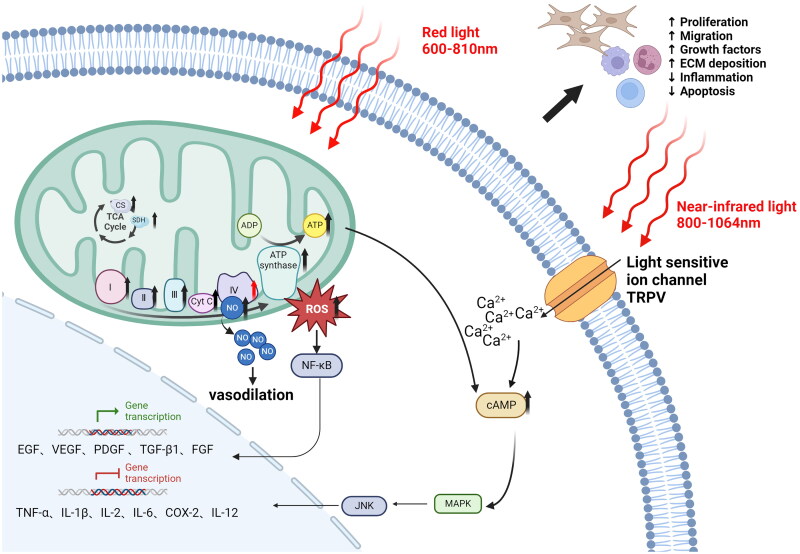
Diabetes mellitus is a metabolic disease that is marked by persistent hyperglycemia due to inadequate insulin secretion or insulin resistance. Its prevalence is increasing yearly. Diabetes mellitus can lead to serious health complications that are the primary cause of mortality and disability among diabetic patients, including diabetic retinopathy, diabetic foot ulcers, diabetic peripheral neuropathy, and diabetic periodontitis, and so on. Traditional treatments for diabetes and its complications still suffer from limited clinical efficacy and high therapeutic side effects. Photobiomodulation (PBM), which utilizes low levels of red or near-infrared laser to irradiate cells and tissues, has been shown to be efficacious for a wide range of organ damage. In this study, we focus on the application of PBM in diabetes and its complications and mechanisms, as well as the advantages, disadvantages with the aim of developing new ideas for the application of PBM.
糖尿病是一种代谢性疾病,其特征是由于胰岛素分泌不足或胰岛素抵抗而导致持续的高血糖。其发病率逐年增加。糖尿病可导致严重的健康并发症,这些并发症是糖尿病患者死亡和残疾的主要原因,包括糖尿病视网膜病变、糖尿病足溃疡、糖尿病周围神经病变和糖尿病牙周炎等。糖尿病及其并发症的传统治疗方法仍然存在临床疗效有限和治疗副作用高的问题。光生物调节(PBM)利用低水平的红光或近红外激光照射细胞和组织,已被证明对广泛的器官损伤有效。在这项研究中,我们专注于 PBM 在糖尿病及其并发症中的应用及其机制,以及优缺点,旨在为 PBM 的应用开发新的思路。