Providence St. Joseph Health, Portland, Oregon, USA.
Providence Saint John's Cancer Institute, Santa Monica, California, USA.
Cancer Med. 2024 Dec;13(23):e70441. doi: 10.1002/cam4.70441.
Despite the favorable prognosis of AJCC stage I/II melanoma patients, up to 20%-30% will develop metastases. Our objective is to predict long-term risk (probability) of recurrence in early-stage melanoma patients.
A Risk Score to predict long-term recurrence was developed using Cox regression based on 2668 patients. Five clinicopathological risk factors were included. The association of the Risk Score with the risk of recurrence was evaluated using parametric models (exponential, Weibull, and Gompertz models) and compared to the Cox model using the Akaike information criterion. The discrimination of the model was measured by time-dependent ROC analyses. A calibration curve was used to evaluate the agreement between predicted and observed recurrence probabilities.
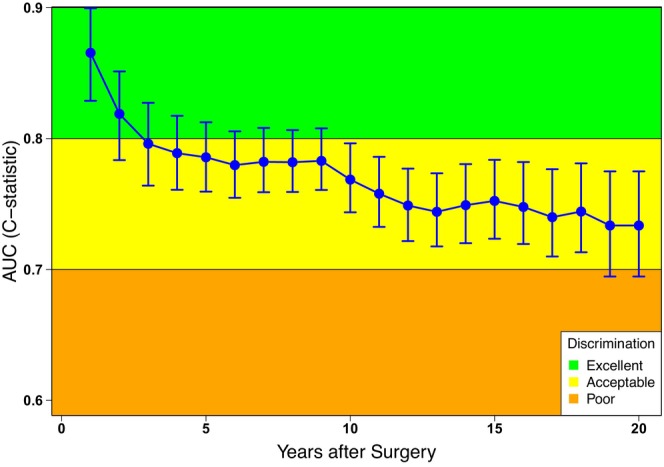
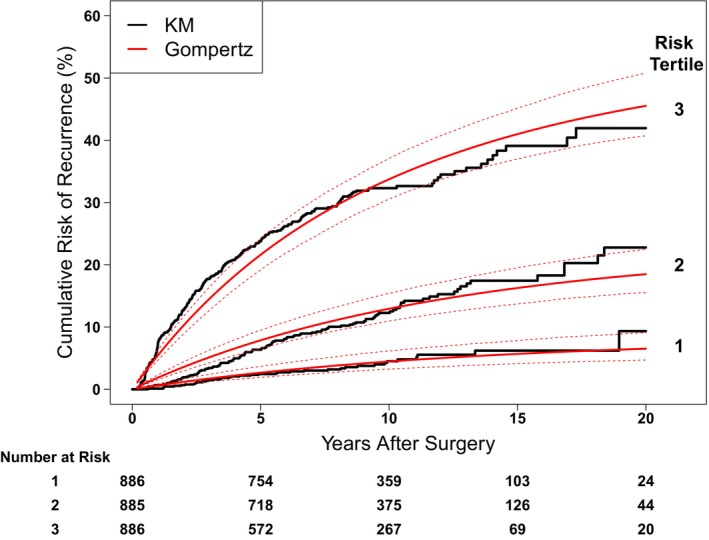
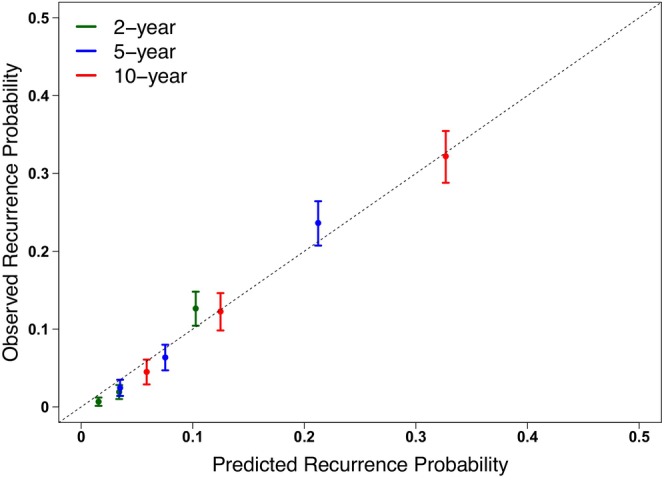
The bootstrap adjusted C-index was 0.76 (95% CI, 0.74-0.79) overall and 0.87 (0.83-0.90) and 0.82 (0.78-0.85) at one and two years, respectively, and then remained above 0.70 up to 20 years. The Gompertz model for prediction of survival from the Risk Score showed the best performance and displayed good agreement with the Kaplan-Meier curves. The calibration curve of the Gompertz model showed a good agreement between predicted and observed 2-, 5-, and 10-year risk of recurrence. Population-level analysis demonstrated a significant association of Risk Score with risk of recurrence, with 10-year risks of recurrence of 4.5%, 13.0%, and 33.7% in the first, second, and third tertiles, respectively.
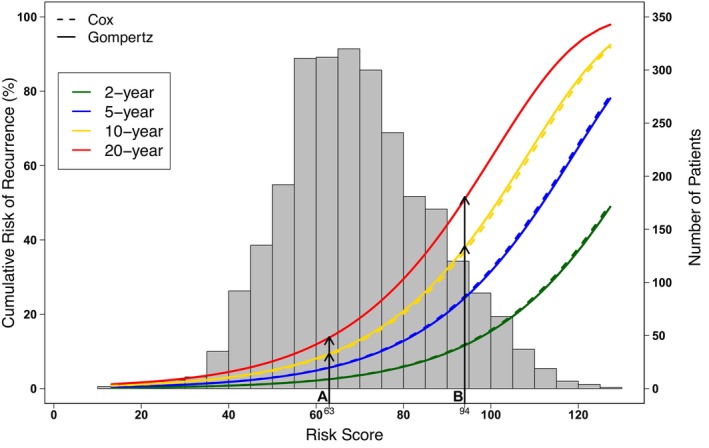
We developed a Risk Score to predict long-term risk of recurrence for early-stage melanoma patients. A Gompertz survival model fit to the Risk Score allows for individualized prediction of time-dependent recurrence risk.
尽管 AJCC Ⅰ/Ⅱ期黑色素瘤患者的预后良好,但仍有 20%-30%的患者会发生转移。我们的目标是预测早期黑色素瘤患者的长期复发风险(概率)。
使用基于 2668 例患者的 Cox 回归建立了一个预测长期复发的风险评分。纳入了 5 个临床病理危险因素。使用参数模型(指数、Weibull 和 Gompertz 模型)评估风险评分与复发风险的关系,并通过赤池信息量准则与 Cox 模型进行比较。通过时间依赖性 ROC 分析评估模型的区分度。使用校准曲线评估预测和观察到的复发概率之间的一致性。
Bootstrap 调整后的 C 指数为 0.76(95%CI,0.74-0.79),总体上为 0.87(0.83-0.90)和 0.82(0.78-0.85),分别在 1 年和 2 年,然后在 20 年内保持在 0.70 以上。用于预测风险评分生存的 Gompertz 模型表现最佳,与 Kaplan-Meier 曲线吻合良好。Gompertz 模型的校准曲线显示了预测和观察到的 2 年、5 年和 10 年复发风险之间的良好一致性。人群水平分析表明,风险评分与复发风险显著相关,第一、二和第三三分位数的 10 年复发风险分别为 4.5%、13.0%和 33.7%。
我们开发了一种风险评分来预测早期黑色素瘤患者的长期复发风险。适用于风险评分的 Gompertz 生存模型允许对时间依赖性复发风险进行个体化预测。