Bischoff Leon M, Endler Christoph, Krausewitz Philipp, Ellinger Joerg, Klümper Niklas, Isaak Alexander, Mesropyan Narine, Kravchenko Dmitrij, Nowak Sebastian, Kuetting Daniel, Sprinkart Alois M, Mürtz Petra, Pieper Claus C, Attenberger Ulrike, Luetkens Julian A
Department of Diagnostic and Interventional Radiology, University Hospital Bonn, Bonn, Germany.
Quantitative Imaging Lab Bonn (QILaB), University Hospital Bonn, Bonn, Germany.
Insights Imaging. 2024 Nov 29;15(1):287. doi: 10.1186/s13244-024-01862-x.
To implement and evaluate a super-fast and high-quality biparametric MRI (bpMRI) protocol for prostate imaging acquired at a new ultra-high gradient 3.0-T MRI system.
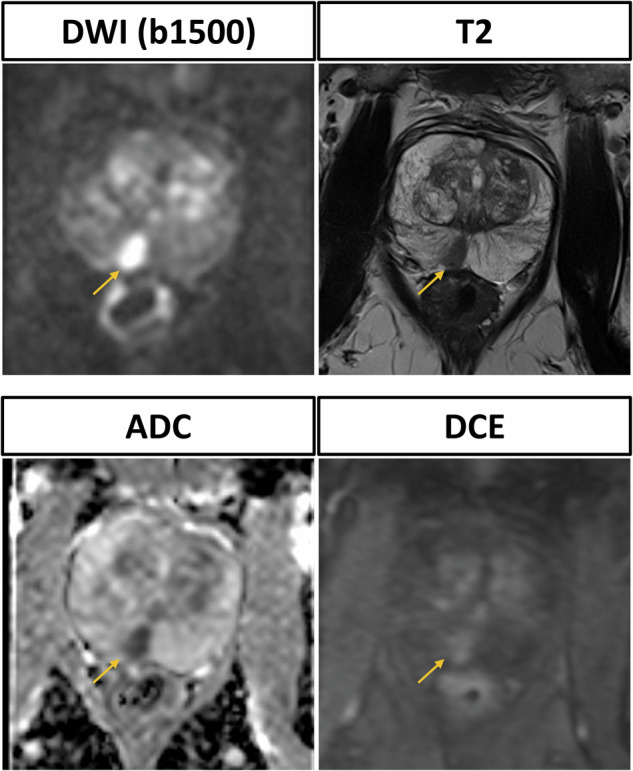
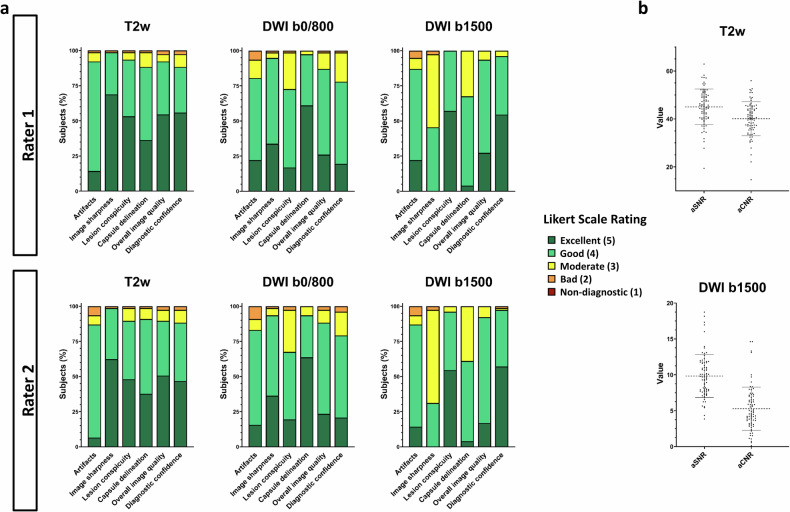
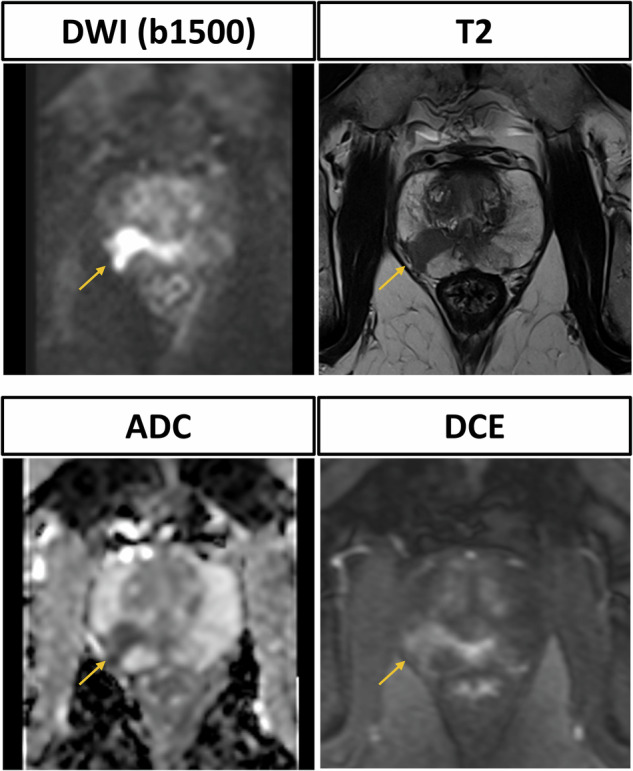
Participants with clinically suspected prostate cancer prospectively underwent a multiparametric MRI (mpMRI) on a new 3.0-T MRI scanner (maximum gradient strength: 200 mT/m, maximum slew rate: 200 T/m/s). The bpMRI protocol was extracted from the full mpMRI protocol, including axial T2-weighted and diffusion-weighted (DWI) sequences (b0/800, b1500). Overall image quality was rated by two readers on a five-point Likert scale from (1) non-diagnostic to (5) excellent. PI-RADS 2.1 scores were assessed by three readers separately for the bpMRI and mpMRI protocols. Cohen's and Fleiss' κ were calculated for PI-RADS agreement between protocols and interrater reliability between readers, respectively.
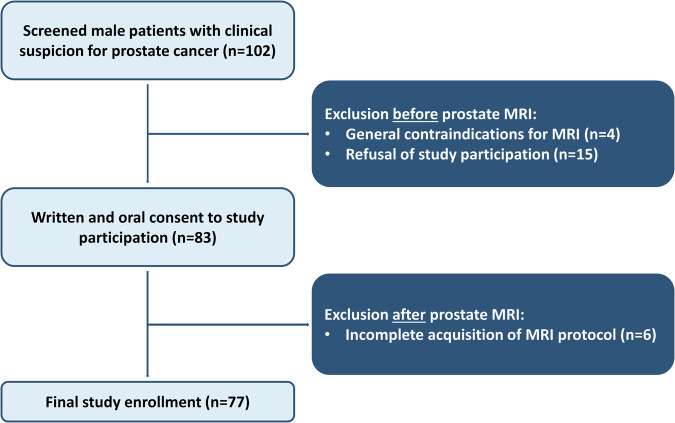
Seventy-seven male participants (mean age, 66 ± 8 years) were included. Acquisition time of the bpMRI protocol was reduced by 62% (bpMRI: 5 min, 33 ± 21 s; mpMRI: 14 min, 50 ± 42 s). The bpMRI protocol showed excellent overall image quality for both the T2-weighted (median score both readers: 5 [IQR: 4-5]) and DWI (b1500) sequence (median score reader 1: 4 [IQR: 4-5]; reader 2: 4 [IQR: 4-4]). PI-RADS score agreement between protocols was excellent (Cohen's κ range: 0.91-0.95 [95% CI: 0.89, 0.99]) with an overall good interrater reliability (Fleiss' κ, 0.86 [95% CI: 0.80, 0.92]).
Ultra-high gradient MRI allows the establishment of a high-quality and rapidly acquired bpMRI with high PI-RADS agreement to a full mpMRI protocol.
Clinicaltrials.gov, NCT06244680, Registered 06 February 2024, retrospectively registered, https://classic.
gov/ct2/show/NCT06244680 .
A novel 3.0-Tesla MRI system with an ultra-high gradient performance enabled high-quality biparametric prostate MRI in 5.5 min while achieving excellent PI-RADS agreement with a standard multiparametric protocol.
Multi- and biparametric prostate MRIs were prospectively acquired utilizing a maximum gradient of 200 mT/m. Super-fast biparametric MRIs showed excellent image quality and had high PI-RADS agreement with multiparametric MRIs. Implementation of high gradient MRI in clinical routine allows accelerated and high-quality biparametric prostate examinations.
在新型超高梯度3.0-T磁共振成像(MRI)系统上实施并评估一种用于前列腺成像的超快速、高质量双参数MRI(bpMRI)方案。
临床怀疑患有前列腺癌的参与者在新型3.0-T MRI扫描仪(最大梯度强度:200 mT/m,最大 slew 率:200 T/m/s)上进行多参数MRI(mpMRI)检查。bpMRI方案从完整的mpMRI方案中提取,包括轴向T2加权和扩散加权(DWI)序列(b0/800,b1500)。两名阅片者根据五分制李克特量表对整体图像质量进行评分,从(1)非诊断性到(5)优秀。三名阅片者分别对bpMRI和mpMRI方案进行PI-RADS 2.1评分。分别计算方案之间PI-RADS一致性的Cohen's κ和阅片者之间的组内相关系数(Fleiss' κ)。
纳入77名男性参与者(平均年龄,66±8岁)。bpMRI方案的采集时间减少了62%(bpMRI:5分钟33±21秒;mpMRI:14分钟50±42秒)。bpMRI方案在T2加权(两名阅片者的中位数评分均为:5 [四分位间距:4 - 5])和DWI(b1500)序列上均显示出优秀的整体图像质量(阅片者1的中位数评分:4 [四分位间距:4 - 5];阅片者2的中位数评分:4 [四分位间距:4 - 4])。方案之间的PI-RADS评分一致性良好(Cohen's κ范围:0.91 - 0.95 [95%置信区间:0.89,0.99]),整体阅片者间可靠性良好(Fleiss' κ,0.86 [95%置信区间:0.80,0.92])。
超高梯度MRI能够建立高质量且快速采集的bpMRI,与完整的mpMRI方案具有高度的PI-RADS一致性。
Clinicaltrials.gov,NCT06244680,2024年2月6日注册,追溯注册,https://classic.
gov/ct2/show/NCT06244680 。
一种具有超高梯度性能的新型3.0特斯拉MRI系统能够在5.5分钟内实现高质量的双参数前列腺MRI,同时与标准多参数方案达成出色的PI-RADS一致性。
前瞻性地利用最大梯度为200 mT/m采集多参数和双参数前列腺MRI。超快速双参数MRI显示出优秀的图像质量,并且与多参数MRI具有高度的PI-RADS一致性。在临床常规中实施高梯度MRI可实现加速且高质量的双参数前列腺检查。