Anders Lisa A, Mesite Frem Jeanette, McCoy Thomas P
Assistant Professor, University of North Carolina at Greensboro School of Nursing, Greensboro, NC, USA.
Lactation Consultant, Babies in Common, Northborough, MA, USA.
J Hum Lact. 2025 Feb;41(1):54-64. doi: 10.1177/08903344241296036. Epub 2024 Nov 30.
Pumping is a common practice in the United States, but it can be uncomfortable and lead to concerns about milk supply. The fit of the flange, or breast shield, used while pumping can contribute to or alleviate these problems. Flanges are available in a wide variety of sizes, and there are inconsistencies in guidance provided by healthcare providers and pump manufacturers for parents choosing a size. There have been no studies comparing different methods of sizing in terms of comfort and milk output.
The aim of this research was to examine differences in milk output and comfort using two methods of flange sizing.
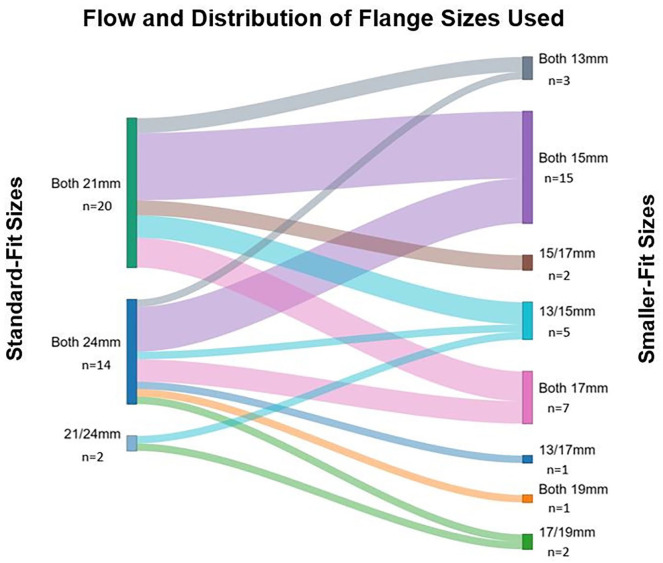
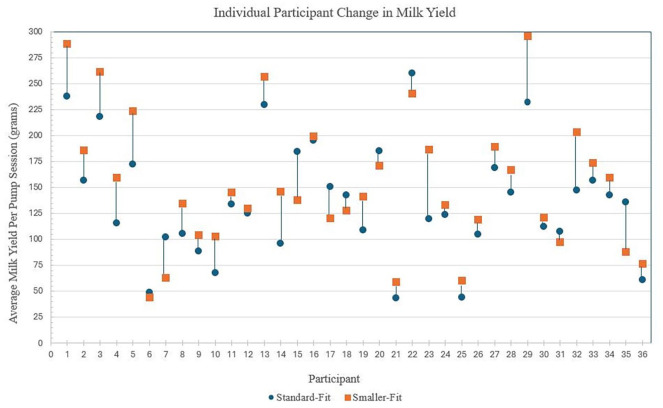
A within-subject cross-over design with a convenience sample of parents exclusively feeding their own human milk was used to compare comfort and milk yield between using smaller-fit and standard-fit flanges. Participants pumped for 1 week with each set of flanges and recorded milk output and comfort outcome measures. Data were collected on participant demographics, nipple measurements, and flange sizes used.
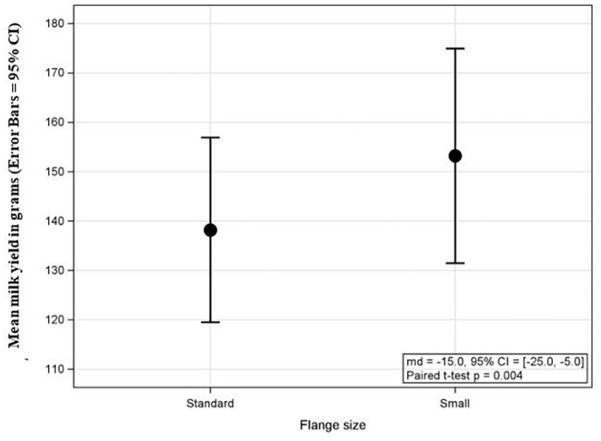
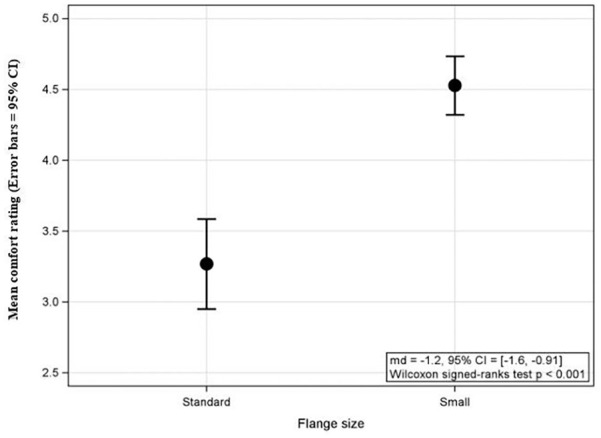
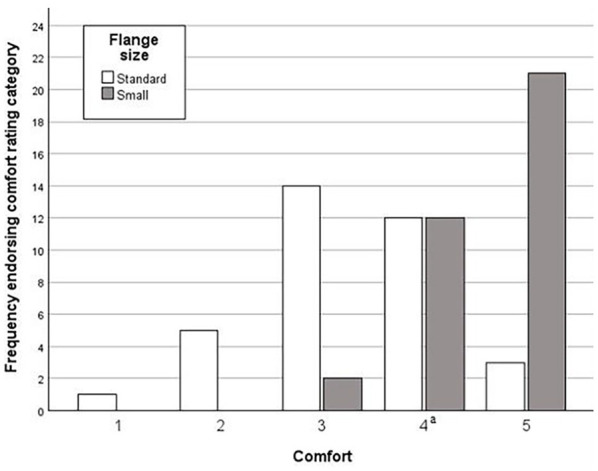
When compared to the newer small-size fitting, participants using the standard fit flanges had significantly less milk output (mean difference = -15.0 g, 95% CI [-25.0, -5.0], = -0.51, = 0.004) and less comfort (mean difference = -1.2, 95% CI [-1.6, -0.91], = -1.23, < 0.001).
Flange fitting is a process that should be individualized to the patient and may require a trial of one or more sizes during a pumping session. Smaller sizes determined using this individualized process and starting with nipple tip measurement may be used without compromising milk output or comfort.
在美国,吸奶器吸奶是一种常见做法,但这可能会让人感到不适,并引发对乳汁供应的担忧。吸奶时使用的喇叭罩(即吸乳护罩)是否合适可能会加剧或缓解这些问题。喇叭罩有多种尺寸可供选择,而医疗保健提供者和吸奶器制造商为家长选择尺寸时提供的指导并不一致。目前尚无研究比较不同尺寸选择方法在舒适度和乳汁产量方面的差异。
本研究的目的是使用两种喇叭罩尺寸选择方法,检验乳汁产量和舒适度的差异。
采用受试者内交叉设计,以纯母乳喂养自己孩子的家长作为便利样本,比较使用较小号和标准尺寸喇叭罩时的舒适度和乳汁产量。参与者每组喇叭罩使用1周,并记录乳汁产量和舒适度指标。收集了参与者的人口统计学数据、乳头测量数据以及所使用的喇叭罩尺寸。
与新的小尺寸适配相比,使用标准尺寸喇叭罩的参与者乳汁产量显著更低(平均差异=-15.0克,95%可信区间[-25.0,-5.0],t=-0.51,p=0.004),舒适度也更低(平均差异=-1.2,95%可信区间[-1.6,-0.91],t=-1.23,p<0.001)。
喇叭罩适配过程应因人而异,在吸奶过程中可能需要试用一种或多种尺寸。使用这种个性化方法并从乳头尖端测量开始确定的较小尺寸,在不影响乳汁产量或舒适度的情况下可以使用。