Gage Christopher B, Powell Jonathan R, Cooke Christine B, Kamholz Jacob C, van den Bergh Shea, Kurth Jordan D, Panchal Ashish
Emergency Medicine, National Registry of Emergency Medical Technicians, Columbus, USA.
General Internal Medicine, Penn State College of Medicine, Hershey, USA.
Cureus. 2024 Oct 31;16(10):e72779. doi: 10.7759/cureus.72779. eCollection 2024 Oct.
Recently, there have been annual increases in emergency medical service (EMS) demand with concurrent clinician shortages. Understanding the diverse number of EMS clinicians available for emergent roles is vital for planning and resource management. Our study aims to understand the roles and environments of US EMS clinicians.
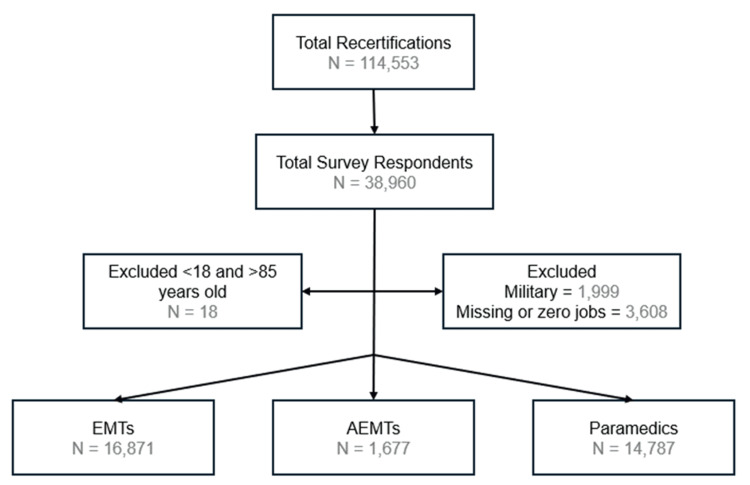
This cross-sectional study analyzed nationally certified civilian US EMS clinicians recertifying from October 2021 to April 2022, ages 18-85, with at least one EMS job. Respondents answered questions regarding their primary and secondary EMS roles, including emergent response (with/without 9-1-1), medical transport (non-emergent), clinical services, mobile integrated health (MIH), or none of the above. Next, respondents were asked about the number of jobs needed to make ends meet. All responses were combined with self-reported National Registry profile data (e.g., age, sex). Descriptive statistics were performed.
The study included 33,335 EMS clinicians (response rate: 34.0%). The primary role reported was emergent response with 25,086 (75.3%), including ground ambulance and non-ambulance response. Clinical service roles were reported by 2,427 (7.3%), including settings such as the emergency department and outpatient clinics. Medical transport roles accounted for 2,346 (7.0%), including ground interfacility and critical ground care. Educators and administrators made up 1,453 (4.4%). Overall, roles varied by sex, and 48.8% of respondents reported needing more than one job to make ends meet.
Our evaluation highlights various US EMS clinician roles. These findings suggest the need for continued focus and attention on EMS roles, compensation structures, and sex distributions to ensure a resilient, diverse, and adequately supported EMS workforce.
近年来,紧急医疗服务(EMS)的需求逐年增加,同时临床医生短缺。了解可担任紧急任务的EMS临床医生的不同数量对于规划和资源管理至关重要。我们的研究旨在了解美国EMS临床医生的角色和工作环境。
这项横断面研究分析了2021年10月至2022年4月期间重新认证的年龄在18 - 85岁、至少有一份EMS工作的美国国家认证平民EMS临床医生。受访者回答了有关其主要和次要EMS角色的问题,包括紧急响应(有/无9 - 1 - 1)、医疗转运(非紧急)、临床服务、移动综合医疗(MIH)或以上都不是。接下来,询问受访者维持生计所需的工作数量。所有回答都与自我报告的国家注册档案数据(如年龄、性别)相结合。进行了描述性统计。
该研究包括33,335名EMS临床医生(回复率:34.0%)。报告的主要角色是紧急响应,有25,086人(75.3%),包括地面救护车和非救护车响应。2,427人(7.3%)报告担任临床服务角色,包括急诊科和门诊诊所等场所。医疗转运角色占2,346人(7.0%),包括地面机构间转运和重症地面护理。教育工作者和管理人员占1,453人(4.4%)。总体而言,角色因性别而异,48.8%的受访者报告需要不止一份工作才能维持生计。
我们的评估突出了美国EMS临床医生的各种角色。这些发现表明,需要继续关注EMS角色、薪酬结构和性别分布,以确保拥有一支有韧性、多样化且得到充分支持的EMS劳动力队伍。