Wang Xin, Zhang Yu, Ca Jingye, Qin Qin, Feng Yi, Yan Jingke
School of Information and Software Engineering, University of Electronic Science and Technology of China, Chengdu, 610000, China.
School of Computer Science and Information Security, Guilin University of Electronic Science and Technology of China, Guilin, 541004, China.
Sci Rep. 2024 Dec 2;14(1):29860. doi: 10.1038/s41598-024-81511-x.
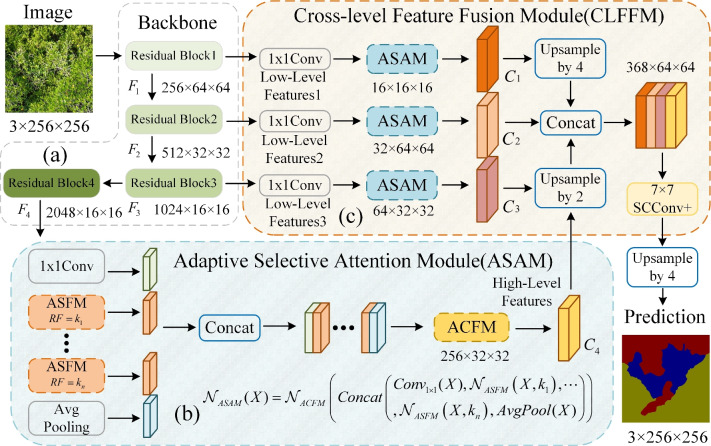
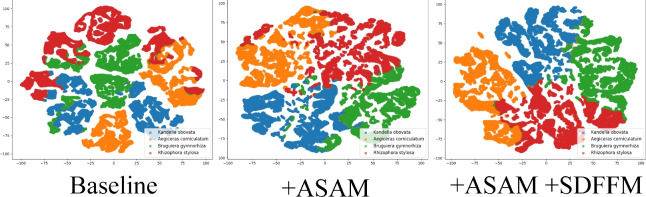
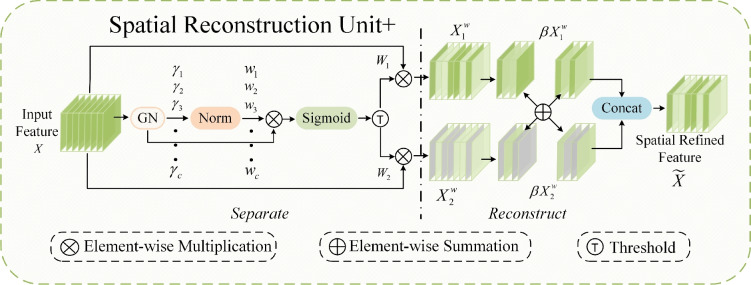
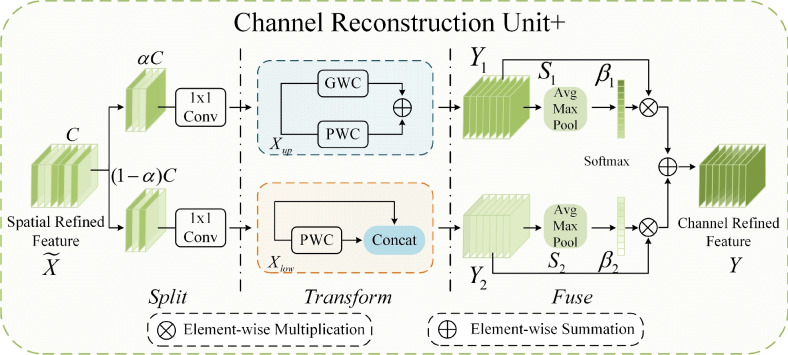
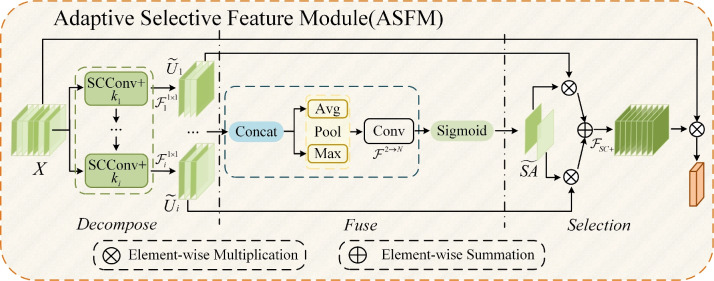
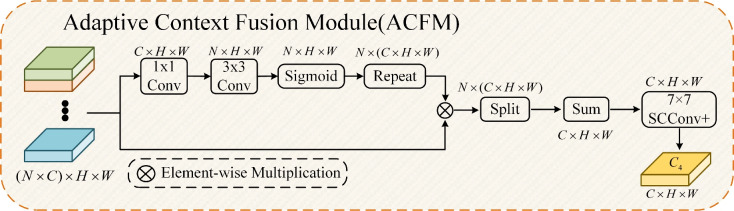
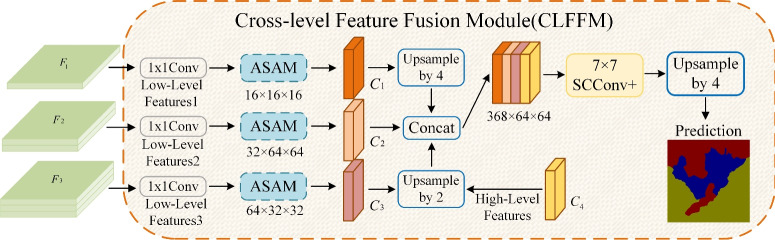
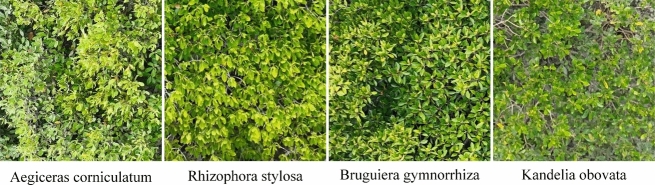
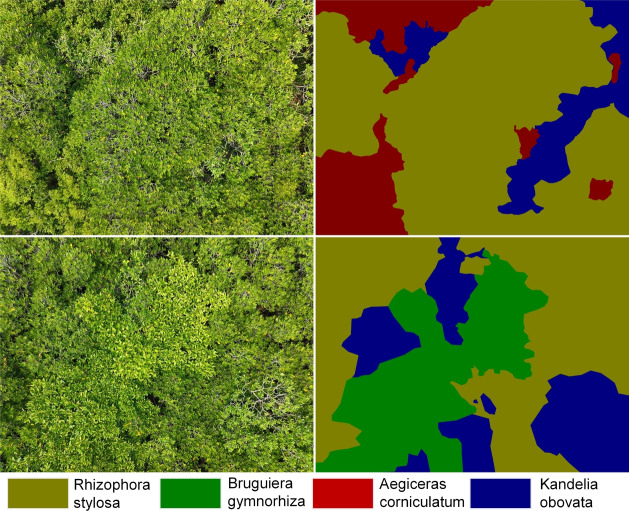
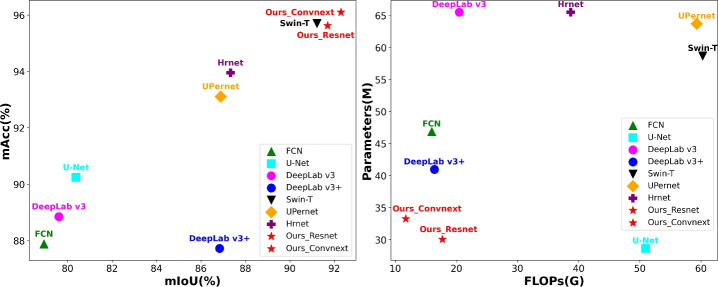
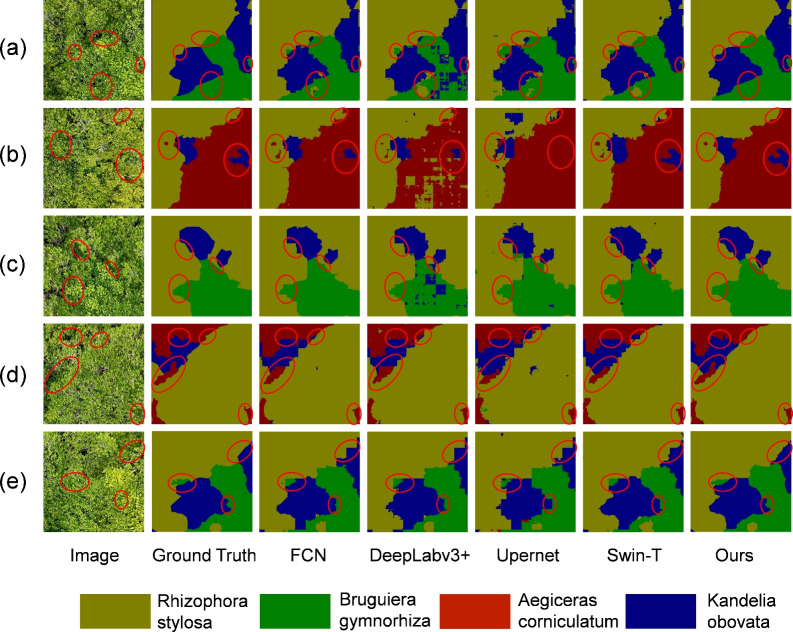
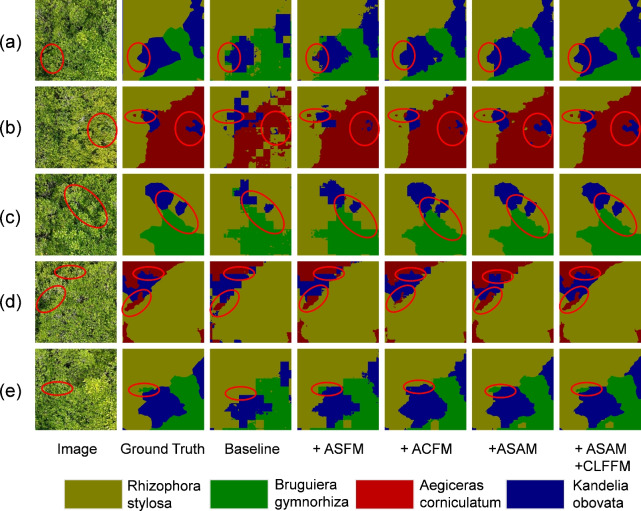
Mangroves are special vegetation that grows in the intertidal zone of the coast and has extremely high ecological and environmental value. Different mangrove species exhibit significant differences in ecological functions and environmental responses, so accurately identifying and distinguishing these species is crucial for ecological protection and monitoring. However, mangrove species recognition faces challenges, such as morphological similarity, environmental complexity, target size variability, and data scarcity. Traditional mangrove monitoring methods mainly rely on expensive and operationally complex multispectral or hyperspectral remote sensing sensors, which have high data processing and storage costs, hindering large-scale application and popularization. Although hyperspectral monitoring is still necessary in certain situations, the low identification accuracy in routine monitoring severely hinders ecological analysis. To address these issues, this paper proposes the UrmsNet segmentation network, aimed at improving identification accuracy in routine monitoring while reducing costs and complexity. It includes an improved lightweight convolution SCConv, an Adaptive Selective Attention Module (ASAM), and a Cross-Layer Feature Fusion Module (CLFFM). ASAM adaptively extracts and fuses features of different mangrove species, enhancing the network's ability to characterize mangrove species with similar morphology and in complex environments. CLFFM combines shallow details and deep semantic information to ensure accurate segmentation of mangrove boundaries and small targets.Additionally, this paper constructs a high-quality RGB image dataset for mangrove species segmentation to address the data scarcity problem. Compared to traditional methods, our approach is more precise and efficient. While maintaining relatively low parameters and computational complexity (FLOPs), it achieves excellent performance with mIoU and mPA metrics of 92.21% and 95.98%, respectively. This performance is comparable to the latest methods using multispectral or hyperspectral data but significantly reduces cost and complexity. By combining periodic hyperspectral monitoring with UrmsNet-supported routine monitoring, a more comprehensive and efficient mangrove ecological monitoring can be achieved.These research findings provide a new technical approach for large-scale, low-cost monitoring of important ecosystems such as mangroves, with significant theoretical and practical value. Furthermore, UrmsNet also demonstrates excellent performance on LoveDA, Potsdam, and Vaihingen datasets, showing potential for wider application.
红树林是生长在海岸潮间带的特殊植被,具有极高的生态和环境价值。不同的红树林物种在生态功能和环境响应方面表现出显著差异,因此准确识别和区分这些物种对于生态保护和监测至关重要。然而,红树林物种识别面临挑战,如形态相似、环境复杂、目标大小可变以及数据稀缺等。传统的红树林监测方法主要依赖昂贵且操作复杂的多光谱或高光谱遥感传感器,数据处理和存储成本高,阻碍了大规模应用和推广。尽管在某些情况下高光谱监测仍然必要,但常规监测中识别准确率低严重阻碍了生态分析。为解决这些问题,本文提出了UrmsNet分割网络,旨在提高常规监测中的识别准确率,同时降低成本和复杂度。它包括改进的轻量级卷积SCConv、自适应选择性注意力模块(ASAM)和跨层特征融合模块(CLFFM)。ASAM自适应地提取和融合不同红树林物种的特征,增强网络对形态相似和处于复杂环境中的红树林物种的表征能力。CLFFM结合浅层细节和深层语义信息,确保准确分割红树林边界和小目标。此外,本文构建了用于红树林物种分割的高质量RGB图像数据集,以解决数据稀缺问题。与传统方法相比,我们的方法更精确、高效。在保持相对较低的参数和计算复杂度(FLOPs)的同时,它分别以92.21%和95.98%的mIoU和mPA指标实现了优异的性能。该性能与使用多光谱或高光谱数据的最新方法相当,但显著降低了成本和复杂度。通过将定期高光谱监测与UrmsNet支持的常规监测相结合,可以实现更全面、高效的红树林生态监测。这些研究结果为红树林等重要生态系统的大规模、低成本监测提供了一种新的技术途径,具有重要的理论和实践价值。此外,UrmsNet在LoveDA、波茨坦和魏辛根数据集上也表现出优异的性能,显示出更广泛应用的潜力。