Zhang Ningyue, Wang Yifan, Wang Jiankui, Zhang Liang, Sun Haoran, Yuan Xiaochun, Wang Siyu, Wang Chunguang, Li Xinhai
College of Animal Science and Technology, Ningxia University, Helan Mountain West Road, Yinchuan, Ningxia, 750021, China.
Beijing Key Laboratory of Animal Genetic Improvement, China Agricultural University, No. 2 Yuanmingyuan West Rd, Beijing, 100193, China.
BMC Genomics. 2024 Dec 2;25(1):1166. doi: 10.1186/s12864-024-11059-7.
Dorper sheep are celebrated for their fast maturation and superior meat quality, with some shedding their wool each spring. Wool shedding occurs naturally due to the hair follicle (HF) cycle, but its regulatory mechanisms remain unclear and need further investigation.
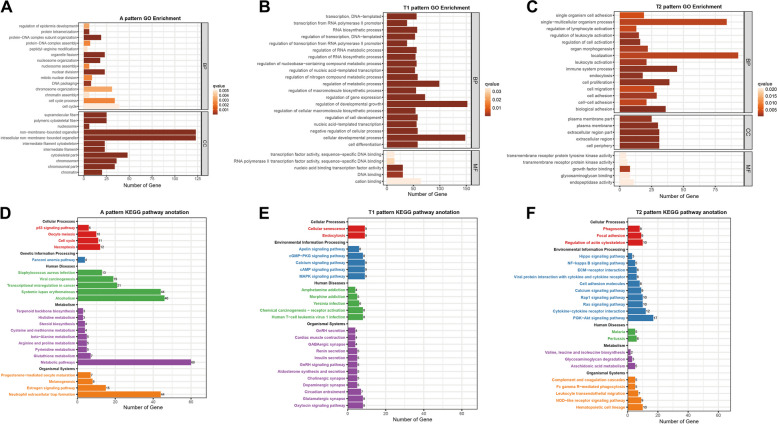
In this study, shedding and non-shedding sheep were selected from the same Dorper flock. Skin samples were collected in September of the first year and January and March of the following years. RNA sequencing was performed on these samples. Principal component analysis (PCA) was used to assess the results. A total of 2536 differentially expressed genes (DEGs) were identified. Using a clustering heatmap and fuzzy clustering analysis three distinct gene expression patterns were identified: A pattern (high expression in anagen), T1 pattern, and T2 pattern (high expression in telogen). For each pattern, differentially expressed genes (DEGs) were analyzed through Gene Ontology (GO) and Kyoto Encyclopedia of Genes and Genomes (KEGG) enrichment analyses. Combining this with pathway expression analysis, six A-pattern and fourteen T-pattern pathways linked to telogen-anagen transition in the HF cycle were identified. Networks of key pathways were then constructed. Additionally, key genes were identified in the telogen-anagen transition, including one A-pattern gene and seven T-pattern (T1, 1; T2, 6) genes, using the Maximal Clique Centrality (MCC) tool in Cytoscape. Predicted transcription factors (TFs) involved in key pathways, such as LEF and STAT5B, were identified. Finally, RNA-seq results were confirmed by RT-qPCR.
This study highlights critical genes and pathways in the telogen-anagen transition, and transcriptome sequencing along with bioinformatics analysis provides new insights into the regulatory mechanisms of the HF cycle and development.
杜泊羊以其快速成熟和优质肉质而闻名,部分杜泊羊每年春季会脱毛。脱毛是由于毛囊(HF)周期自然发生的,但调控机制仍不清楚,需要进一步研究。
本研究从同一杜泊羊群中选取了脱毛和不脱毛的绵羊。在第一年的9月以及次年的1月和3月采集皮肤样本。对这些样本进行RNA测序。使用主成分分析(PCA)评估结果。共鉴定出2536个差异表达基因(DEG)。通过聚类热图和模糊聚类分析,确定了三种不同的基因表达模式:A模式(生长期高表达)、T1模式和T2模式(休止期高表达)。对于每种模式,通过基因本体论(GO)和京都基因与基因组百科全书(KEGG)富集分析对差异表达基因(DEG)进行分析。结合通路表达分析,确定了六个与毛囊周期中休止期 - 生长期转变相关的A模式和十四个T模式通路。然后构建关键通路网络。此外,使用Cytoscape中的最大团中心性(MCC)工具,在休止期 - 生长期转变中鉴定出关键基因,包括一个A模式基因和七个T模式(T1,1个;T2,6个)基因。鉴定了参与关键通路的预测转录因子(TF),如LEF和STAT5B。最后,通过RT - qPCR验证了RNA测序结果。
本研究突出了休止期 - 生长期转变中的关键基因和通路,转录组测序及生物信息学分析为毛囊周期调控机制及发育提供了新见解。