Su Rui, Gong Gao, Zhang Lingtian, Yan Xiaochun, Wang Fenghong, Zhang Lei, Qiao Xian, Li Xiaokai, Li Jinquan
College of Animal Science, Inner Mongolia Agricultural University, Hohhot, Inner Mongolia Autonomous Region, 010018, China.
Key Laboratory of Animal Genetics, Breeding and Reproduction, Hohhot, Inner Mongolia Autonomous Region, 010018, China.
Arch Anim Breed. 2020 May 26;63(1):155-164. doi: 10.5194/aab-63-155-2020. eCollection 2020.
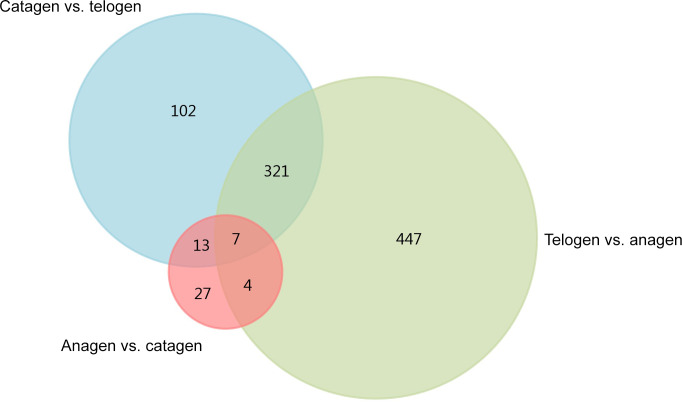
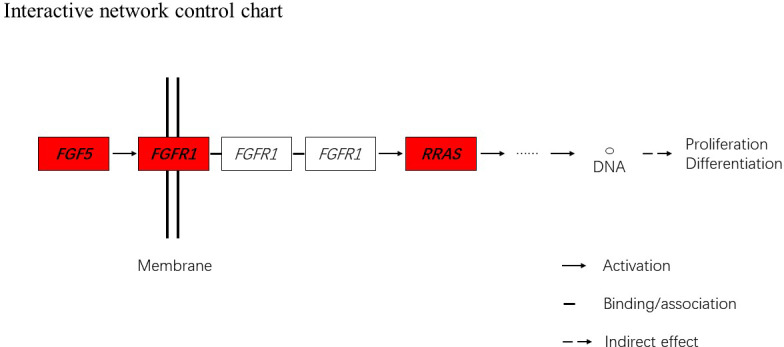
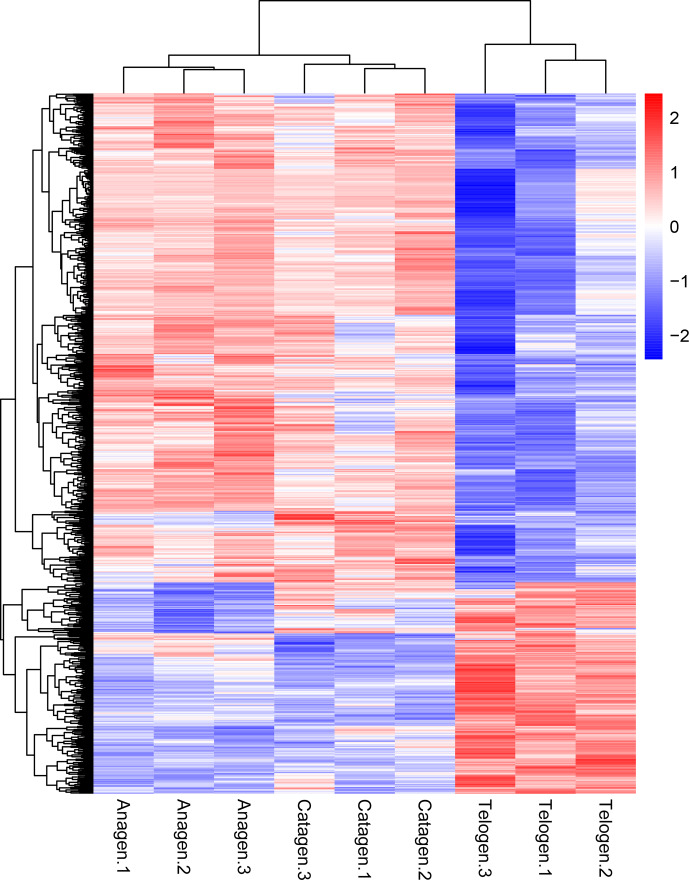
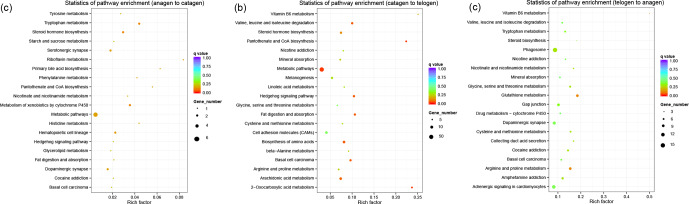
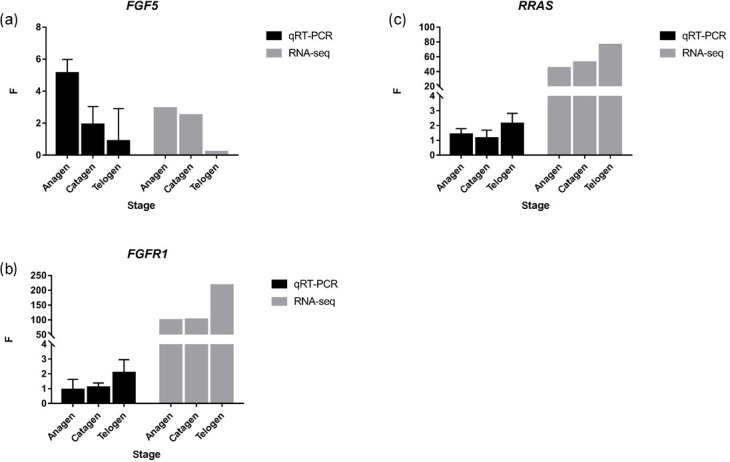
Inner Mongolian Cashmere goat is an excellent local breed selected for the dual-purpose of cashmere and meat. There are three lines of Inner Mongolian Cashmere goat: Erlangshan, Alashan and Aerbasi. Cashmere is a kind of precious textile raw material with a high price. Cashmere is derived from secondary hair follicle (SHF), while hair is derived from primary hair follicle (PHF). The growth cycle of SHF of cashmere goat is 1 year, and it can be divided into three different stages: anagen, catagen and telogen. In this study, we tried to find some important influence factors of SHF growth cycle in skin tissue from Inner Mongolian Cashmere goats by RNA sequencing (RNA-Seq). Three female Aerbasi Inner Mongolian Cashmere goats (2 years old) were used as experimental samples in this study. Skin samples were collected in September (anagen), December (catagen) and March (telogen) at dorsal side from cashmere goats. Results showed that over 511 396 044 raw reads and 487 729 890 clean reads were obtained from sequence data. In total, 51 different expression genes (DEGs) including 29 downregulated genes and 22 upregulated genes were enriched in anagen-catagen comparing group. The 443 DEGs contained 117 downregulated genes and 326 upregulated genes that were enriched in catagen-telogen comparing group. In telogen-anagen comparing group, 779 DEGs were enriched including 582 downregulated genes and 197 upregulated genes. The result of gene ontology (GO) annotation showed that DEGs are in different growth cycle periods, and enriched GO items are mostly related to the transformation of cell and protein. The Kyoto Encyclopedia of Genes and Genomes (KEGG) enrichment result indicated that metabolic process has a great impact on SHF growth cycle. Based on the results of a comprehensive analysis of differentially expressed genes, GO enrichment and KEGG enrichment, we found that , and had an effect on the hair follicle growth cycle. The results of this study may provide a theoretical basis for further research on the growth and development of SHF in Inner Mongolian Cashmere goats.
内蒙古绒山羊是一种优良的地方品种,具有绒肉兼用的特点。内蒙古绒山羊有三个品系:二郎山系、阿拉善系和阿尔巴斯系。羊绒是一种价格昂贵的珍贵纺织原料。羊绒源自次级毛囊(SHF),而毛发源自初级毛囊(PHF)。绒山羊次级毛囊的生长周期为1年,可分为三个不同阶段:生长期、退行期和休止期。在本研究中,我们试图通过RNA测序(RNA-Seq)找出内蒙古绒山羊皮肤组织中次级毛囊生长周期的一些重要影响因素。本研究使用了三只2岁的阿尔巴斯系内蒙古绒山羊母羊作为实验样本。于9月(生长期)、12月(退行期)和3月(休止期)采集绒山羊背部的皮肤样本。结果显示,从序列数据中获得了超过511396044条原始 reads 和487729890条clean reads。在生长期 - 退行期比较组中,共富集了51个差异表达基因(DEGs),其中包括29个下调基因和22个上调基因。在退行期 - 休止期比较组中,443个DEGs包含117个下调基因和326个上调基因。在休止期 - 生长期比较组中,富集了779个DEGs,包括582个下调基因和197个上调基因。基因本体(GO)注释结果表明,DEGs处于不同的生长周期阶段,富集的GO条目大多与细胞和蛋白质的转化有关。京都基因与基因组百科全书(KEGG)富集结果表明,代谢过程对次级毛囊生长周期有很大影响。基于对差异表达基因、GO富集和KEGG富集的综合分析结果,我们发现 、 和 对毛囊生长周期有影响。本研究结果可能为进一步研究内蒙古绒山羊次级毛囊的生长发育提供理论依据。