Lawinger Hannah, Khan Amina, Lysen Colleen, Oppert Marydale, Hill Vince R, Yoder Jonathan S, Roberts Virginia A, Mattioli Mia C, Hlavsa Michele C
MMWR Surveill Summ. 2024 Dec 5;73(8):1-15. doi: 10.15585/mmwr.ss7308a1.
PROBLEM/CONDITION: Splash pads are recreational interactive water venues that spray or jet water on users. Splash pads are intended for children aged <5 years and designed so that water typically does not collect in areas accessible to users, thereby minimizing the risk for drowning. Splash pads were first found to be associated with waterborne disease outbreaks in 1997.
1997-2022.
Since 1971, waterborne disease outbreaks have been voluntarily reported to CDC by state, local, and territorial health departments using a standard paper form via the Waterborne Disease and Outbreak Surveillance System (WBDOSS). Beginning in 2009, WBDOSS reporting was made available exclusively through the National Outbreak Reporting System, a web-based platform. This report characterizes waterborne disease outbreaks associated with splash pads reported to CDC that occurred during 1997-2022.
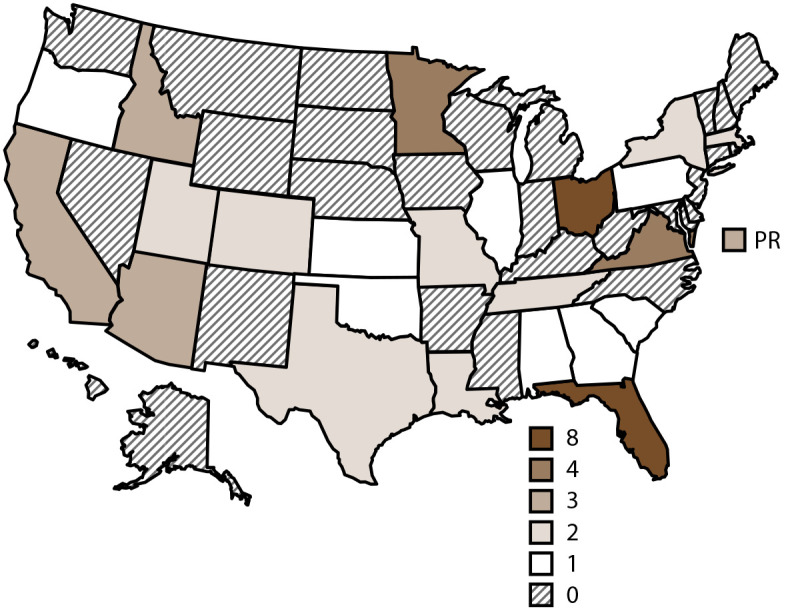
During 1997-2022, public health officials from 23 states and Puerto Rico reported 60 waterborne disease outbreaks associated with splash pads. These reported outbreaks resulted in 10,611 cases, 152 hospitalizations, 99 emergency department visits, and no reported deaths. The 40 (67%) outbreaks confirmed to be caused, in part, by Cryptosporidium resulted in 9,622 (91%) cases and 123 (81%) hospitalizations. Two outbreaks suspected to be caused by norovirus resulted in 72 (73%) emergency department visits.
Waterborne pathogens that cause acute gastrointestinal illness can be transmitted by ingesting water contaminated with feces from infected persons. Chlorine is the primary barrier to pathogen transmission in splash pad water. However, Cryptosporidium is tolerant to chlorine and is the most common cause of reported waterborne disease outbreaks associated with splash pads.
Public health officials and the aquatics sector can use the findings in this report to promote the prevention of splash pad-associated outbreaks (e.g., recommended user behaviors) and guide the construction, operation, and management of splash pads. Public health practitioners and the aquatics sector also can collaborate to voluntarily adopt CDC's Model Aquatic Health Code recommendations to prevent waterborne illness associated with splash pads.
问题/状况:戏水池是一种娱乐性互动水上场所,会向使用者喷水或射水。戏水池面向5岁以下儿童设计,通常不会在使用者可触及的区域积水,从而将溺水风险降至最低。1997年首次发现戏水池与水传播疾病暴发有关。
1997年至2022年。
自1971年以来,州、地方和地区卫生部门通过《水传播疾病与暴发监测系统》(WBDOSS)使用标准纸质表格,自愿向美国疾病控制与预防中心报告水传播疾病暴发情况。从2009年开始,WBDOSS报告仅通过基于网络的平台《国家暴发报告系统》提供。本报告描述了1997年至2022年期间向美国疾病控制与预防中心报告的与戏水池相关的水传播疾病暴发情况。
在1997年至2022年期间,来自23个州和波多黎各的公共卫生官员报告了60起与戏水池相关的水传播疾病暴发。这些报告的暴发导致10611例病例、152例住院、99次急诊就诊,且无死亡报告。40起(67%)暴发被确认为部分由隐孢子虫引起,导致9622例(91%)病例和123例(81%)住院。两起疑似由诺如病毒引起的暴发导致72次(73%)急诊就诊。
导致急性胃肠疾病的水传播病原体可通过摄入被感染者粪便污染的水传播。氯是戏水池水中病原体传播的主要屏障。然而,隐孢子虫对氯具有耐受性,是报告的与戏水池相关的水传播疾病暴发的最常见原因。
公共卫生官员和水上娱乐行业可利用本报告中的研究结果,促进预防与戏水池相关的疾病暴发(如推荐的使用者行为),并指导戏水池的建设、运营和管理。公共卫生从业者和水上娱乐行业也可合作,自愿采用美国疾病控制与预防中心的《水上健康规范模型》建议,以预防与戏水池相关的水传播疾病。