Li Mei-Xin, Hu Sheng, Lei He-Hua, Yuan Meng, Li Xu, Hou Wen-Kui, Huang Xiang-Jie, Xiao Bing-Wen, Yu Teng-Xiang, Zhang Xiao-Hui, Wu Xiao-Ting, Jing Wen-Qiang, Lee Hyeon-Jeong, Li Juan-Juan, Fu Da, Zhang Li-Min, Yan Wei
Hubei Key Laboratory of Cell Homeostasis, College of Life Sciences, TaiKang Center for Life and Medical Sciences, Wuhan University, Wuhan, Hubei, 430072, China.
State Key Laboratory of Magnetic Resonance and Atomic and Molecular Physics, National Centre for Magnetic Resonance in Wuhan, Innovation Academy of Precision Measurement Science and Technology, Chinese Academy of Sciences (CAS), Wuhan, Hubei, 430064, China.
Nat Commun. 2024 Dec 3;15(1):10539. doi: 10.1038/s41467-024-54706-z.
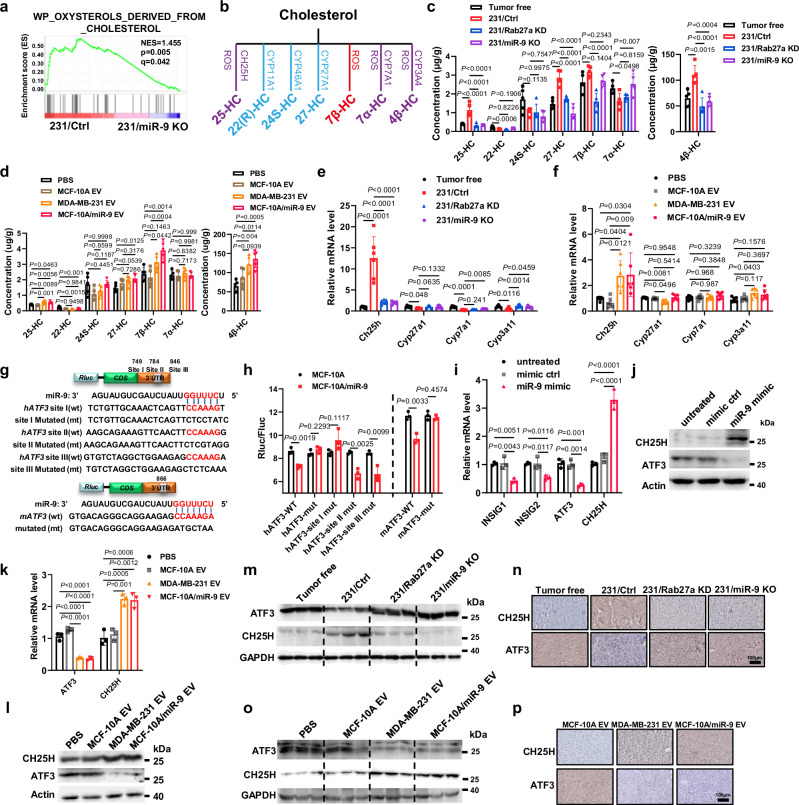
Cancer cells secrete extracellular vesicles (EV) encapsulating bioactive cargoes to facilitate inter-organ communication in vivo and are emerging as critical mediators of tumor progression and metastasis, a condition which is often accompanied by a dysregulated cholesterol metabolism. Whether EVs are involved in the control of cholesterol homeostasis during tumor metastasis is still undefined and warrant further investigation. Here, we find that breast cancer-derived exosomal miR-9-5p induces the expression of HMGCR and CH25H, two enzymes involved in cholesterol synthesis and the conversion of 25-hydroxycholesterol from cholesterol by targeting INSIG1, INSIG2 and ATF3 genes in the liver. Notably, in vivo miR-9-5p antagomir treatment and genetic CH25H ablation prevents tumor metastasis in a mouse model of breast cancer. Thus, our findings reveal the regulatory mechanism of tumor-derived miR-9-5p in liver metastasis by linking oxysterol metabolism and Kupffer cell polarization, shedding light on future applications for cancer diagnosis and treatment.
癌细胞分泌包裹生物活性物质的细胞外囊泡(EV),以促进体内器官间的通讯,并逐渐成为肿瘤进展和转移的关键介质,而肿瘤进展和转移往往伴随着胆固醇代谢失调。EV 是否参与肿瘤转移过程中胆固醇稳态的调控仍不明确,值得进一步研究。在这里,我们发现乳腺癌来源的外泌体 miR-9-5p 通过靶向肝脏中的 INSIG1、INSIG2 和 ATF3 基因,诱导参与胆固醇合成以及将胆固醇转化为 25-羟基胆固醇的两种酶 HMGCR 和 CH25H 的表达。值得注意的是,在乳腺癌小鼠模型中,体内 miR-9-5p 拮抗剂治疗和 CH25H 基因消融可预防肿瘤转移。因此,我们的研究结果通过将氧化甾醇代谢与库普弗细胞极化联系起来,揭示了肿瘤来源的 miR-9-5p 在肝转移中的调控机制,为癌症诊断和治疗的未来应用提供了线索。