Gabel-Pfisterer Ameli, Lang Stefan Johann, Boehringer Daniel, Agostini Hansjürgen, de Geus Lotte C, de Faber Jan Tjeerd
Department of Ophthalmology, Ernst-Von-Bergmann Hospital, Potsdam, Germany.
Department of Ophthalmology, Brandenburg Medical School Theodor Fontane (MHB), University Hospital Brandenburg, Brandenburg/ Havel, Germany.
Graefes Arch Clin Exp Ophthalmol. 2025 Apr;263(4):1157-1165. doi: 10.1007/s00417-024-06677-6. Epub 2024 Dec 4.
After 2 years of pandemic sales ban, on New Year`s Eve 2022/23 consumer firework articles were officially available again in Germany and the Netherlands.
In the Netherlands we prospectively and anonymously collected data on patients treated for firework induced eye injuries from 2009 on, in Germany since 2016.
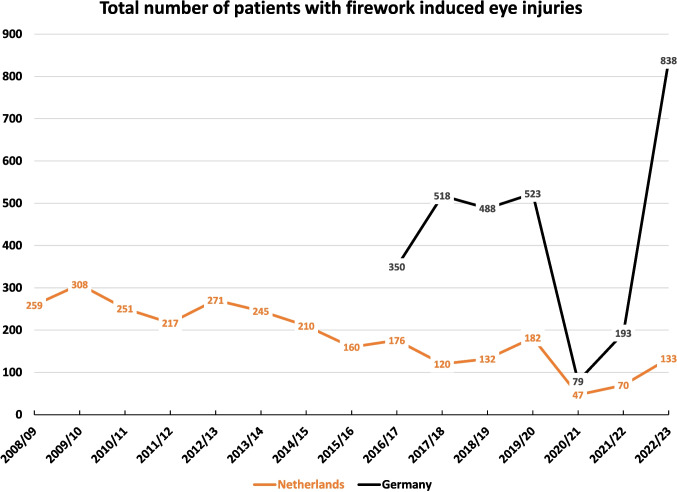
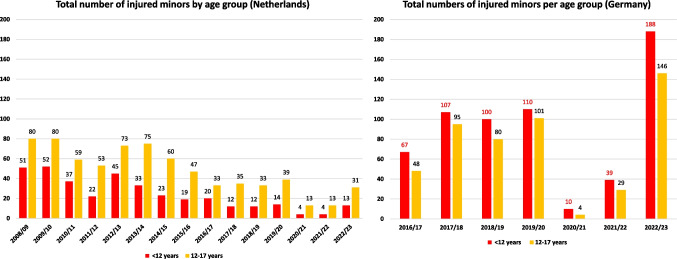
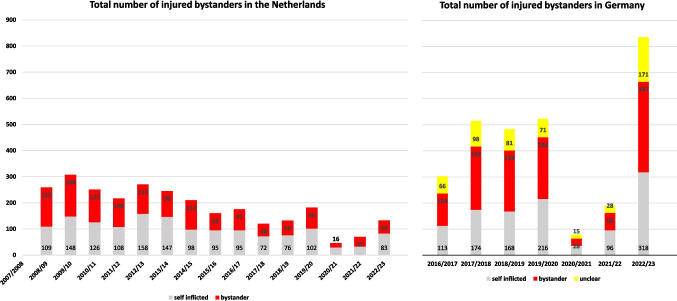
Around New Year ́s Eve 2022/23 the number of patients with firework inflicted eye injuries increased in the Netherlands to 133 and in Germany to 838. In both countries the participation of eye departments was 90%. The incidence of firework induced eye injuries in the Netherlands was 0,8 /100 000 in 2022/23, in Germany 1,0 /100 000 in 2022/23. Comparing age groups of minors with firework induced eye injuries, in the Netherlands, total numbers of children below 12 years was lower than total numbers of adolescents between 12 and 17 years. Yet, in Germany from 2016 on every year, total number of children below 12 years were higher than total number of adolescents. The number of patients who reported on being injured as bystander was between 34% in 2020/21 and 53% in both countries.
While the incidence of firework induced eye injuries in the Netherlands was reduced due to awareness campaigns and regulatory work, the incidence was increasing on the first New Year`s Eve after the pandemic regulations of consumer fireworks in Germany. Especially young children below 12 years need more protection in Germany. In both countries, effective measures of protection need to be implemented for protection of bystanders, whose numbers were low during the first pandemic years.
What is known: overrepresentation of affected minors below 18 years and a rate of up to 50% of injured bystanders according to our data collection over 15 years in the Netherlands and 7 years in Germany What is new: In 2022/2023, total numbers of patients with fire work induced eye injuries in the Netherlands and Germany increased significantly after 2 years of pandemic regulations with a sales ban of consumer fire work articles In 2022/23, incidence of firework induced eye injuries is 1/100 000 in Germany, 0,8/100 000 in the Netherlands Among affected minors in Germany school children up to 12 years are at higher risk than adolescents.
在实施了两年的烟花销售禁令后,2022年新年前夜,德国和荷兰正式再次允许销售面向消费者的烟花制品。
在荷兰,我们自2009年起前瞻性地、匿名收集因烟花导致眼部受伤而接受治疗的患者数据;在德国,则自2016年起开始收集。
在2022/23年新年前夜前后,荷兰因烟花导致眼部受伤的患者人数增至133人,德国则增至838人。两国眼科部门的参与率均为90%。2022/23年,荷兰因烟花导致眼部受伤的发病率为0.8/10万,德国为1.0/10万。比较因烟花导致眼部受伤的未成年人年龄组,在荷兰,12岁以下儿童的总数低于12至17岁青少年的总数。然而,在德国,自2016年起,每年12岁以下儿童的总数高于青少年的总数。报告称自己是旁观者而受伤的患者人数在两国占比介于2020/21年的34%至53%之间。
尽管荷兰通过开展宣传活动和监管工作,因烟花导致眼部受伤的发病率有所降低,但在德国,在实施了关于消费烟花的疫情管控规定后的首个新年前夜,该发病率却在上升。在德国,尤其12岁以下的幼儿需要更多保护。在两国,都需要实施有效的保护措施,以保护旁观者,在疫情管控的头几年,旁观者受伤的人数较少。
已知情况:根据我们在荷兰15年和德国7年的数据收集,18岁以下受影响的未成年人占比过高,受伤旁观者的比例高达50% 新情况:在实施了两年关于禁止销售面向消费者的烟花制品的疫情管控规定后,2022/2023年,荷兰和德国因烟花导致眼部受伤的患者总数显著增加 2022/23年,德国因烟花导致眼部受伤的发病率为1/10万,荷兰为0.8/10万 在德国受影响的未成年人中,12岁及以下的学童比青少年面临更高风险