Hong Juhyeon, Lee Dajun, Hwang Ayoung, Kim Taekeun, Ryu Hong-Yeoul, Choi Jungmin
Department of Biomedical Sciences, Korea University College of Medicine, Seoul, 02841, Republic of Korea.
School of Life Sciences, BK21 FOUR KNU Creative BioResearch Group, College of Natural Sciences, Kyungpook National University, Daegu, 41566, Republic of Korea.
Genomics Inform. 2024 Dec 3;22(1):28. doi: 10.1186/s44342-024-00032-1.
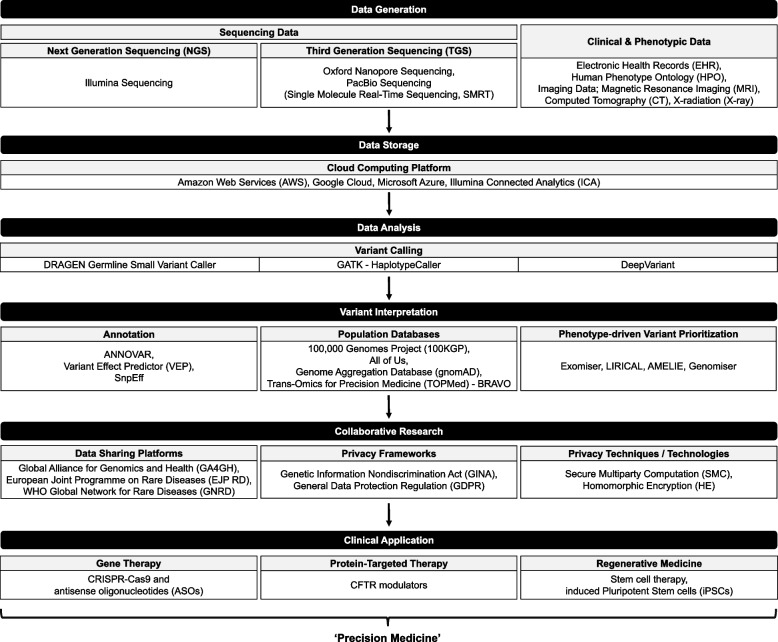
Rare diseases, though individually uncommon, collectively affect millions worldwide. Genomic technologies and big data analytics have revolutionized diagnosing and understanding these conditions. This review explores the role of genomics in rare disease research, the impact of large consortium initiatives, advancements in extensive data analysis, the integration of artificial intelligence (AI) and machine learning (ML), and the therapeutic implications in precision medicine. We also discuss the challenges of data sharing and privacy concerns, emphasizing the need for collaborative efforts and secure data practices to advance rare disease research.
罕见病虽然单种疾病并不常见,但在全球范围内总计影响着数百万人。基因组技术和大数据分析已经彻底改变了对这些疾病的诊断和认知。本综述探讨了基因组学在罕见病研究中的作用、大型联盟计划的影响、广泛数据分析的进展、人工智能(AI)和机器学习(ML)的整合,以及在精准医学中的治疗意义。我们还讨论了数据共享的挑战和隐私问题,强调需要通过合作努力和安全的数据实践来推进罕见病研究。