S Sowmiya, L S Dhivya, Rajendran Praveen, N Harikrishnan, Singh S Ankul
Department of Pharmacology, Dr M.G.R. Educational and Research Institute, Poonamalle High Road, Velappanchavadi, Chennai, Tamil Nadu 600 077, India.
Department of Pharmaceutical Chemistry, Dr M.G.R. Educational and Research Institute, Poonamalle High Road, Velappanchavadi, Chennai, Tamil Nadu 600 077, India.
IBRO Neurosci Rep. 2024 Nov 8;17:441-455. doi: 10.1016/j.ibneur.2024.11.004. eCollection 2024 Dec.
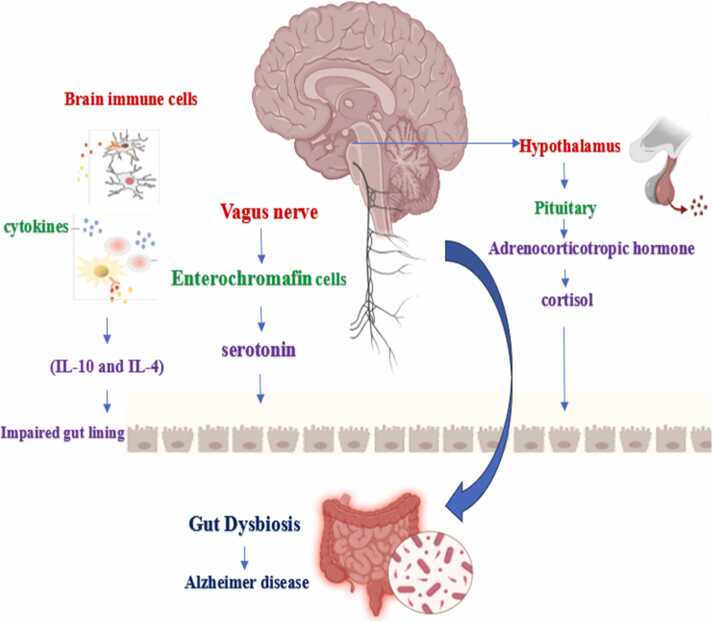
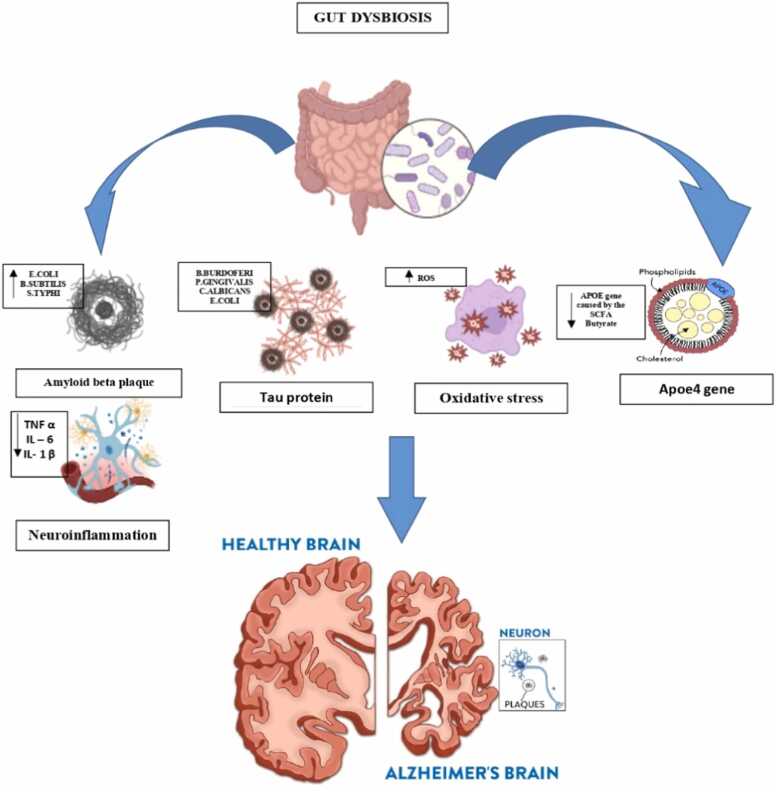
Alzheimer's disease is a fatal neurodegenerative disorder that causes memory loss and cognitive decline in older people. There is increasing evidence suggesting that gut microbiota alteration is a cause of Alzheimer's disease pathogenesis. This review explores the link between gut dysbiosis and the development of Alzheimer's disease contributing to neuroinflammation, amyloid β accumulation, and cognitive decline. We examine the recent studies that illustrate the gut-brain axis (GBA) as a bidirectional communication between the gut and brain and how its alteration can influence neurological health. Furthermore, we discuss the potential of probiotic supplementation as a management approach to restore gut microbiota balance, and ultimately improve cognitive function in AD patients. Based on current research findings, this review aims to provide insights into the promising role of probiotics in Alzheimer's disease management and the need for further investigation into microbiota-targeted interventions.
阿尔茨海默病是一种致命的神经退行性疾病,会导致老年人记忆力丧失和认知能力下降。越来越多的证据表明,肠道微生物群改变是阿尔茨海默病发病机制的一个原因。本综述探讨了肠道菌群失调与阿尔茨海默病发展之间的联系,这种联系导致神经炎症、β-淀粉样蛋白积累和认知能力下降。我们研究了最近的一些研究,这些研究阐明了肠-脑轴(GBA)是肠道与大脑之间的双向通信途径,以及其改变如何影响神经健康。此外,我们讨论了补充益生菌作为恢复肠道微生物群平衡、最终改善AD患者认知功能的一种管理方法的潜力。基于目前的研究结果,本综述旨在深入了解益生菌在阿尔茨海默病管理中的潜在作用,以及对以微生物群为靶点的干预措施进行进一步研究的必要性。