Colenso-Semple Lauren M, McKendry James, Lim Changhyun, Atherton Philip J, Wilkinson Daniel J, Smith K, Phillips Stuart M
Exercise Metabolism Research Group, Department of Kinesiology, McMaster University, Hamilton, ON, Canada.
Food, Nutrition and Health, Faculty of Land and Food Systems, The University of British Columbia, Vancouver, BC, Canada.
J Physiol. 2025 Mar;603(5):1109-1121. doi: 10.1113/JP287342. Epub 2024 Dec 4.
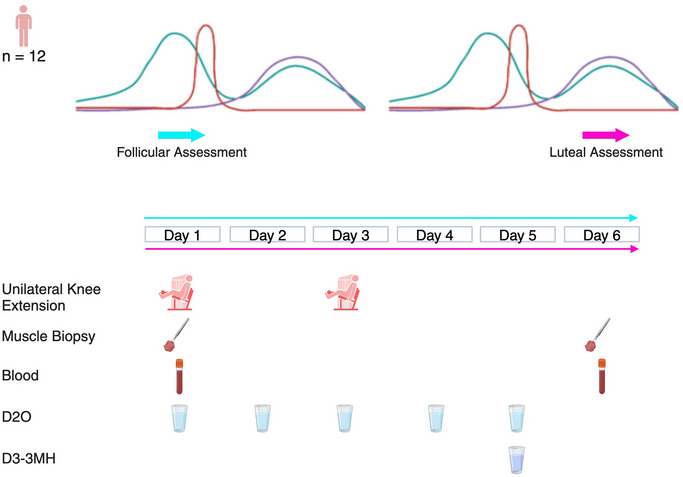
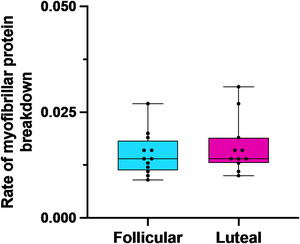
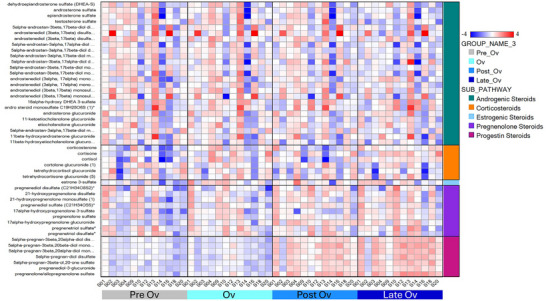
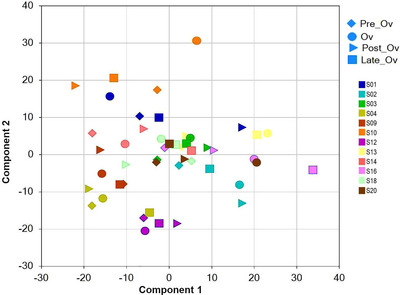
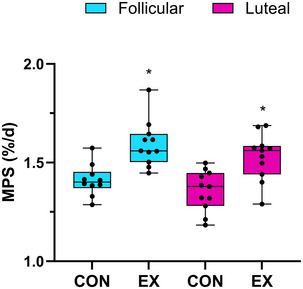
It has been hypothesised that skeletal muscle protein turnover is affected by menstrual cycle phase with a more anabolic environment during the follicular vs. the luteal phase. We assessed the influence of menstrual cycle phase on muscle protein synthesis and myofibrillar protein breakdown in response to 6 days of controlled resistance exercise in young females during peak oestrogen and peak progesterone, using stable isotopes, unbiased metabolomics and muscle biopsies. We used comprehensive menstrual cycle phase-detection methods, including cycle tracking, blood samples and urinary test kits, to classify menstrual phases. Participants (n = 12) completed two 6 day study phases in a randomised order: late follicular phase and mid-luteal phase. Participants performed unilateral resistance exercise in each menstrual cycle phase, exercising the contralateral leg in each phase in a counterbalanced manner. Follicular phase myofibrillar protein synthesis (MPS) rates were 1.33 ± 0.27% d in the control leg and 1.52 ± 0.27% d in the exercise leg. Luteal phase MPS was 1.28 ± 0.27% d in the control leg and 1.46 ± 0.25% d in the exercise leg. We observed a significant effect of exercise (P < 0.001) but no effect of cycle phase or interaction. There was no significant effect of menstrual cycle phase on whole-body myofibrillar protein breakdown (P = 0.24). Using unbiased metabolomics, we observed no notable phase-specific changes in circulating blood metabolites associated with any particular menstrual cycle phase. Fluctuations in endogenous ovarian hormones influenced neither MPS, nor MPB in response to resistance exercise. Skeletal muscle is not more anabolically responsive to resistance exercise in a particular menstrual cycle phase. KEY POINTS: It has been hypothesised that the follicular (peak oestrogen) vs. the luteal (peak progesterone) phase of the menstrual cycle is more advantageous for skeletal muscle anabolism in response to resistance exercise. Using best practice methods to assess menstrual cycle status, we measured integrated (over 6 days) muscle protein synthesis (MPS) and myofibrillar protein breakdown (MPB) following resistance exercise in females (n = 12) in their follicular and luteal phases. We observed the expected differences in oestrogen and progesterone concentrations that confirmed our participants' menstrual cycle phase; however, there were no notable metabolic pathway differences, as measured using metabolomics, between cycle phases. We observed that resistance exercise stimulated MPS, but there was no effect of menstrual cycle phase on either resting or exercise-stimulated MPS or MPB. Our data show no greater anabolic effect of resistance exercise in the follicular vs. the luteal phase of the menstrual cycle.
有假说认为,骨骼肌蛋白质周转受月经周期阶段的影响,在卵泡期相对于黄体期具有更合成代谢的环境。我们评估了月经周期阶段对年轻女性在雌激素峰值和孕激素峰值期间进行6天控制性抗阻运动时肌肉蛋白质合成和肌原纤维蛋白分解的影响,采用了稳定同位素、非靶向代谢组学和肌肉活检技术。我们使用了全面的月经周期阶段检测方法,包括周期跟踪、血液样本和尿液检测试剂盒,来对月经阶段进行分类。参与者(n = 12)以随机顺序完成了两个6天的研究阶段:卵泡晚期和黄体中期。参与者在每个月经周期阶段进行单侧抗阻运动,在每个阶段以平衡的方式锻炼对侧腿。卵泡期对照腿的肌原纤维蛋白合成(MPS)率为1.33±0.27%/天,运动腿为1.52±0.27%/天。黄体期对照腿的MPS为1.28±0.27%/天,运动腿为1.46±0.25%/天。我们观察到运动有显著影响(P < 0.001),但周期阶段或交互作用没有影响。月经周期阶段对全身肌原纤维蛋白分解没有显著影响(P = 0.24)。使用非靶向代谢组学,我们观察到与任何特定月经周期阶段相关的循环血液代谢物没有明显的阶段特异性变化。内源性卵巢激素的波动既不影响MPS,也不影响抗阻运动后的MPB。骨骼肌在特定月经周期阶段对抗阻运动的合成代谢反应并不更强。要点:有假说认为,月经周期的卵泡期(雌激素峰值)相对于黄体期(孕激素峰值)在抗阻运动时对骨骼肌合成代谢更有利。我们采用最佳实践方法评估月经周期状态,测量了女性(n = 12)在卵泡期和黄体期进行抗阻运动后6天综合的肌肉蛋白质合成(MPS)和肌原纤维蛋白分解(MPB)。我们观察到雌激素和孕激素浓度有预期差异,证实了我们参与者的月经周期阶段;然而,使用代谢组学测量,各周期阶段之间没有明显的代谢途径差异。我们观察到抗阻运动刺激了MPS,但月经周期阶段对静息或运动刺激的MPS或MPB均无影响。我们的数据表明,月经周期的卵泡期和黄体期相比,抗阻运动的合成代谢作用并无更大差异。