
从多种木质纤维素来源中提取羟基肉桂酸:与底物组成及分类学的相关性,用于调味和抗氧化应用
Hydroxycinnamic Acid Extraction from Multiple Lignocellulosic Sources: Correlations with Substrate Composition and Taxonomy for Flavoring and Antioxidant Applications.
作者信息
Tramontina Robson, Scopel Eupidio, Cardoso Victor Gustavo Kelis, Martins Manoela, da Silva Marcos Fellipe, Flaibam Bárbara, Salvador Marcos J, Goldbeck Rosana, Damasio André, Squina Fabio Marcio
机构信息
Laboratório de Ciências Moleculares, Universidade de Sorocaba (UNISO), Sorocaba, São Paulo 18023-000, Brazil.
Instituto de Química, Universidade Estadual de Campinas (UNICAMP), Campinas, São Paulo 13083-970, Brazil.
出版信息
J Agric Food Chem. 2024 Dec 18;72(50):28048-28059. doi: 10.1021/acs.jafc.4c08540. Epub 2024 Dec 4.
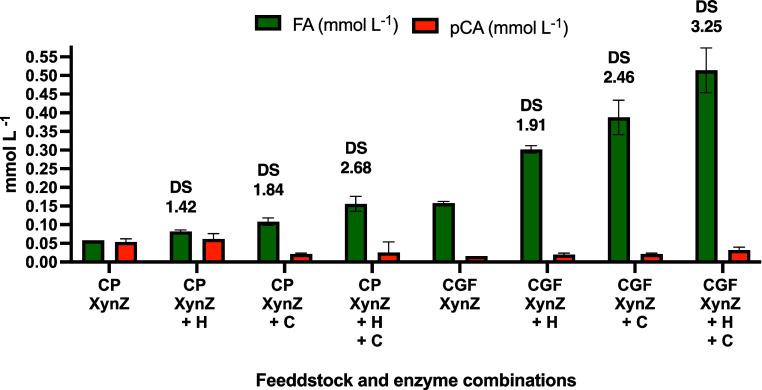
The extraction of hydroxycinnamic acids (HCADs) is a strategy for lignocellulosic biomass valorization due to their high value-added nature and the possibility of application as flavoring and antioxidants. This study proposes correlations between the composition and taxonomy of 28 globally available agro-industrial feedstocks with the production of HCADs using chemometric tools. Principal component analysis indicated strong correlations between ferulic acid release and hemicellulose type and content, especially in grass biomasses. Conversely, coumaric acid release was mainly correlated with cellulose content across diverse taxonomic origins. Among the evaluated agro-industrial feedstocks, corn-based biomasses were identified as prime sources of ferulic acid after mild alkaline treatment, releasing up to 10.5 g kg and producing hydrolysates with an antioxidant capacity up to 3.3 mmol Trolox equivalents g. Notably, sugar cane bagasse was the best source of -coumaric acid, yielding 4.8 g kg. Corn hydrolysates were successfully converted into 4-vinylguaiacol using a genetically modified strain, achieving high yields of 0.75 g L. This work enhances our understanding of HCAD sources and biomass valorization strategies, demonstrating potential applications in the food and cosmetics sectors.
由于羟基肉桂酸(HCADs)具有高附加值的特性以及作为调味剂和抗氧化剂的应用可能性,其提取是木质纤维素生物质增值的一种策略。本研究使用化学计量工具提出了28种全球可用的农业工业原料的组成和分类与HCADs生产之间的相关性。主成分分析表明,阿魏酸的释放与半纤维素类型和含量之间存在很强的相关性,尤其是在草类生物质中。相反,香豆酸的释放在不同分类来源中主要与纤维素含量相关。在评估的农业工业原料中,经过温和碱性处理后,玉米基生物质被确定为阿魏酸的主要来源,释放量高达10.5 g/kg,产生的水解产物抗氧化能力高达3.3 mmol Trolox当量/g。值得注意的是,甘蔗渣是对香豆酸的最佳来源,产量为4.8 g/kg。使用转基因菌株成功地将玉米水解产物转化为4-乙烯基愈创木酚,实现了0.75 g/L的高产率。这项工作增进了我们对HCADs来源和生物质增值策略的理解,展示了在食品和化妆品行业的潜在应用。



 Zotero 插件