Castle Laurence, Andreassen Monica, Aquilina Gabriele, Bastos Maria, Boon Polly, Fallico Biagio, FitzGerald Reginald, Frutos Fernandez Maria Jose, Grasl-Kraupp Bettina, Gundert-Remy Ursula, Gürtler Rainer, Houdeau Eric, Kurek Marcin, Louro Henriqueta, Morales Patricia, Passamonti Sabina, Degen Gisela, Engel Karl-Heinz, Fowler Paul, Carfí Maria, Civitella Consuelo, Dino Borana, Gagliardi Gabriele, Mech Agnieszka, Zakidou Panagiota, Martino Carla
EFSA J. 2024 Dec 4;22(12):e9091. doi: 10.2903/j.efsa.2024.9091. eCollection 2024 Dec.
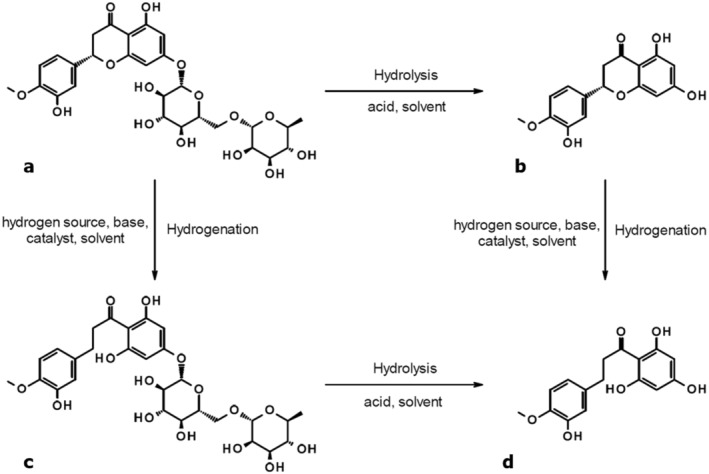
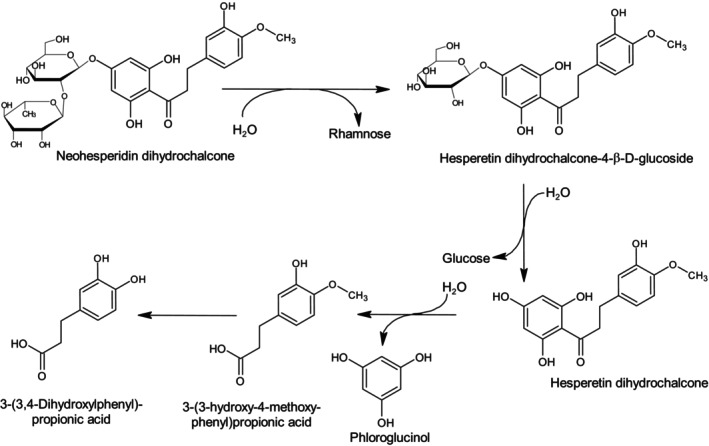
The EFSA Panel on Food Additives and Flavourings (FAF) was requested to evaluate the safety of hesperetin dihydrochalcone [FL-no: 16.137] as a new flavouring substance, in accordance with Regulation (EC) No 1331/2008. The substance is structurally related to the group of flavonoids evaluated in FGE.32 and is the aglycone of neohesperidine dihydrochalcone. Based on the data provided for [FL-no: 16.137], the Panel considered that a read-across between hesperetin dihydrochalcone and the substances in FGE.32 is not needed. Nevertheless, the flavonoids evaluated in FGE.32 were considered in a cumulative exposure assessment. The information provided on the manufacturing process, the composition and the stability of [FL-no: 16.137] was considered sufficient. The Panel concluded that there is no concern with respect to genotoxicity. No absorption, distribution, metabolism and excretion (ADME) studies on [FL-no: 16.137] were provided, but studies investigating the ADME of neohesperidine dihydrochalcone were submitted. The Panel noted that [FL-no: 16.137] has the same fate in the organism, as that of neohesperidine dihydrochalcone and considered that [FL-no: 16.137] can be anticipated to be metabolised to innocuous products only. In a prenatal developmental toxicity study, no maternal or foetal toxicity was observed. In a 90-day toxicity study, indications were obtained that the substance affects thyroid hormone levels at all doses tested (100-1000 mg/kg bw per day). Since these changes were not accompanied by apical findings indicative of hypothyroidism, the Panel considered these hormonal effects as not adverse. Using 1000 mg/kg bodyweight (bw) per day as reference point, adequate margins of exposure were calculated for adults and children, when considering the chronic added portions exposure technique (APET) dietary exposure estimates. Cumulative chronic exposure estimates to [FL-no: 16.137] and the four structurally related substances evaluated in FGE.32 do not raise a safety concern. The use of [FL-no: 16.137] as food flavouring, under the proposed conditions of use, does not raise a safety concern.
应要求,欧洲食品安全局食品添加剂和调味剂专家委员会(FAF)根据欧盟法规(EC)No 1331/2008,对橙皮素二氢查耳酮[FL编号:16.137]作为一种新型调味物质的安全性进行评估。该物质在结构上与FAF第32号意见书中评估的黄酮类化合物相关,是新橙皮苷二氢查耳酮的苷元。根据提供的[FL编号:16.137]的数据,专家委员会认为无需在橙皮素二氢查耳酮与FAF第32号意见书中的物质之间进行类推。尽管如此,在累积暴露评估中还是考虑了FAF第32号意见书中评估的黄酮类化合物。所提供的关于[FL编号:16.137]的生产工艺、成分和稳定性的信息被认为是充分的。专家委员会得出结论,该物质不存在遗传毒性方面的问题。未提供关于[FL编号:16.137]的吸收、分布、代谢和排泄(ADME)研究,但提交了有关新橙皮苷二氢查耳酮ADME的研究。专家委员会指出,[FL编号:16.137]在生物体内的代谢情况与新橙皮苷二氢查耳酮相同,并认为[FL编号:16.137]预计只会代谢为无害产物。在一项产前发育毒性研究中,未观察到母体或胎儿毒性。在一项90天毒性研究中,有迹象表明该物质在所有测试剂量(每天100 - 1000 mg/kg体重)下都会影响甲状腺激素水平。由于这些变化并未伴有表明甲状腺功能减退的顶端效应,专家委员会认为这些激素效应并非有害。以每天1000 mg/kg体重作为参考点,在考虑慢性添加量暴露技术(APET)膳食暴露估计值时,计算出了成人和儿童足够的暴露余量。对[FL编号:16.137]以及FAF第32号意见书中评估的四种结构相关物质的累积慢性暴露估计值并未引发安全担忧。在拟议的使用条件下,将[FL编号:16.137]用作食品调味剂不会引发安全担忧。