More Simon, Bampidis Vasileios, Benford Diane, Bragard Claude, Halldorsson Thorhallur, Hernández-Jerez Antonio, Bennekou Susanne Hougaard, Koutsoumanis Kostas, Lambré Claude, Machera Kyriaki, Naegeli Hanspeter, Nielsen Søren, Schlatter Josef, Schrenk Dieter, Silano Deceased Vittorio, Turck Dominique, Younes Maged, Castenmiller Jacqueline, Chaudhry Qasim, Cubadda Francesco, Franz Roland, Gott David, Mast Jan, Mortensen Alicja, Oomen Agnes G, Weigel Stefan, Barthelemy Eric, Rincon Ana, Tarazona Jose, Schoonjans Reinhilde
EFSA J. 2021 Aug 3;19(8):e06769. doi: 10.2903/j.efsa.2021.6769. eCollection 2021 Aug.
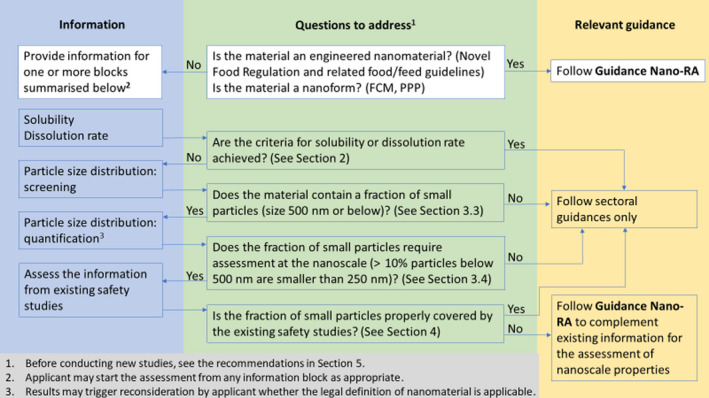
Following a mandate from the European Commission, EFSA has developed a Guidance on Technical Requirements (Guidance on Particle-TR), defining the criteria for assessing the presence of a fraction of small particles, and setting out information requirements for applications in the regulated food and feed product areas (e.g. novel food, food/feed additives, food contact materials and pesticides). These requirements apply to particles requiring specific assessment at the nanoscale in conventional materials that do not meet the definition of engineered nanomaterial as set out in the Novel Food Regulation (EU) 2015/2283. The guidance outlines appraisal criteria grouped in three sections, to confirm whether or not the conventional risk assessment should be complemented with nanospecific considerations. The first group addresses solubility and dissolution rate as key physicochemical properties to assess whether consumers will be exposed to particles. The second group establishes the information requirements for assessing whether the conventional material contains a fraction or consists of small particles, and its characterisation. The third group describes the information to be presented for existing safety studies to demonstrate that the fraction of small particles, including particles at the nanoscale, has been properly evaluated. In addition, in order to guide the appraisal of existing safety studies, recommendations for closing the data gaps while minimising the need for conducting new animal studies are provided. This Guidance on Particle-TR complements the Guidance on risk assessment of nanomaterials to be applied in the food and feed chain, human and animal health updated by the EFSA Scientific Committee as co-published with this Guidance. Applicants are advised to consult both guidance documents before conducting new studies.
应欧盟委员会的要求,欧洲食品安全局(EFSA)制定了《技术要求指南》(《颗粒TR指南》),定义了评估小颗粒部分存在情况的标准,并规定了在受监管的食品和饲料产品领域(如新型食品、食品/饲料添加剂、食品接触材料和农药)应用的信息要求。这些要求适用于在常规材料中需要在纳米尺度进行特定评估的颗粒,这些常规材料不符合《2015/2283号欧盟新型食品法规》中规定的工程纳米材料的定义。该指南概述了分为三个部分的评估标准,以确认常规风险评估是否应以纳米特定考虑因素作为补充。第一组涉及溶解度和溶解速率,作为评估消费者是否会接触颗粒的关键物理化学性质。第二组规定了评估常规材料是否含有小颗粒部分或由小颗粒组成及其特性的信息要求。第三组描述了现有安全性研究应提供的信息,以证明小颗粒部分,包括纳米尺度的颗粒,已得到适当评估。此外,为了指导对现有安全性研究的评估,提供了关于填补数据空白同时尽量减少进行新动物研究需求的建议。本《颗粒TR指南》补充了欧洲食品安全局科学委员会更新的、与本指南共同发布的《食品和饲料链、人类和动物健康中应用的纳米材料风险评估指南》。建议申请人在开展新研究之前查阅这两份指南文件。