Samsonas Danielius, Skliutas Edvinas, Čiburys Arūnas, Kontenis Lukas, Gailevičius Darius, Berzinš Jonas, Narbutis Donatas, Jukna Vytautas, Vengris Mikas, Juodkazis Saulius, Malinauskas Mangirdas
Laser Research Center, Physics Faculty, Vilnius University, Sauletekio Ave. 10, Vilnius, Lithuania.
Light Conversion, Keramikų 2b, Vilnius, LT-10223, Lithuania.
Nanophotonics. 2023 Jan 13;12(8):1537-1548. doi: 10.1515/nanoph-2022-0629. eCollection 2023 Apr.
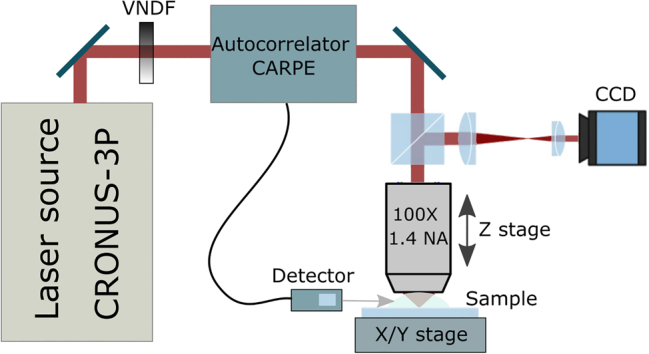
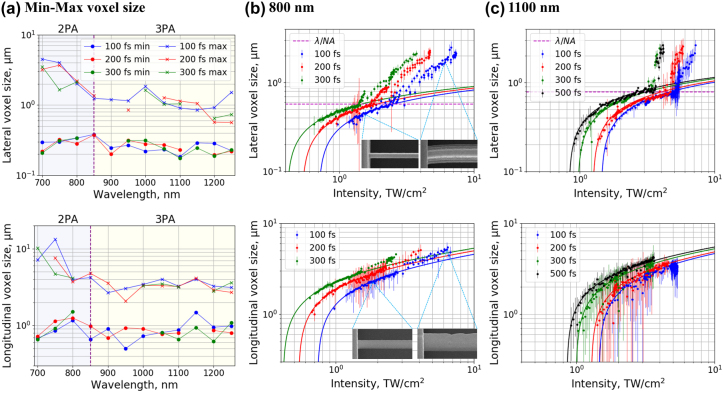
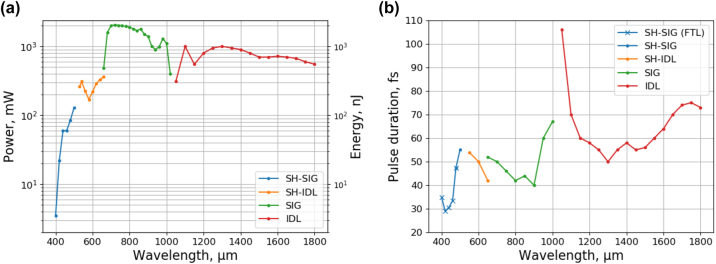
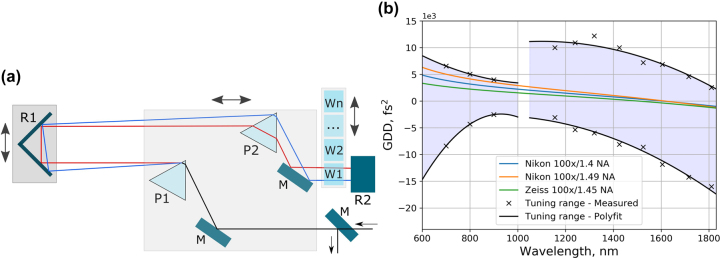
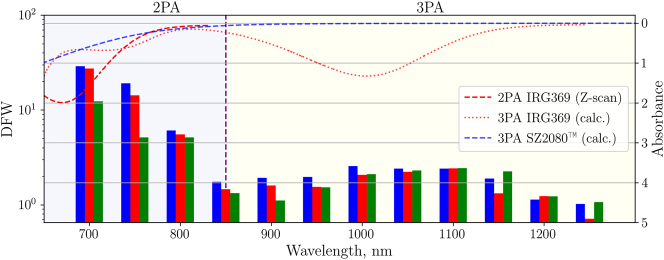
The dependence of the polymerization and optical damage thresholds in multi-photon polymerization (MPP) lithography was studied using a broadly-tunable laser system with group delay dispersion (GDD) control. The order of non-linearity and the light-matter interaction mechanisms were investigated using the resolution bridges method for non-photosensitized SZ2080 and photosensitized SZ2080 + IRG369 prepolymers. Energy deposition, voxel dimension growth, and the size of the dynamic fabrication window (DFW) were measured in the 700-1300 nm wavelength range at three different pulse durations measured at the sample - 100, 200 and 300 fs. Polymerization was observed at all wavelengths and pulse durations without significant differences in the achieved minimal spatial dimension ( nm). This was achieved despite the broad range of excitation wavelengths used which spanned two- and three-photon absorption bands, and the differences in the absorption spectra of the prepolymers. The lateral and longitudinal voxel growth dynamics revealed an abrupt change in the power dependence of polymerization and a significant variation of the DFW - from 1 at 1250 nm to 29 at 700 nm. This result can be interpreted as a consequence of a change in the instantaneous refractive index and a lowering of the polymerization but not the damage threshold. The optimization of energy delivery to the material by a wavelength-tunable laser source with pulse duration control was experimentally validated. These findings are uncovering the complexity of polymerization mechanisms and are useful in further development of MPP technology.
利用具有群延迟色散(GDD)控制的宽可调谐激光系统,研究了多光子聚合(MPP)光刻中聚合和光学损伤阈值的依赖性。使用分辨率桥方法,对非光敏SZ2080和光敏SZ2080 + IRG369预聚物,研究了非线性的阶次和光与物质的相互作用机制。在700 - 1300 nm波长范围内,在样品处测量的三种不同脉冲持续时间(100、200和300 fs)下,测量了能量沉积、体素尺寸增长和动态制造窗口(DFW)的大小。在所有波长和脉冲持续时间下均观察到聚合现象,所实现的最小空间尺寸( nm)没有显著差异。尽管使用的激发波长范围很宽,跨越了双光子和三光子吸收带,并且预聚物的吸收光谱存在差异,但仍实现了这一点。横向和纵向体素生长动力学揭示了聚合功率依赖性的突然变化以及DFW的显著变化——从1250 nm处的1变化到700 nm处的29。这一结果可以解释为瞬时折射率变化和聚合阈值降低而非损伤阈值降低的结果。通过具有脉冲持续时间控制的波长可调谐激光源对材料进行能量传输优化得到了实验验证。这些发现揭示了聚合机制的复杂性,对MPP技术的进一步发展具有重要意义。